Episode Summary
Executive Summary: The episode examines Italy’s 2018 populist upheaval, focusing on the League–Five Star coalition and Steve Bannon’s claim that it marks a nationalist revolt against global elites. The hosts and Luigi Zingales argue Italy’s crisis reflects deeper economic stagnation, elite disconnect, and anti-establishment resentment, while also serving as a warning for U.S. politics if similar left-right populist alliances emerge.
Main Topics: Italy’s Political Chaos and the Coalition Government: The episode opens with the formation of an unusual coalition between the League and Five Star Movement, described as an anti-establishment alliance that finally stabilized after market turmoil and a clash with the president over cabinet appointments. Bannon, Populism, and the Globalist vs. Nationalist Framing: Steve Bannon’s presence in Rome frames Italy as a symbolic battleground in a broader contest between nationalist populism and the globalist elite, though the hosts question whether that interpretation fully explains events. Why Markets Reacted Sharply: Markets were spooked by uncertainty over an anti-EU economic minister, the president’s refusal to appoint him, and fears the coalition might collapse before taking office. League and Five Star as Political Analogues to Trump and Bernie: Zingales characterizes the League as Trump-like: anti-immigrant, pro-business, tax-cutting. Five Star is portrayed as closer to a Bernie Sanders-style movement: grassroots, anti-corruption, pro-welfare, and not reliant on big donors. Policy Agenda: Tax Cuts, Welfare, Justice Reform, and EU Renegotiation: The coalition’s program centers on a flatter tax system, expanded welfare tied to job search, tougher justice enforcement, and renegotiation of EU immigration rules such as the Dublin Agreement. Italy as a Warning for the United States and Other Western Democracies: The conversation broadens into a comparison between Italy and the U.S., with both hosts debating whether economic stagnation, globalization, media, and elite capture could eventually produce a similar cross-ideological populist coalition in America. Structural Causes: Inequality, Globalization, Media, and Disaffection: Zingales argues resentment stems not just from the financial crisis but from decades of globalization, technology-driven displacement, stagnant median incomes, and the perception that mainstream left and right serve corporations and insiders.
Key Arguments: Italy’s political turmoil is important not just financially but as a political preview of where Western democracies could be headed. The president’s resistance to an anti-EU economic minister likely reflected constitutional caution, but also provided cover for one coalition party to exit negotiations. The League resembles a Trump-style movement because it is nationalist, anti-immigrant, and pro-small-business, but lacks Trump’s plutocratic dimension. Five Star resembles a Bernie Sanders-style insurgency because it is grassroots, anti-corruption, anti-establishment, and funded diffusely rather than by major donors. Italy’s coalition is unusual because it combines a right-wing populist party and a left-leaning populist party into one governing alliance. Italian anger toward the EU is compared to American anger toward Washington, but Europe’s ethnic and national divisions make the dynamic more intense. Median-income stagnation and globalization are presented as deeper drivers of populism than the 2008 financial crisis alone. A new left could emerge if established parties continue excluding dissenting voices and appearing too close to business interests. Education and competitiveness are suggested as partial remedies to the dislocations caused by globalization and technology. The coalition may still fail, but if it succeeds, it could reshape political expectations in the U.S. and Europe.
Data Points: Financial crisis anniversary: 10th year - The episode is framed around the decade since the global financial crisis, which the hosts say helped set the stage for Trump and Italian populism. Populist movements in Europe: Brexit, Marine Le Pen, Orban, Slovenia - Examples cited as part of a broader European wave of populist politics. Italian economic decline: Per capita income lower than 20 years ago - Used by Zingales to explain why populism gained traction in Italy. Unemployment: Very high, especially in southern Italy - Described as a major structural grievance fueling anti-establishment politics. U.S. unemployment rate: 4% - Kate Waldock cites the current U.S. labor market as better than Italy’s, helping explain why American populism has not yet converged in the same way. Median income in the U.S.: Did not grow for 40 years - Used to argue that aggregate growth can obscure stagnation felt by ordinary Americans. Coalition-building time: Almost a month - The League and Five Star spent nearly a month drafting their governing contract. Italy’s political lag: 20 years ahead of the United States - Bannon/Zingales frame Italy as an early warning system for American politics.
Pivotal Quotes: "Italy is 20 years ahead of. The United States, unfortunately, 20 years ahead down the tube. But it's 20 years ahead." — Steve Bannon: Opening claim that Italy is a preview of U.S.-style populist politics. "It's a bit like Bernie Sanders and Steve Bannon getting together and form a government." — Host: A shorthand description of the unusual coalition between Five Star and the League. "If these are the leaders of the left, I think there is room for a new left." — Luigi Zingales: Argument that disillusionment with elite liberal-left leadership could create space for a new populist left.
Implications: Listeners should see Italy as a live experiment in anti-establishment coalition politics. If it works, similar cross-ideological populist alliances could spread; if it fails, it may still foreshadow deeper Western political fragmentation.
About Capitalisnt
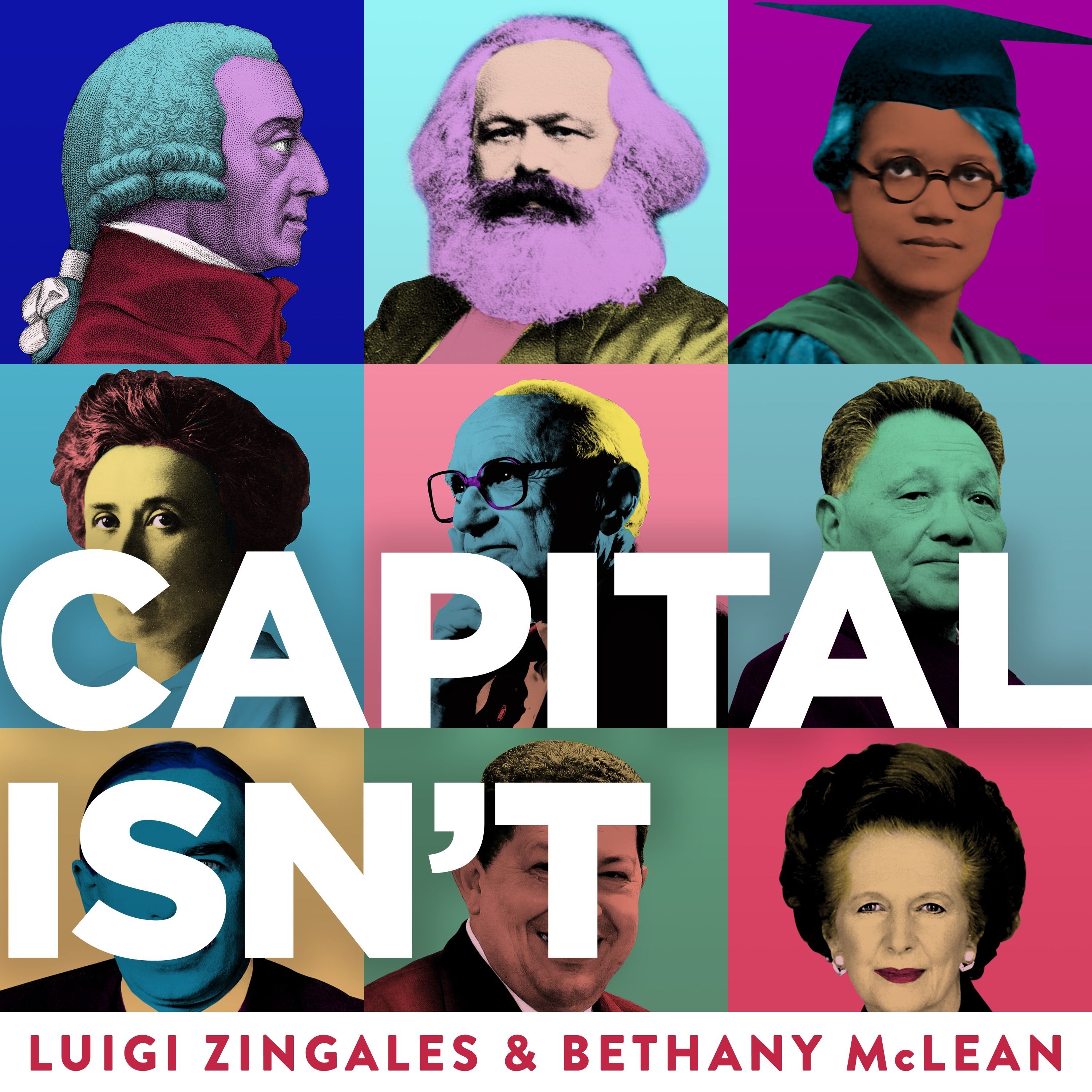
Is capitalism the engine of destruction or the engine of prosperity? On this podcast we talk about the ways capitalism is—or more often isn’t—working in our world today. Hosted by Vanity Fair contributing editor, Bethany McLean and world renowned economics professor Luigi Zingales, we explain how capitalism can go wrong, and what we can do to fix it. Cover photo attributions: https://www.chicagobooth.edu/research/stigler/about/capitalisnt. If you would like to send us feedback, suggestions fo...