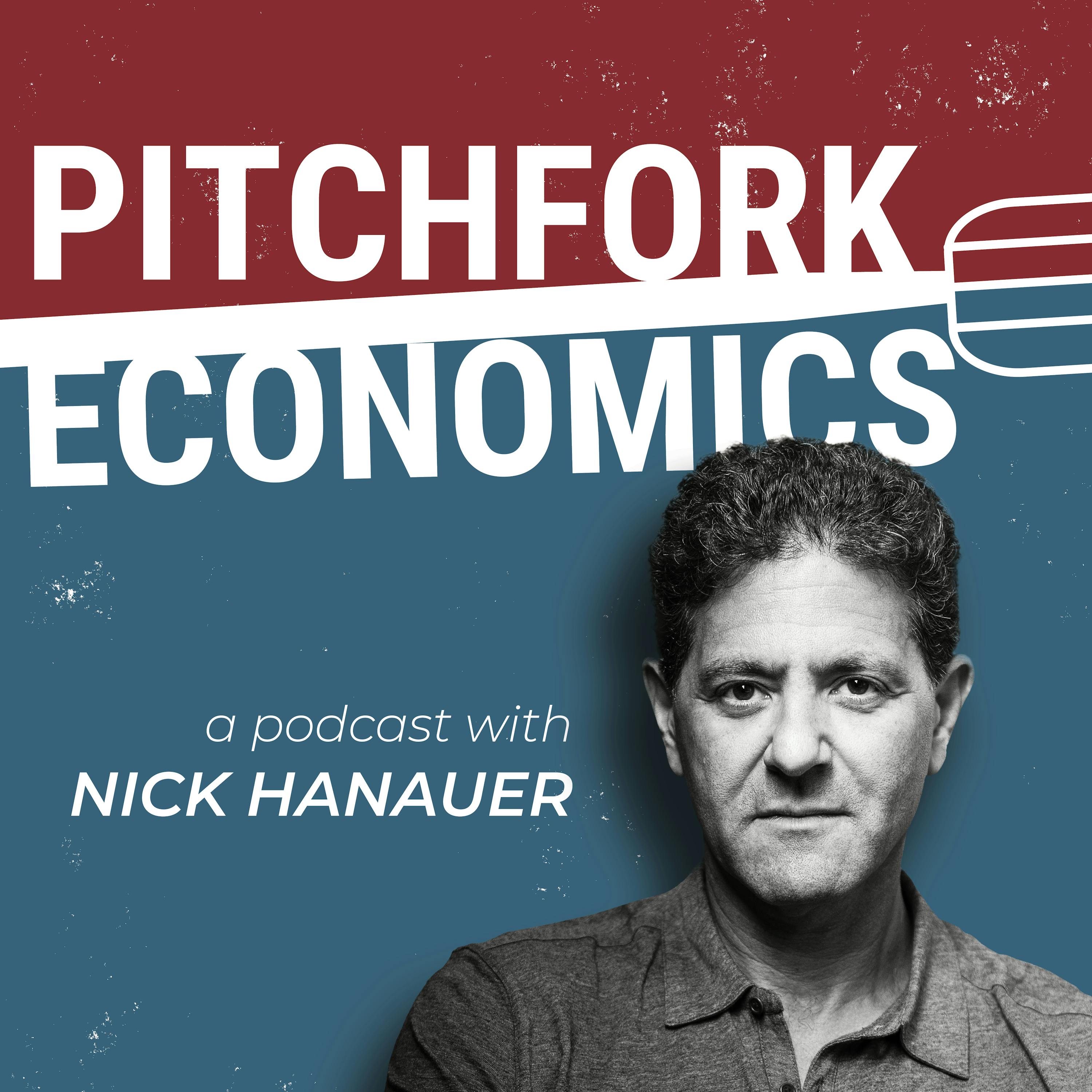
Episode Summary
Executive Summary: This AMA episode uses listener questions to clarify Pitchfork Economics’ stance: it rejects both socialism and laissez-faire capitalism in favor of a new economic framework that emphasizes broad-based prosperity, better wages, and stronger public policy. The hosts argue that inequality suppresses growth, housing requires mixed solutions beyond deregulation, portable benefits deserve negotiation, and political/narrative change is essential.
Main Topics: Defining the hosts’ economic philosophy: A listener asks what school of thought the show represents. The hosts explain they are neither socialists nor traditional capitalists and say they are developing a new term and book to describe an alternative framework between capitalism and socialism. Inequality and the ‘growing pie’ debate: The hosts reject the idea that growth and redistribution are opposites. They argue that more even distribution of income expands consumer demand, productivity, innovation, and the overall size of the economy. Housing affordability and urban supply constraints: They discuss the housing crisis as a mix of zoning limits, wage stagnation, urbanization, and market incentives that favor luxury housing. Their solution combines zoning reform, wage growth, and public-sector housing. Portable benefits and labor standards: In response to a question about Uber, they describe ongoing work with Uber and labor leaders on a portable benefits framework in Washington state, while acknowledging the process is slow and politically complex. Minimum wage design and regional inequality: They debate whether minimum wage should be tied to local cost of living. One host prefers standards based on company size and top-end wages to avoid reinforcing regional inequality and to raise wages in low-cost areas too. How listeners can contribute: The episode closes with advice on supporting worker organizations, ballot initiatives, and independent media outlets as ways to create policy change and shift economic narratives.
Key Arguments: The show’s framework is intentionally distinct from socialism, neoliberalism, and traditional capitalism, and a new book will formalize the language for it. Economic growth is not a fixed pie: reducing extreme inequality can increase total economic output by bringing more people in as workers, innovators, and consumers. Housing affordability cannot be solved by deregulation alone; markets will preferentially build luxury housing, so policy must include zoning reform, higher wages, subsidies, and public housing. Raising wages is part of the housing solution because stagnant incomes, not just high rents, drive unaffordability. Portable benefits may be a practical compromise for gig workers, and cooperation with companies like Uber can be preferable to imposing policy later. Minimum wage policy should avoid reinforcing regional economic gaps; tying wages to big firms or top incomes may be more equitable than linking them only to local costs. Political spending and narrative-building can sometimes create more impact than direct charity, especially via ballot initiatives and media support.
Data Points: Seattle single-family zoning share: 65% - Used to illustrate how restrictive land-use rules limit new housing supply in Seattle. Amazon CEO net worth example: $100 billion - Cited as an example of extreme wealth concentration that would likely be lower if workers were paid living wages. Potential reduced Bezos wealth example: $10 billion - Illustrative estimate suggesting wage increases for workers would reduce top-end wealth while still leaving the owner extremely rich. Podcast contact number: 731-388-9334 - Listener voicemail line shared at the end for questions and episode suggestions. Episode timing reference: next year / within the next 12 months - Refers to the anticipated release window for the authors’ new economics book.
Pivotal Quotes: "The pie actually grows faster when the portions are distributed more evenly." — Nick Hanauer: Explaining why inequality can slow economic growth and why redistribution can be expansionary. "We need whatever you want to call it a public option on housing." — Nick Hanauer: Describing a proposed government role in building and maintaining affordable rental housing outside the market. "If those hedge fund dudes want to pay themselves a couple of billion dollars a year, well, fine. But that means that the minimum wage will rise essentially in concert." — Nick Hanauer: Arguing for linking minimum wage growth to top-end pay rather than only local living costs.
Implications: The episode frames economic reform as pragmatic, not ideological: broader wage gains, public investment, and worker power are presented as necessary to restore affordability, growth, and democratic stability. It also encourages listeners to support policy campaigns and independent media.
About Pitchfork Economics
We are living through a paradigm shift from trickle-down neoliberalism to middle-out economics — a new understanding of who gets what and why. Join zillionaire class-traitor Nick Hanauer and some of the world’s leading economic and political thinkers as they explore the latest thinking on how the economy actually works.