Episode Summary
Executive Summary: This episode argues that wages are not determined by workers’ worth but by bargaining power. Through economist Marshall Steinbaum and labor advocate Saru Jayaraman, it debunks the marginal productivity theory, links low wages to race, gender, and industry lobbying, and shows how worker power, labor standards, and collective action—not “skill” alone—shape pay and inequality.
Main Topics: Marginal productivity as a false wage theory: The hosts and Marshall Steinbaum explain that the idea workers are paid exactly what they produce is a simplified, ideological model rather than a real description of labor markets. Power, not worth, sets wages: The conversation repeatedly emphasizes that bargaining power, labor market structure, and employer leverage determine pay far more than productivity or merit. Why economists cling to the theory: Steinbaum argues the theory persists because it is easy to model, protects the discipline’s prestige, and supports a 'just world' narrative that legitimizes inequality. Minimum wage, labor standards, and evidence: The episode cites empirical evidence—minimum wage studies, wage divergence, and firm-level rent sharing—to show the theory fails in practice. Restaurant labor, tipping, and historical exploitation: Saru Jayaraman details how tipped wages emerged from slavery-era labor practices and continue to depress pay, increase harassment, and shift power toward customers. Collective action and unions as counterweights: The episode concludes that worker organizing, labor standards, and collective bargaining are necessary to secure fair pay and shared prosperity.
Key Arguments: Workers are not automatically paid what they are worth; they are paid what they can negotiate in a labor market shaped by power. The marginal productivity model is used to justify low wages, oppose minimum wage hikes, and rationalize inequality as natural. Empirical evidence contradicts the theory: output has risen much faster than median pay, and minimum wage increases do not produce the predicted job losses. Firm-specific events like patents can raise wages, showing compensation depends on employer context and rent-sharing, not just market-wide productivity. Race and gender wage gaps expose the role of hierarchy and discrimination, which the theory cannot explain without absurdly claiming different groups are inherently worth different amounts. Restaurant tipping and the subminimum wage are rooted in slavery and continue to make workers dependent on customers rather than employers. Higher wages can reduce turnover, improve productivity, and increase industry stability, so paying workers more can benefit business as well as workers. Collective bargaining and labor standards are presented as the practical mechanisms for correcting power imbalances and making markets fairer.
Data Points: Federal tipped minimum wage: $2.13/hour - Saru Jayaraman describes the federal subminimum wage for tipped workers as a legacy of slavery-era labor policy. Lowest-paying jobs in the U.S.: 7 of the 10 lowest-paying jobs - Jayaraman says these are in the restaurant industry, despite the sector’s size and growth. Restaurant employment: Over 13 million workers - The restaurant industry is described as one of the largest and fastest-growing sectors of the U.S. economy. Share of American workers in restaurants: 1 in 11 - Jayaraman says restaurant work is approaching 1 in 10 American workers. Americans who have worked in restaurants: 1 in 2 - Used to illustrate how widespread restaurant labor is across the population. States with full minimum wage for tipped workers: 7 states - California, Oregon, Washington, Nevada, Minnesota, Montana, and Alaska require full minimum wage without the tipped subminimum. Sexual harassment rate: About half the rate - Jayaraman says states without a subminimum wage see roughly half the sexual harassment in the restaurant industry. Employee turnover: Cut in half - Cornell-related research cited by Jayaraman found higher wages and mobility can reduce turnover by 50%. Turnover in some restaurant positions: 300% - She notes some positions turn over three times per year. Working poor trend: From 1 in 3 to nearly 1 in 2 - Hanauer says full-time working poverty has risen dramatically over time in the U.S.
Pivotal Quotes: "If it's not marginal product that determines how much you make, what is it? It's power." — Nick Hanauer: Central thesis of the episode linking wages to bargaining power rather than productivity. "The welfare of the laboring classes depends on whether they get much or little, but their attitude towards other classes." — John Bates Clark (quoted by the hosts): Cited as revealing the political purpose of marginal productivity theory: convincing workers they receive what they deserve. "They are paid what we can negotiate." — Unknown caller / summarized by hosts: A listener response that reinforces the episode’s core argument about wage determination.
Implications: The episode suggests wage fairness depends on shifting power toward workers through unions, minimum wages, and labor protections. Without that, inequality, harassment, and working poverty will continue to rise.
About Pitchfork Economics
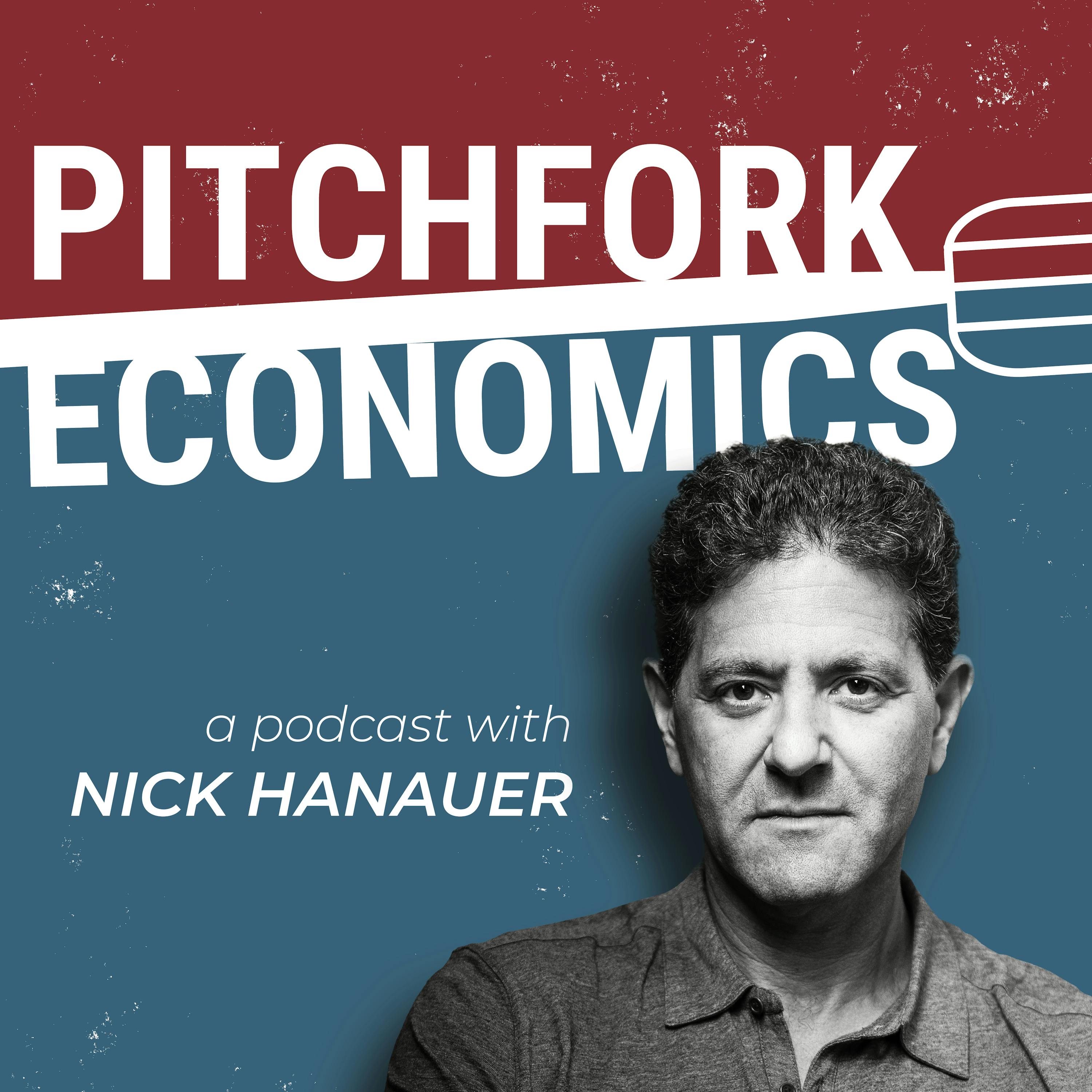
We are living through a paradigm shift from trickle-down neoliberalism to middle-out economics — a new understanding of who gets what and why. Join zillionaire class-traitor Nick Hanauer and some of the world’s leading economic and political thinkers as they explore the latest thinking on how the economy actually works.