Episode Summary
Executive Summary: The episode debates Thomas Piketty’s Capital in the 21st Century and its claim that when the return on capital exceeds economic growth (r > g), wealth concentrates and inequality worsens. The hosts largely agree inequality is real, but question Piketty’s data, broad definition of capital, and policy emphasis on wealth taxes, arguing that competition, labor market structure, and entrepreneurship also shape inequality.
Main Topics: Piketty’s rise as a public intellectual: The hosts frame the book as an unexpected bestseller that turned a technical economics text into a mainstream discussion about inequality and capitalism. Income and wealth inequality trends: They review Piketty’s evidence that the top 1% share rose sharply in the U.S. after the 1980s, while noting measurement issues and temporary distortions in the data. The r > g framework: The core theoretical claim is that if returns on capital exceed growth, wealth holders accumulate faster than the rest of society, leading to persistent concentration. What counts as capital and how returns are measured: The speakers dispute Piketty’s broad aggregation of assets like housing, paintings, stocks, and bonds, and raise concerns about depreciation and differing return dynamics. Inheritance versus entrepreneurship: The discussion contrasts inherited wealth with billionaire fortunes built through innovation, suggesting that much top wealth in the U.S. is not purely inherited. Policy prescriptions and wealth taxation: They debate Piketty’s support for taxing wealth and inheritance, with criticism that the book focuses too much on limiting the rich rather than expanding opportunity or competition. Alternative explanations for inequality: One speaker argues that monopoly power, licensing, regulation, and weak competition in sectors like finance and medicine may explain inequality better than capital accumulation alone.
Key Arguments: Piketty’s historical data suggest the income share of the top 1% fell through much of the 20th century and rose again after the 1980s, especially in the United States. A temporary rise in measured top income may partly reflect tax-reporting changes, including the 1986 U.S. tax reform, so raw trends can be misleading. Piketty’s central logic is that when the return on capital exceeds growth, owners of wealth can reinvest gains and pull further ahead of wage earners. Critics argue Piketty’s definition of capital is too broad because it lumps together unlike assets with different economics, such as factories, houses, and art. Critics also note that returns must be considered net of depreciation; higher gross returns do not necessarily imply higher effective wealth accumulation. A large share of modern top fortunes in the U.S. comes from entrepreneurs, not inherited wealth, which complicates a simple inheritance-driven inequality story. Lottery-win evidence suggests that wealth alone does not guarantee long-run persistence without financial knowledge, connections, or institutions. The book’s policy center of gravity is a wealth/inheritance tax, but the hosts question whether that addresses root causes or just punishes accumulation. An alternative explanation for inequality is limited competition and market power in professions and finance, which may generate unusually high incomes independent of capital dynamics. The broad argument remains that capitalism can naturally generate inequality, but the precise mechanism may be more about institutions and market structure than r > g alone.
Data Points: Top 1% income share trend: Rose sharply after the early 1980s in the United States - Used to support the claim that inequality has increased substantially over recent decades Share of U.S. top 1% rise explained by tax reform: About one-third - Attributed to the 1986 tax reform changing reporting behavior Estate tax rate in the U.S.: 40% - Cited from a Tax Foundation/OECD comparison Highest estate tax in OECD: 55% in Japan - Used to compare U.S. inheritance taxation internationally Countries with no estate tax on direct heirs in OECD: 15 countries - Illustrates variation in inheritance taxation across developed economies Annual bequests and gifts as share of national income in England: 8% in 2010 - Piketty’s inheritance-flow measure Annual bequests and gifts as share of national income in France: 14% in 2010 - Piketty’s inheritance-flow measure Annual bequests and gifts as share of national income in Germany: 11% in 2010 - Piketty’s inheritance-flow measure Inherited wealth share of total U.S. capital: 20% to 30% - Piketty’s estimate cited during the discussion Commonly discussed threshold for being rich: $250,000 income - Used to show that a single national threshold ignores cost-of-living differences Growth rate in China: 8% - Example of a high-growth economy contrasted with France Growth rate in France: 1.5% - Example of a lower-growth economy contrasted with China Historical growth rate reference: Less than 0.5% - Used to argue that historical growth has typically been low relative to capital returns
Pivotal Quotes: "if R is greater than G, then that means that the people who have wealth... are making more money than the average person in society" — Kate Waldock: Explaining Piketty’s central inequality mechanism "the main policy recommendation has to do with taxing the rich" — Luigi Zingales: Summarizing and criticizing Piketty’s policy emphasis "the source of the problem is not necessarily that capital grows faster than the economy is that there is not enough competition" — Luigi Zingales: Presenting an alternative explanation for inequality
Implications: Listeners are left with a nuanced view: inequality is real, but diagnosing it requires separating capital returns from market power, institutions, and measurement issues. The policy debate may be less about wealth taxes alone and more about competition, mobility, and opportunity.
From the Episode
Off, but the rate at which people in China are getting better off is higher. So, what's really important to Piketty is the difference between these two variables. If R is greater than G, then that means that the people who have wealth, and wealth is usually saved in things that earn people a rate of interest, it means that they're making more money than the average person in society who's just growing at this general growth rate of G. And not only that. But if you have wealth, if you have a trust fund, if you were one of those few people who was lucky enough that mom and dad left you like, you know, $5 million, you don't need to live poorly. You can go out, you can go skiing, you can go to fancy restaurants. You don't need to save all that money, but even saving just a tiny fraction of that can actually grow your wealth. Whereas this isn't the case for most people. Most people are like pretty hand-to-mouth. It's actually hard to save on a regular basis.
Can provide a lot of insights on what works and what doesn't. One of my colleagues, actually, two of my colleagues, Ida and Zwick, have a paper documenting where most of the 1% income is coming from. And if you go through the list, you see those are doctors, they are car dealers, they are dentists, they are financial traders. Many of them rely on a lot of restrictions in the local market. Doctors have a license, have a healthcare system that is designed to sort of give them a large source of income. The financial industry, as I've written, is too big and not sufficiently competitive. You can go on a lot of sectors to realize what is the source of the problem, is not necessarily. That capital grows faster than the economy is that there is not enough competition. And he's completely silent on this important point. Why are those necessarily incompatible? I didn't say they are incompatible. I'm just saying that he misses the point. Out of whatever, 600 pages of books, he misses the most important point for capital in the 21st century. A book called Capital in the 21st Century is kind of a big miss. So you're saying that.
About Capitalisnt
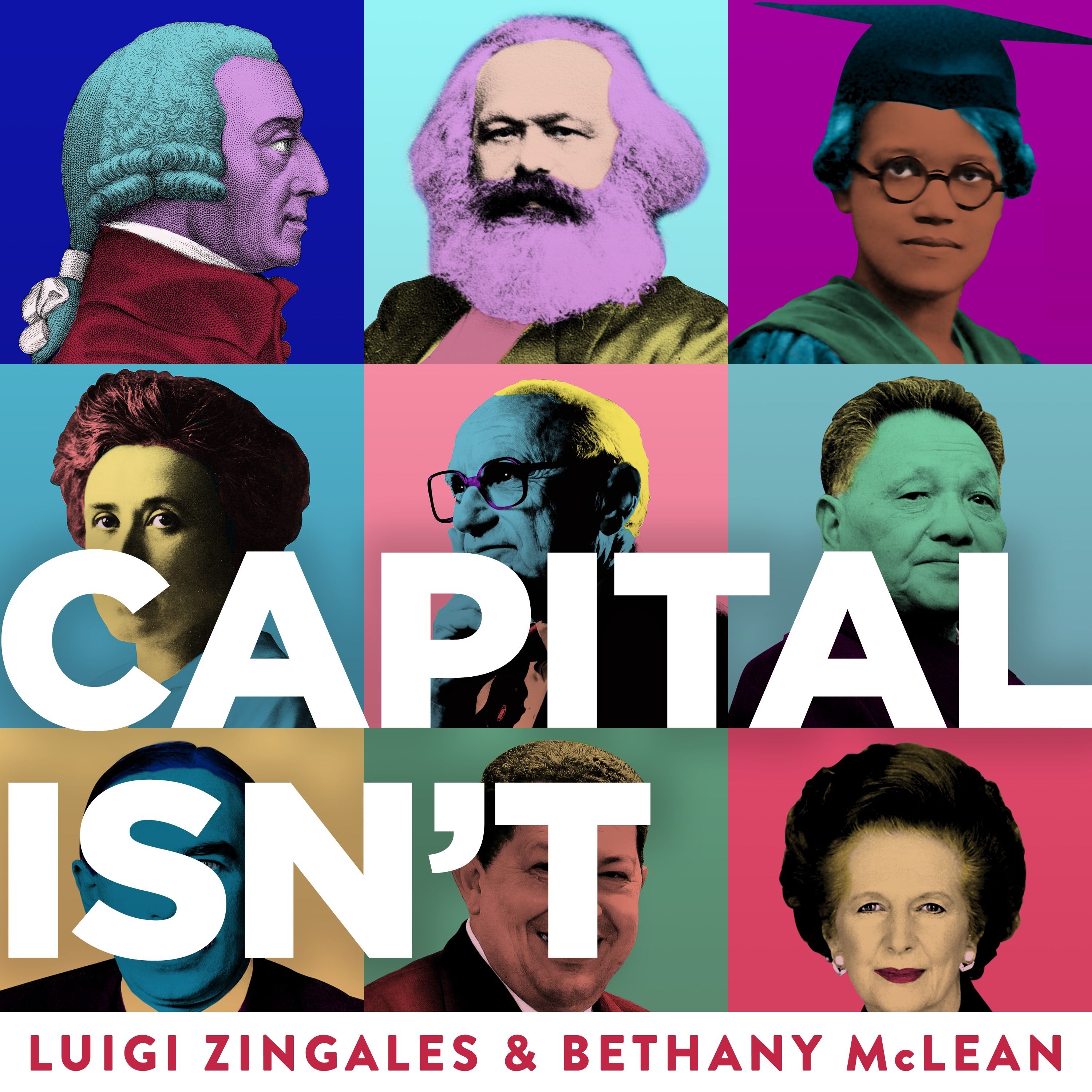
Is capitalism the engine of destruction or the engine of prosperity? On this podcast we talk about the ways capitalism is—or more often isn’t—working in our world today. Hosted by Vanity Fair contributing editor, Bethany McLean and world renowned economics professor Luigi Zingales, we explain how capitalism can go wrong, and what we can do to fix it. Cover photo attributions: https://www.chicagobooth.edu/research/stigler/about/capitalisnt. If you would like to send us feedback, suggestions fo...