Episode Summary
Executive Summary: The episode pits the hosts’ critique of capitalism against Yanis Varoufakis’s argument that capitalism has evolved into “techno-feudalism.” Varoufakis argues markets are being undermined by concentrated digital power, central-bank-driven zombie firms, and corporate ownership structures that block competition, and he proposes cooperative ownership, reworked corporate law, and public prizes/lump-sum rewards instead of perpetual patents. The hosts push back on feasibility, scale, incentives, and the role of the state, then close with a discussion of the Theranos verdict as a test of how capitalism, law, and morality intersect.
Main Topics: Varoufakis’s theory of techno-feudalism: He argues capitalism’s two pillars—private profits and market-based value extraction—are being replaced by central-bank support and digital platform fiefdoms that concentrate power and erode individual autonomy. Cooperative ownership and corporate law reform: Varoufakis proposes one-person-one-vote ownership structures, especially for corporations, to restore competition, reduce oligopoly power, and distribute profits more broadly. Can markets innovate without capitalism’s crises?: The conversation debates whether capitalism’s innovation can be preserved without its recurring crises, fraud, monopoly, and exploitation, and whether cooperative systems can generate similar dynamism. Scale, incentives, and feasibility of cooperatives: The hosts question whether worker-owned firms can handle large capital needs, economies of scale, heterogeneous labor, and leadership-driven innovation in sectors like manufacturing and pharma. Intellectual property, vaccines, and public prizes: Varoufakis argues patents distort public health and that governments should reward breakthroughs with lump sums or prizes while keeping knowledge owned by humanity. Media, Greece, and the politics of power: Varoufakis reflects on being vilified during Greece’s debt crisis and discusses how media and political elites protect insiders, punish dissent, and reinforce technocratic consensus. Theranos verdict and capitalism’s legal logic: The hosts analyze Elizabeth Holmes’s conviction, contrasting moral outrage with legal burden-of-proof standards and debating whether investors or patients should have been protected.
Key Arguments: Varoufakis argues capitalism is not mainly unjust but inefficient, because it creates innovation and crisis together as built-in features rather than accidents. He claims the economy has shifted from private-profit capitalism to a system driven by central-bank money and digital platform control, which he labels techno-feudalism. He proposes that corporations be governed by one person, one share, one vote, with shares treated like non-transferable privileges rather than tradable property. He argues this ownership redesign would reduce monopoly power organically, shrink firms where necessary, and restore genuine competition without heavy state intervention. He believes worker/cooperative firms can be efficient and innovative, pointing to Linux, the internet’s commons, and some cooperative banks as evidence. He says patents should be replaced with public prizes or lump-sum rewards for breakthroughs, especially in vaccines, because perpetual patents harm global welfare. The hosts argue that his model underestimates economies of scale, heterogeneous workforces, and the need for large-scale capital in sectors like pharma and platforms. They also argue that cooperative firms may face governance problems, entry restrictions, and de facto caste-like allocation if access to successful cooperatives becomes closed. On Theranos, Bethany McLean argues the jury properly focused on investor-fraud charges and burden of proof, while others frame the case as a broader test of patient protection and market incentives.
Data Points: Year of joint-stock company breakthrough: 1599 - Varoufakis identifies the 1599 invention of the joint stock company in London as a turning point toward modern capitalism and anonymous share ownership. Greece finance minister tenure: short period of time - Varoufakis is described as having served briefly as Greece’s Minister of Finance during debt renegotiations with the EU. Central bank-driven corporate sector: since 2008 - He says the post-2008 bailout of the financial sector zombified much of corporate capitalism. Target interest rates Fed fears: 3-4% - Varoufakis claims the Fed fears raising rates to this level because of the zombified corporate sector. Vaccination rate in Africa: less than 7% - He uses this figure to argue that patent-driven vaccine scarcity is monumentally inefficient. Tesla worker ownership model: one share, one vote - He describes a reformed corporate structure where every employee, including Elon Musk, has one vote and one share. Tesla example scale: 500,000 employee company - The hosts cite the challenge of regulating or managing an extremely large cooperative firm at this scale. Washington State cooperative video game company size: 330 employees - Varoufakis cites a cooperative company he knew that operated successfully with flat management. Washington State cooperative revenue: more than a billion dollars annually - The same cooperative video game company reportedly generated over $1 billion in annual revenue. Theranos conviction counts: 4 guilty counts - Bethany notes Elizabeth Holmes was convicted on four fraud-related counts involving investors. Theranos acquittal counts: not guilty on patient/doctor fraud counts - Bethany says Holmes was acquitted on charges involving defrauding patients and doctors. Theranos hung counts: a couple of other counts - Bethany explains the jury hung on additional investor-fraud counts tied to specific investors. Government vaccine funding example: $10 billion - Varoufakis references Trump’s offer of roughly $10 billion to Pfizer and others as precedent for public lump-sum rewards.
Pivotal Quotes: "My critique of capitalism is not that it is unjust. My critique of capitalism is that it is inefficient." — Bethany McLean: Opening framing of the episode’s core disagreement over whether capitalism’s main failure is injustice or inefficiency. "The system we live in is driven and fueled by central bank money." — Yanis Varoufakis: Explains his claim that post-2008 capitalism has ceased to be driven by private profits alone. "If I have a machine in your house... you are training it to train you to desire the things that I want you to buy off my platform." — Yanis Varoufakis: Describes how digital platforms and smart devices create dependence and undermine autonomy in techno-feudalism.
Implications: Listeners are left with two competing diagnoses: capitalism as fixable market failure versus a system already transformed into digital feudalism. The debate highlights unresolved tensions around ownership, scale, innovation, patents, and how much power the state should have in reshaping markets.
About Capitalisnt
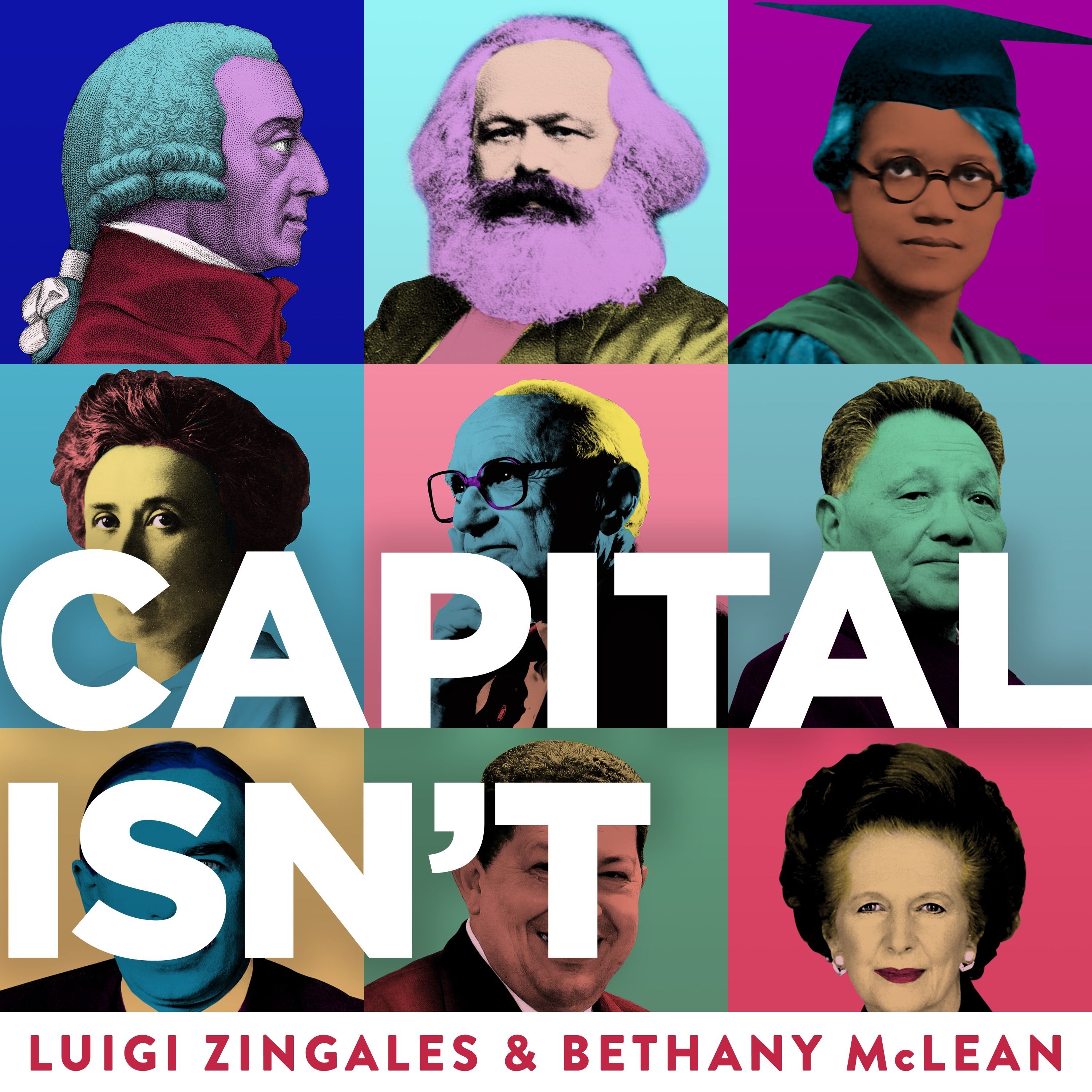
Is capitalism the engine of destruction or the engine of prosperity? On this podcast we talk about the ways capitalism is—or more often isn’t—working in our world today. Hosted by Vanity Fair contributing editor, Bethany McLean and world renowned economics professor Luigi Zingales, we explain how capitalism can go wrong, and what we can do to fix it. Cover photo attributions: https://www.chicagobooth.edu/research/stigler/about/capitalisnt. If you would like to send us feedback, suggestions fo...