Episode Summary
Executive Summary: David Leonhardt argues that capitalism works best when paired with democratic institutions, strong unions, and public investment. The discussion traces how U.S. liberalism shifted from worker-centered New Deal populism to an elite, socially progressive “Brahmin left,” weakening ties to working-class voters. Immigration, globalization, corporate power, and lost civic culture are framed as major drivers of rising inequality and political backlash.
Main Topics: Democratic capitalism vs. laissez-faire capitalism: Leonhardt distinguishes rough-and-tumble capitalism from a democratic version in which government and unions restrain excesses and spread gains more broadly. The left’s shift from workers to elites: The conversation argues that the Democratic left moved away from labor and toward civil rights, consumer rights, and elite cultural concerns, leaving workers politically alienated. Immigration, wages, and labor-market tradeoffs: The episode debates whether high immigration suppresses low-end wages and whether the political class is honest about distributional costs, while still supporting a managed pro-immigration stance. Globalization, trade, and corporate incentives: The guests discuss WTO-era globalization, China trade, and how corporate interests and elite donors helped shape Democratic policy in ways that benefited capital more than workers. Union decline and bargaining power: Union weakness is presented as central to rising inequality, weaker worker voice, and the erosion of a political counterweight to corporate power. Elite culture, morality, and shame: The discussion ends on the loss of local community norms and restraint among executives, replaced by global status competition, entitlement, and weak moral limits on greed.
Key Arguments: The New Deal model of capitalism was more democratic because workers organized and bargained for gains, unlike early-20th-century elite progressivism. The modern left became increasingly elite, highly educated, and dismissive of working-class views on immigration, religion, patriotism, COVID, and gender issues. Democratic politicians who win nationally, such as Biden and Obama, often moderate or adapt to working-class sensibilities rather than embrace full elite-left positions. Immigration likely has some downward wage effects at the lower end of the labor market, even if the average effects are modest; elites often ignore this because they benefit from cheaper services. Corporate America and globalism promised broad gains from trade and China engagement but failed to adequately compensate communities that lost jobs and bargaining power. Without unions, individual workers lack information and leverage, so wages tend to settle near the low end of what employers can pay. The postwar business culture was more restrained because executives felt tied to local communities and feared communism/fascism; today’s global elite is less accountable and more status-driven. A sustainable capitalism needs not just rules and regulation but a moral culture that restrains excessive extraction from workers and communities.
Data Points: Time period of postwar democratic capitalism: 1940s–1970s - Used to describe the era when New Deal-style public investment and unions spread productivity gains more broadly. Immigration and inequality period: Late 19th century–1920s; 1970s–present - Leonhardt contrasts high-immigration eras with rising inequality against the low-immigration, lower-inequality mid-20th century. Low-immigration era: 1930s–1970s - Described as a period of falling inequality in the United States. National Academy of Sciences report: 600+ pages - Referenced as a thorough review of immigration’s wage effects. Political support for transgender-related restrictions: Very large majority - Leonhardt says polling shows broad support for some restrictions on medical procedures for children and on sex-segregated school sports. Obama’s working-class performance: Better than Kerry and Clinton - He won working-class white voters more effectively than John Kerry or Hillary Clinton. Boeing fatalities: More than 300 people died - Mentioned as an example of corporate misconduct that draws less elite outrage than cultural disputes. Davos/global elite: International elite network - Used to illustrate how CEOs now benchmark themselves against a global, not local, status hierarchy.
Pivotal Quotes: "Why do those people vote against their economic interests?" — Bethany McLean: Critiquing the condescending framing often used by the left to explain working-class voting behavior. "You can't build a majority party just with intellectuals." — David Leonhardt: Explaining why the left’s shift away from workers is politically unsustainable. "We have socialism for the very rich, rugged individualism for the poor." — Luisa Zingales: Opening the episode’s critique of how capitalism and policy often protect the powerful while exposing workers to risk.
Implications: The episode warns that capitalism and democracy weaken when workers lose power, elites ignore tradeoffs, and moral restraint erodes. For parties and firms alike, rebuilding trust likely requires stronger labor voice, more honest policy on trade/immigration, and less elite condescension.
About Capitalisnt
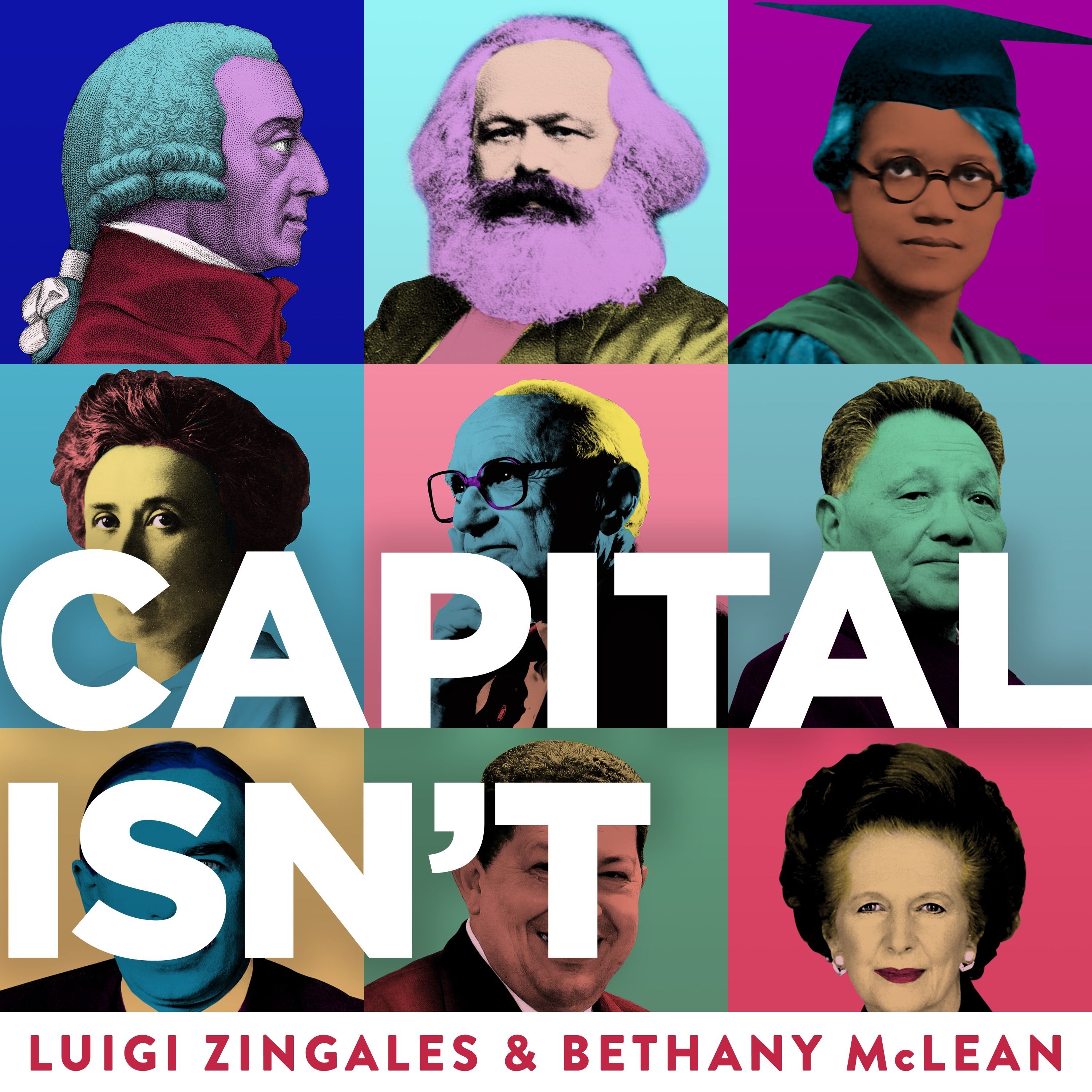
Is capitalism the engine of destruction or the engine of prosperity? On this podcast we talk about the ways capitalism is—or more often isn’t—working in our world today. Hosted by Vanity Fair contributing editor, Bethany McLean and world renowned economics professor Luigi Zingales, we explain how capitalism can go wrong, and what we can do to fix it. Cover photo attributions: https://www.chicagobooth.edu/research/stigler/about/capitalisnt. If you would like to send us feedback, suggestions fo...