Episode Summary
Executive Summary: The transcript is a playful launch intro for "Capital Isn't," a podcast hosted by Luigi Zingales and Kate Waldock. It frames capitalism as a system worth understanding rather than demonizing, emphasizing its historical roots, market power, political capture, and the role of competition as its main corrective.
Main Topics: Historical origins of capitalism: The intro traces capitalism back to 1494 and Luca Pacioli's Summa de Arithmetica et Geometria, highlighting the first printed use of "capital" and using Italian history as a narrative hook. Purpose of the podcast: The hosts define the show as an exploration of how capitalism works today, rather than a political attack on the system or propaganda for any side. Market power and distorted incentives: A central theme is that firms with market power can distort incentives, shaping outcomes in ways that may harm people and the broader economy. Political capture by firms: The transcript argues that firms can capture political power to protect and expand profits, suggesting a close link between business dominance and policymaking. Competition as capitalism's remedy: The hosts present competition as capitalism's "savings grace," implying that competitive markets are what keep the system functional and responsive. Podcast identity and tone: The intro establishes a conversational, humorous style with references to Marxism, class warfare, and Italian flair, signaling accessible economics content.
Key Arguments: Capitalism should be studied pragmatically: the goal is to understand what works and what doesn't, not to destroy the system. Market power can distort incentives, creating harms for consumers, workers, and the economy. Firms may use political influence to generate more profits at the expense of people. Competition is capitalism's key safeguard and the main force that limits abuse. Historical context matters: understanding capitalism's origins helps explain its modern structure and problems.
Data Points: Year referenced for capitalism's origins: 1494 - The intro opens by situating the story of capitalism in 1494 and linking it to early accounting history. Book title: Summa de Arithmetica et Geometria - Cited as the work associated with the first printed appearance of the word "capital." Institution: University of Chicago - Luigi Zingales identifies himself as a professor there. Institution: Georgetown University - Kate Waldock identifies herself as a professor there. Podcast title: Capital Isn't - Named as the show hosted by the speakers.
Pivotal Quotes: "We're here to understand what works and what doesn't." — Luigi Zingales: Defines the podcast's analytical, non-propagandistic mission. "why competition is the savings grace of capitalism." — Luigi Zingales: Summarizes the hosts' view of competition as capitalism's central balancing mechanism. "how capitalism isn't perfect. But how we are stuck with it, and we better make the best of it." — Kate Waldock: Positions the podcast as pragmatic rather than ideological.
Implications: Listeners can expect a balanced, economics-focused show that examines capitalism's flaws and guardrails. The series likely connects historical roots to modern debates over market power, inequality, and policy.
About Capitalisnt
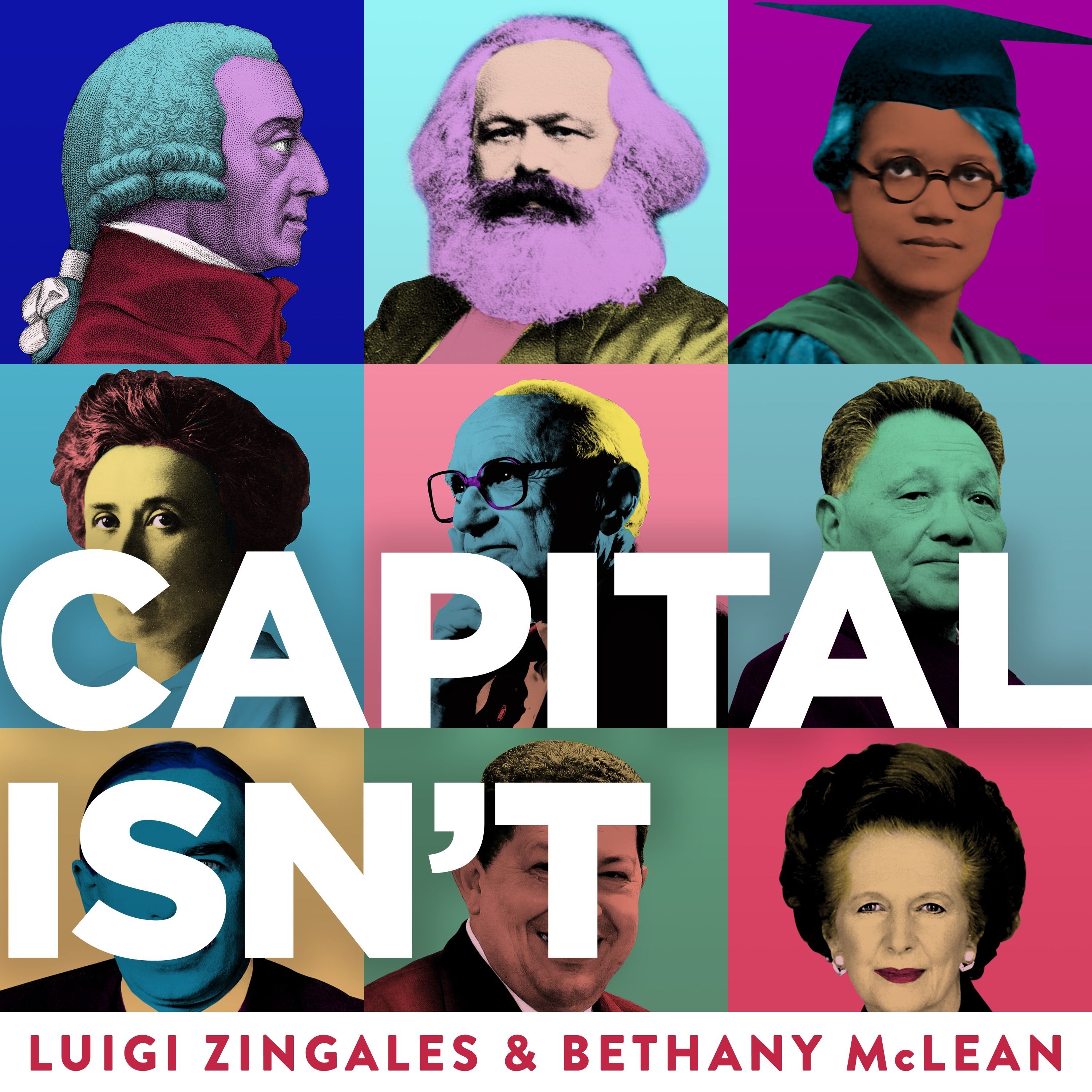
Is capitalism the engine of destruction or the engine of prosperity? On this podcast we talk about the ways capitalism is—or more often isn’t—working in our world today. Hosted by Vanity Fair contributing editor, Bethany McLean and world renowned economics professor Luigi Zingales, we explain how capitalism can go wrong, and what we can do to fix it. Cover photo attributions: https://www.chicagobooth.edu/research/stigler/about/capitalisnt. If you would like to send us feedback, suggestions fo...