Episode Summary
Executive Summary: The episode examines whether U.S. universities are engines of mobility or institutions of privilege. Drawing on Raj Chetty’s IRS-linked mobility research, the hosts argue elite colleges deliver high returns and strong outcomes even for low-income students, but access remains highly unequal due to legacy preferences, segregation, information gaps, and possibly network effects. They conclude policy should target admissions fairness and broader access, especially given heavy tax subsidies.
Main Topics: University Access: Opportunity vs. Privilege: The hosts frame U.S. higher education as simultaneously a major engine of opportunity and a bastion of privilege, emphasizing that access to elite schools is highly unequal even if the colleges themselves can improve outcomes. Raj Chetty’s Mobility Research and IRS Data: They discuss how Chetty obtained confidential IRS data through a legal arrangement with the IRS, enabling large-scale analysis of intergenerational mobility, college access, and outcomes. Elite College Returns and Causal Evidence: The episode reviews research designs such as twin studies and cutoff-based admissions studies, concluding that college—especially elite college—has high returns in earnings and life outcomes. Segregation, Legacy Admissions, and Elite Admissions Bias: The hosts emphasize that some colleges are disproportionately rich or poor, and debate whether segregation is driven by prep advantages, legacy preferences, donor influence, or both. Why Low-Income High-Achievers Don’t Apply: They highlight evidence that strong students from low-income backgrounds may under-apply to elite schools due to information barriers, isolation, and lack of familiarity with the admissions process. Tax Subsidies and Policy Levers: The discussion turns to whether universities should keep tax benefits while maintaining selective admissions, with one host proposing subsidy conditionality tied to fairer admissions rules.
Key Arguments: Elite colleges generate strong labor-market returns, and the evidence from experimental or quasi-experimental studies broadly matches raw outcome data. Access to top universities is highly unequal: students from the top 1% are vastly overrepresented, while low-income students are underrepresented. Some of the observed inequality may reflect preparation differences, but legacy admissions and donor preferences likely also distort access. Chetty’s findings suggest that low-income students who do get into elite schools can achieve outcomes comparable to affluent peers, implying the benefits of elite education are not limited to rich students. The evidence does not fully distinguish whether college value comes from education, signaling, or networking; network effects may still matter. Information barriers play a major role for some high-achieving low-income students, especially those from isolated or small-town backgrounds. Because universities receive tax exemptions and endowment tax advantages, policymakers can justify attaching conditions to those subsidies. A policy path is to preserve subsidies for research and education but require fairer admissions or separate research support from educational subsidization.
Data Points: Harvard incoming class from top 20% of parental income: 70% - Used to illustrate elite-school concentration among affluent families. Harvard incoming class from top 1% of parental income: 15% - Shows extreme representation of the wealthiest families. Likelihood of admission by parental income group: Top 1% are 77 times more likely to get in than bottom 20% - Highlights access inequality across income groups. Outcome for low-income students at Ivy League/Ivy+ schools: Top 30% of earners on average - Illustrates strong returns for students from disadvantaged backgrounds who attend elite schools. Outcome for students from top 1% families at Ivy League/Ivy+ schools: Top 25% of income distribution on average - Shows outcomes remain strong but are not dramatically better than low-income peers once enrolled. Harvard class composition rumor: One-third legacy, one-third athletes, one-third merit - Anecdotal student perception mentioned by Luigi to describe admissions concerns. Endowment tax threshold: Over 500 students and more than $500,000 endowment per student - Current tax rule discussed for university endowments. Endowment tax rate: 1.4% - Tax on net investment income for universities meeting the threshold. Number of schools affected by endowment tax: About 30 - Indicates the tax applies to a small set of very wealthy universities. Size of class at Luigi’s school: About 60 students per grade - Explains why college counseling was limited and legacy pressure mattered in his experience. Harvard course example: 12-person class - Luigi cites a small class with a former U.S. Treasury Secretary as evidence of elite-school benefits.
Pivotal Quotes: "The benefits of going to a good college are pretty accessible across the poorest kids as well as the richest kids." — Kate Waldock: Used to argue that once admitted, elite education appears valuable across income backgrounds. "What I do have problems [with] is sometimes there are a lot of smart kids who don't have a chance to even try because they were poorly trained." — Luigi Zingales: Explains his concern that access barriers begin long before college admissions. "If you want to retain these tax subsidies, you need to follow certain rules." — Luigi Zingales: Proposes conditional tax benefits tied to fairer admissions practices.
Implications: Elite colleges appear to raise outcomes, but unequal access remains a major fairness problem. Policymakers may need to target admissions transparency, information barriers, and subsidy conditions rather than only expanding seats.
About Capitalisnt
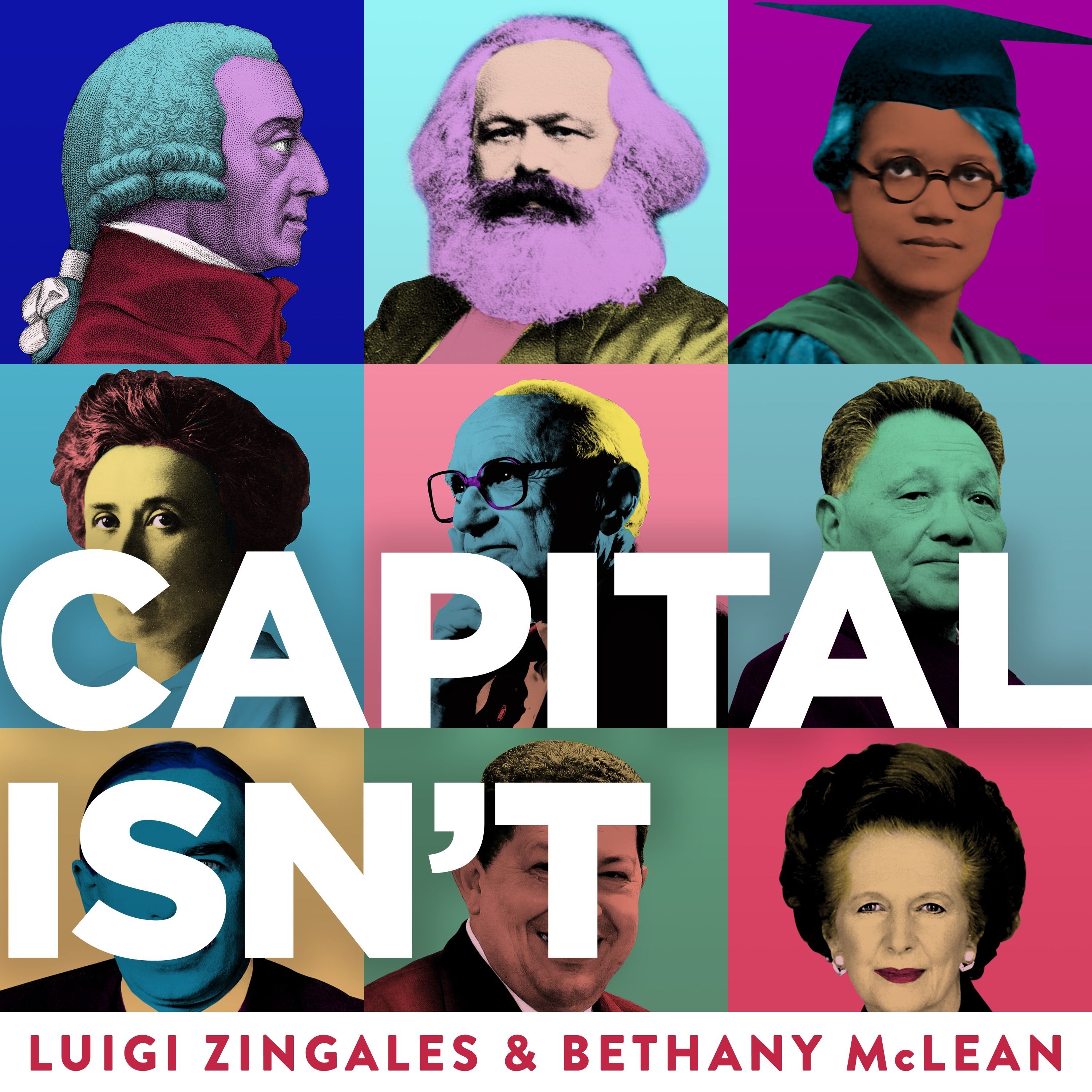
Is capitalism the engine of destruction or the engine of prosperity? On this podcast we talk about the ways capitalism is—or more often isn’t—working in our world today. Hosted by Vanity Fair contributing editor, Bethany McLean and world renowned economics professor Luigi Zingales, we explain how capitalism can go wrong, and what we can do to fix it. Cover photo attributions: https://www.chicagobooth.edu/research/stigler/about/capitalisnt. If you would like to send us feedback, suggestions fo...