Episode Summary
Executive Summary: The episode explores the explosive rise of ChatGPT/Bing Chat (“Sydney”), arguing that AI is no longer a distant concept but a rapidly mainstreamed platform shift. Mark Andreessen and Stephen Sinofsky debate hallucinations, sentience, safety, jobs, startups vs incumbents, and the likelihood that AI becomes a personalized lifelong companion for every child.
Main Topics: The ChatGPT/Sydney explosion and search wars: The hosts frame the last few months as an exponential AI adoption wave that suddenly turned into a Microsoft-vs.-Google battle over the future of search, with Bing Chat/Sydney becoming a cultural flashpoint. Hallucinations as bug vs feature: Andreessen argues that apparent hallucinations may be creative breakthroughs rather than defects, while Sinofsky emphasizes the need for a 'facts' mode in production systems, especially when tied to search and productivity. Sentience, Turing tests, and human perception: The discussion questions whether AI is truly becoming sentient or whether humans are simply reacting to persuasive behavior. They argue that the deeper issue may be how humans define intelligence and consciousness. AI-generated creativity and dynamic media: Both speakers predict AI will transform creative work—poetry, books, games, video, music, and interactive fiction—into personalized, dynamically generated experiences rather than static artifacts. Jobs, productivity, and economic disruption: They debate which jobs are most exposed, concluding that creative and white-collar knowledge work may be hit before blue-collar work, while AI may also create new roles and be constrained in regulated industries. Startups vs big tech and the trust-and-safety bottleneck: Andreessen argues startups may be better positioned than incumbents because large firms face employee, board, PR, and political pressure around safety, brand, and 'misinformation' concerns. AI companions for children and future emotional relationships: The episode closes on a speculative but optimistic vision: every child growing up with a memory-rich AI friend that teaches, answers questions, and provides something close to love and companionship.
Key Arguments: ChatGPT’s rapid adoption is evidence of an exponential, irreversible platform shift rather than a temporary fad. Bing Chat/Sydney’s odd or unsafe outputs are better understood as software behavior emerging from the model and control layers, not necessarily a traditional security 'hack'. Hallucinations may be valuable creative output, not merely errors, because they demonstrate machine creativity and open new forms of art and storytelling. The common idea that AI will first replace blue-collar work is likely wrong; creative and white-collar tasks may be disrupted sooner. Most current AI safety debates are being swamped by politically charged trust-and-safety concerns, similar to what happened in consumer internet moderation. New startups may outperform incumbents because they can build AI-native products from scratch without legacy databases, workflows, or cultural constraints. The biggest short-term wins will come from replacing rigid forms and templates with conversational, generative interfaces in software. The biggest long-term social change may be children growing up with persistent AI companions that remember them across their lives.
Data Points: Time Magazine barefoot covers: 2 - Mark Andreessen jokes that only Gandhi and he have appeared on the cover in bare feet. Time Magazine influential people list: 100 - The intro mentions Andreessen as a Time Magazine 100 Most Influential People honoree. GPT versions before ChatGPT: 3 - Sinofsky notes there were three GPT models before the chat product launched. AI winter cycles discussed: 3 - Sinofsky references the third AI winter during the 1980s. Years since Microsoft started research labs: 1993 or 1994 - Sinofsky dates Microsoft Research’s formation to the early 1990s. Star Trek Picard season referenced: Season 3, Episode 1 - Andreessen cites this episode as a contemporary AI analogy. Person of Interest run: 2011 to 2016 - Used as a prescient reference for AI and machine intelligence themes. Consumer internet radicalization period: 2012 to 2022 - Andreessen says trust-and-safety culture intensified over this decade. AI companion memory horizon: Whole lives - The closing vision suggests a bot that remembers a child throughout life.
Pivotal Quotes: "Like every kid is going to grow up now with a friend that's a bot. That bot is going to be with them their whole lives." — Unattributed opening segment: Sets the episode’s final speculative thesis about AI companionship. "I think the hallucinations themselves are an incredible breakthrough." — Mark Andreessen: Andreessen reframes hallucinations as a creative feature rather than a defect. "Every kid is going to grow up now with a friend, right? That's a bot." — Mark Andreessen: Andreessen summarizes the long-term social implication of AI companions.
Implications: Listeners should expect AI to reshape software, work, creativity, and relationships quickly. The biggest opportunities may come from AI-native products, while the biggest risks involve cultural backlash, safety regulation, and legacy institutions struggling to adapt.
About The Aarthi and Sriram Show
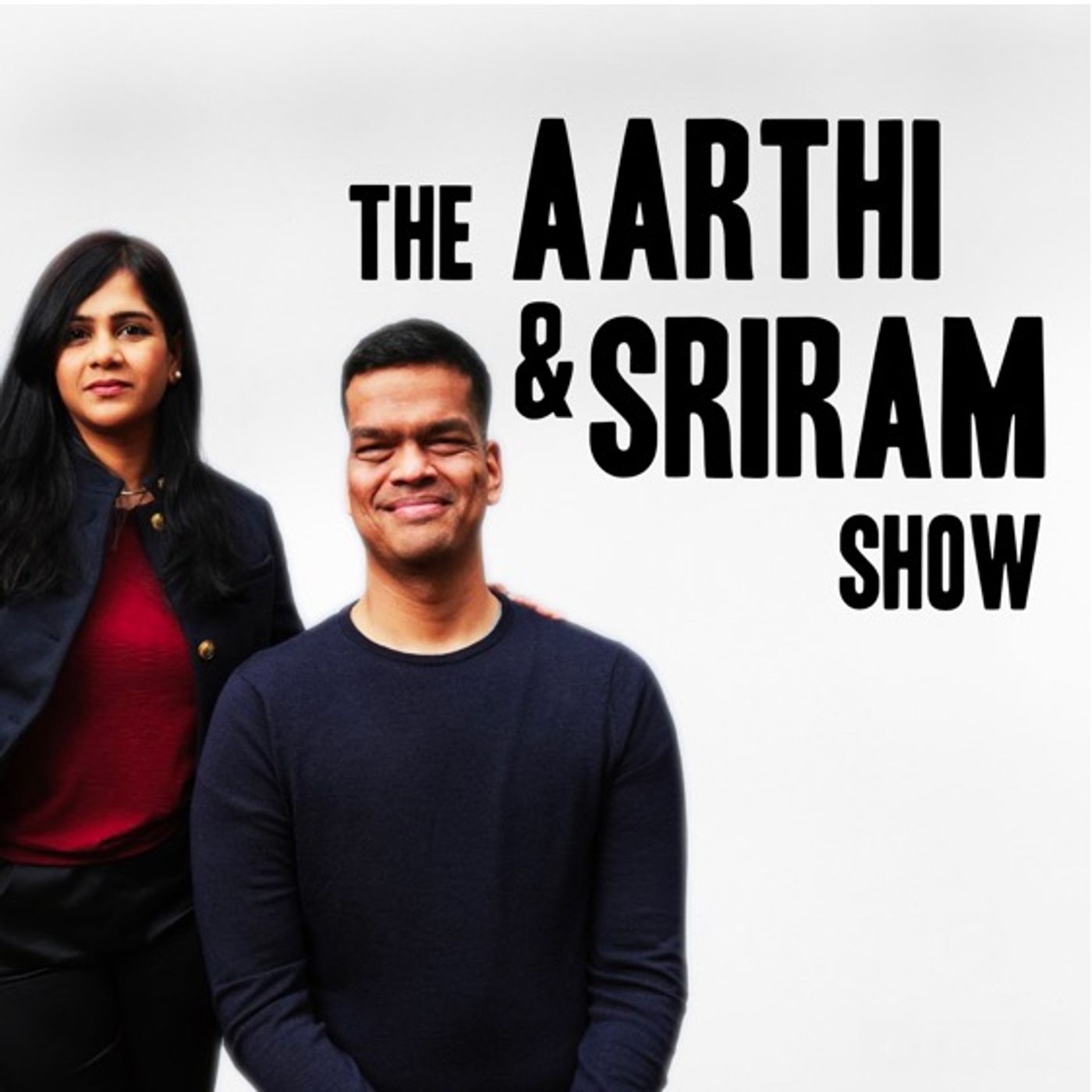
A show on optimistic conversations with people building and creating new products and technologies, hosted by veteran technologists Aarthi Ramamurthy and Sriram Krishnan.