Episode Summary
Executive Summary: The episode moves from a philosophical question about whether swapping sensory inputs would erase the self, to quantum spin and atomic density, and ends with Hannah Fry’s striking near-prediction of COVID via a BBC pandemic simulation. The discussion emphasizes that identity may be less fixed than we assume, science often relies on useful metaphors, and institutions should inform rather than manipulate or persuade.
Main Topics: Selfhood, sensory input, and the illusion of a “you” (Priority: 5/5): Michael and Hannah explore whether a person would remain themselves if sensory inputs were swapped, discussing neuroplasticity, body ownership, dreams, and the possibility that the sense of a unified self is an illusion constructed by the brain. Quantum spin and the limits of metaphor (Priority: 4/5): They explain that quantum spin is not literal spinning but a particle property with only certain allowed states, illustrating how physics concepts are often described through imperfect analogies that obscure as much as they reveal. How dense matter changes size: empty space in atoms (Priority: 4/5): The hosts discuss how much smaller humans and the observable universe would be if all empty space were removed or compressed to neutron-star density, using this to illustrate how diffuse ordinary matter really is. Hannah Fry’s BBC pandemic simulation and the COVID coincidence (Priority: 5/5): Hannah recounts a BBC project using an app and 100,000 participants to simulate disease spread in the UK, including a model that eerily aligned with later COVID outcomes and the first domestic UK transmission in Hazelmere, Surrey. Trust, informed consent, and vaccine hesitancy (Priority: 5/5): Reflecting on the BBC program Unvaccinated, Hannah argues that people make decisions emotionally and socially, not just statistically, and that institutions should focus on informing people rather than trying to force persuasion. Humility in science communication (Priority: 4/5): The episode closes with a broader argument that humility, honesty about uncertainty, and respect for autonomy are more effective than overconfident messaging, especially in crises.
Key Arguments: A person may still feel like themselves if only one sensory channel is swapped, but swapping all inputs could challenge or even dissolve the sense of self. The “self” may be a retrospective construction the brain uses to explain actions and experiences rather than a central inner controller. Quantum spin is a real particle property, not literal rotation, and the term survives because it is a useful but limited metaphor. If all empty space in matter were removed, humans and the universe would be vastly smaller; ordinary matter is mostly not solid in the intuitive sense. The BBC pandemic model was not a conspiracy but a practical data-gathering exercise that accidentally became highly predictive of COVID patterns. People’s vaccine decisions are shaped by trust, context, emotional associations, and autonomy more than by raw statistics. Public-health and institutional messaging should prioritize informing honestly over persuading deceptively, because white-hat bias can erode trust. Humility is presented as the best stance for science communication and decision-making under uncertainty.
Data Points: DNA content: 2% - The ad reads that genes make up only 2% of DNA, with the rest including ancient viral fragments and the so-called dark genome. Cancer survival improvement in the UK: double over the past 50 years - Cancer Research UK sponsorship copy states research has helped double survival in the UK over five decades. App participants in the pandemic study: 100,000 people - Hannah describes the citizen-science app used to model contacts and spread during the BBC pandemic project. Spatial data resolution outside Hazelmere: 100 meters square - The app collected location data at 100 m² scale for most users, with finer detail in Hazelmere. Estimated deaths without interventions: 886,000 - Hannah says the BBC model estimated nearly 886,000 UK deaths if no restrictions were imposed. Government estimate referenced: 833,000 - She compares their estimate to internal NERVTAG early estimates, which were close to the BBC model. Observable universe compressed to neutron-star density: 2.9 × 10^11 meters across - Cited as the diameter if all matter in the observable universe were squeezed to neutron-star density. Human compressed to neutron-star density: 2 micrometers on a side - An 80 kg human would become a cube about 2 μm per side under the same compression assumption. Neutron star density example: 10^18 kilograms per cubic meter - Used to illustrate extreme density; a cubic meter of neutron star matter is described as weighing around this amount. Neutron star teaspoon comparison: about 10 million tons - A teaspoon of neutron star matter is said to weigh more than the Titanic.
Pivotal Quotes: "The spin of an electron is like a spinning ball, except that it's not spinning and there is no ball." — Michael Stevens: Used to summarize the metaphorical nature of quantum spin. "We don't have any firm evidence that is the case. It may be that actually all of that is just an illusion of a conscious self." — Hannah Fry: Hannah explains her evolving view that the self may be a brain-generated construct rather than a central observer. "The job of an institution is to inform rather than persuade." — Hannah Fry: Her conclusion after reflecting on the BBC vaccine show and broader pandemic communication.
Implications: Listeners are left with a reminder that selfhood, science, and public trust are fragile constructions. Good communication should be humble, transparent, and emotionally aware, especially when decisions affect both individuals and society.
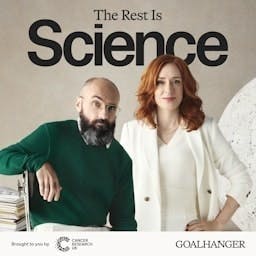
About The Rest is Science
Join mathematician Professor Hannah Fry and science creator Michael Stevens (Vsauce) as they dig into the weird scientific questions that often go unexplored. Welcome to The Rest Is Science, a show that sits in the fascinating space between what we think we know, and what we actually know. Why do we assume we understand things like time, randomness, or even gravity? Once you start questioning these familiar ideas, reality becomes astonishingly strange and completely fragile. Whether you're a lifelong science fan or just naturally curious, The Rest Is Science will change your perception of reality, and prove that the biggest questions are always the most fun.