Episode Summary
Executive Summary: The episode examines corporate crime and punishment, arguing that deferred prosecution agreements, internal investigations, and weak incentives have created a system where corporations often evade meaningful accountability while shareholders absorb costs. The hosts and guest debate reforms: tougher cooperation requirements, whistleblower bounties, public investigations, shame-based deterrence, and prosecutorial outsourcing. The second half applies similar institutional skepticism to the Supreme Court’s West Virginia v. EPA ruling and the balance between agency power and congressional authority.
Main Topics: Corporate crime and the rise of deferred prosecution agreements: John Coffey argues that DPAs have become the dominant corporate enforcement tool, often functioning as negotiated settlements that erase criminal consequences without identifying responsible individuals. Internal investigations and the influence of big law: The discussion critiques internal investigations as costly, delay-producing, and potentially biased toward corporate clients, while also acknowledging they can uncover more than prosecutors alone. Why individual accountability rarely materializes: The speakers explore how corporations and prosecutors use corporate structures, negotiated facts, and the 'following orders'/'I knew nothing' logic to avoid pinning blame on executives. Reform proposals for better enforcement: Coffey proposes stronger self-reporting incentives, whistleblower bounties, using private plaintiffs' firms for enforcement support, public court appearances by executives, and probation-like restrictions on incentive pay. Shame, humiliation, and deterrence: A major theme is whether corporate enforcement should reintroduce public shame through court proceedings, versus the risk of mob justice, overreach, or punishing people before proof is clear. Whistleblowers, legal filters, and the cost of enforcement: The hosts debate whether bounty systems are efficient or wasteful, concluding that some waste is acceptable if it surfaces real misconduct and helps overcome corporate concealment. West Virginia v. EPA and the limits of agency power: The conversation shifts to the Supreme Court's climate ruling, weighing congressional authority, the major questions doctrine, judicial activism, and whether the EPA had already been delegated relevant power.
Key Arguments: Deferred prosecution agreements reduce criminal punishment to a negotiated contract, often allowing corporations to pay fines and avoid admissions by individuals, which weakens deterrence. Corporate internal investigations are expensive and slow, and because they are controlled by defense-oriented law firms, they can be shaped to avoid reaching the highest levels of management. The current system creates legal inequality: wealthy corporations can buy different outcomes, generating public cynicism and a shadow justice system that remains opaque. Strong corporate cooperation is necessary to identify individual wrongdoers, but companies currently have little incentive to self-report or hand over senior employees. Whistleblower bounty programs work because they align incentives and overcome information asymmetry; more aggressive use outside the SEC/IRS could improve enforcement. Private law firms on contingency could help overworked prosecutors and regulators pursue fact-intensive cases without increasing taxpayer costs. Public, in-court acknowledgment of wrongdoing by CEOs and senior managers would restore deterrence through shame and humiliation, but it carries risks of abuse and over-punishment. Punishing only negligence in corporate crime would conflict with traditional criminal-law mens rea standards; willful ignorance is a more defensible basis for liability. The EPA case illustrates a broader conflict between agency discretion and congressional lawmaking; whether the decision is good depends on whether Congress had already delegated authority and how far the court can invoke the major questions doctrine.
Data Points: Deferred prosecution / non-prosecution agreements with corporations (2002-2016): 419 - The podcast cites the rise of DPAs/NPAs in the Justice Department during this period. Deferred prosecution / non-prosecution arrangements with corporations (prior 10 years): 18 - Shows how dramatically the use of these settlements increased relative to the previous decade. U.S. Sentencing Commission self-reporting credit (2009-2012): 0 companies - Coffey says no company received self-reporting credit in this period. Internal investigation cost: Well north of $10 million - Typical cost cited for large, board-commissioned internal investigations. Corporate fraud estimate among large public firms: About 10% per year - Luigi Zingales cites his research estimating the prevalence of securities fraud in large public companies. Estimated annual cost of corporate fraud: $830 billion - Zingales’ paper estimates the economic impact of the fraud. Willingness to trade off economic value to smooth earnings: 78% of CFOs said yes - Cited from John Graham and coauthors on CFO behavior. Whistleblower reward under SEC-style bounty: 20% to 30% - Proposed reward range for information that initiates an investigation. Potential fine size motivating whistleblowers: $500 million to $1 billion - Used to illustrate why bounties could attract insiders. Major questions doctrine ruling: 6-3 - Supreme Court majority in West Virginia v. EPA.
Pivotal Quotes: "We've managed to take out of the criminal justice system for corporations, and really only corporations, any element of shame or humiliation." — Bethany McLean: Opening framing of why corporate punishment feels toothless. "We have socialism for the very rich, rugged individualism for the poor." — Luigi Zingales: The hosts’ introduction to the broader critique of capitalism and unequal enforcement. "The deferred prosecution agreement is really a contract between the prosecutor and the corporation... you will pay this fine... we will let you withdraw the plea guilty and erase all this from the record." — John Coffey: Definition of the central enforcement mechanism under critique.
Implications: The episode argues that corporate accountability needs sharper incentives, more transparency, and less deference to legal elites. For listeners, the takeaway is that enforcement design—not just rules—determines whether capitalism appears legitimate or rigged.
About Capitalisnt
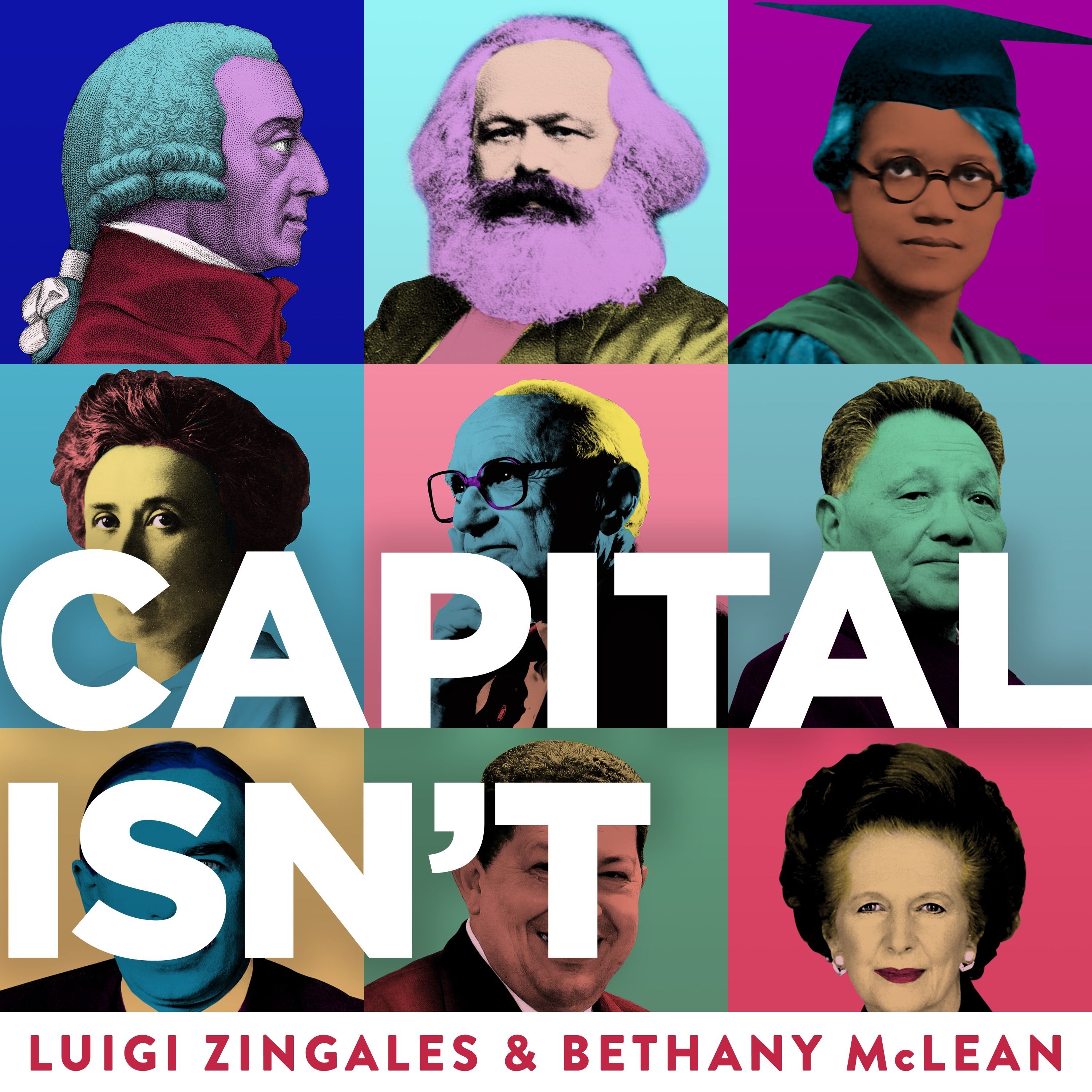
Is capitalism the engine of destruction or the engine of prosperity? On this podcast we talk about the ways capitalism is—or more often isn’t—working in our world today. Hosted by Vanity Fair contributing editor, Bethany McLean and world renowned economics professor Luigi Zingales, we explain how capitalism can go wrong, and what we can do to fix it. Cover photo attributions: https://www.chicagobooth.edu/research/stigler/about/capitalisnt. If you would like to send us feedback, suggestions fo...