Episode Summary
Executive Summary: The episode uses a quirky washing-up anecdote to explore the Sapir-Whorf idea that language shapes attention, categorization, and experience, then pivots into science Q&A on escape velocity, soap chemistry, and flawed historical theories. Across the conversation, the hosts argue for a middle ground: language doesn’t determine reality, but it strongly influences what we notice, name, and think about.
Main Topics: Language shapes perception and attention: The hosts discuss the Sapir-Whorf hypothesis through examples like color naming, Irish grammar, autism terminology, and generational labels, arguing that words influence what people notice and how quickly they categorize the world. Words, identity, and emotional relief: They explore how naming experiences can reduce ambiguity and provide comfort, especially for late-diagnosed autism and culturally specific distinctions like Irish uses of 'to be' or Persian vocabulary for a lingering smell. Escape velocity and atmospheric drag: A listener question prompts a detailed explanation of what escape velocity really means: not truly leaving gravity, but moving fast enough that the object never reaches zero velocity until infinitely far away. Soap as one of humanity’s most important inventions: The hosts explain soap’s ancient origins, how saponification works, and why soap is so effective against viruses and bacteria with lipid membranes, emphasizing its public-health importance. Scientific error and the self-correcting method: Using the discredited 'rain follows the plow' theory, they show how science can confidently get causation wrong and stress that good science tries to disprove hypotheses rather than confirm them. Historical and conceptual naming of decades and eras: They reflect on how periods like the '60s or 'naughties' gain identity through naming, and how some eras feel more real or culturally coherent once language fixes them into a category.
Key Arguments: Having a word for something can make it easier to notice, sort, and think about, even if the thing existed before the word. The strong version of Sapir-Whorf is likely wrong: lack of a word does not make a concept impossible, since people can invent new abstractions without prior terminology. Language and experience probably interact bidirectionally: words shape attention, but lived experience also shapes which words become available or meaningful. Escape velocity is not literal escape from gravity; it means having enough initial speed that deceleration by gravity never brings the object to rest before infinite distance. Soap works not just by removing dirt but by disrupting lipid membranes, making it highly effective against many viruses and bacteria. The historical 'rain follows the plow' theory shows how compelling but wrong causal stories can be accepted when correlations are mistaken for causes. Science is strongest when it actively tries to falsify its own theories, rather than searching only for confirming evidence.
Data Points: Age of oldest known human cancer example: 1.7 million years old - Mentioned in the Cancer Research UK sponsor segment about a foot bone showing a tumor before Neanderthals existed. Cancer survival improvement in the UK: doubled over the past 50 years - Cancer Research UK segment highlighting improved survival due to research. Number of cancer types targeted by research: over 200 - Cancer Research UK sponsorship copy. Age of soap recipes: 2,200 BCE - Soap history discussion referencing Mesopotamian tablets. Escape velocity at Earth’s surface: 11.186 km/s - Explained as the minimum initial speed needed so gravity never reduces an object to zero before infinite distance. Approximate miles per hour for Earth escape velocity: 25,000 mph - Converted from 11.186 km/s during the rock/escape velocity explanation. Voyager 1 speed: 17 km/s - Used to illustrate that it is still being slowed by gravity but remains above escape velocity. Voyager 1 speed at infinite distance: 10.27 km/s - Hypothetical asymptotic speed after escaping the solar system’s gravity well. Chicxulub impact speed: 20 km/s - Used as an example of a rock moving fast enough to survive atmospheric passage only because it was enormous. SpinLaunch funding: $230 million - Mentioned in the discussion of vacuum centrifuge launch systems. SpinLaunch achieved speed: a little over 2 km/s - The company’s current acceleration capability was compared with the much higher speed needed for orbital escape. Force requirement for spun satellites: 10,000 Gs - Satellites launched by SpinLaunch must withstand extreme acceleration. Estimated time in atmosphere for Chicxulub: about five seconds - The host notes the asteroid spent only a few seconds in the atmosphere before impact. Mass loss of Chicxulub meteor: 1% - The giant meteor lost only about 1% of its mass passing through the atmosphere.
Pivotal Quotes: "Does having a word for something make you more able to notice it?" — Hannah Fry: Introduces the central theme of language influencing perception and cognition. "The strong version that says the thing doesn't exist until it has a name, I wouldn't go along with." — Michael Stevens: Michael rejects the most extreme Sapir-Whorf interpretation while accepting that language affects attention. "Science is saying if you have a theory, you do everything you possibly can to disprove it." — Hannah Fry: Summarizes the scientific method during the discussion of false theories like 'rain follows the plow'.
Implications: The episode suggests language is a practical cognitive tool: it can sharpen perception, provide relief through naming, and influence culture, but it does not fully determine reality. For science and everyday life, careful definitions and falsifiable reasoning remain essential.
About The Rest is Science
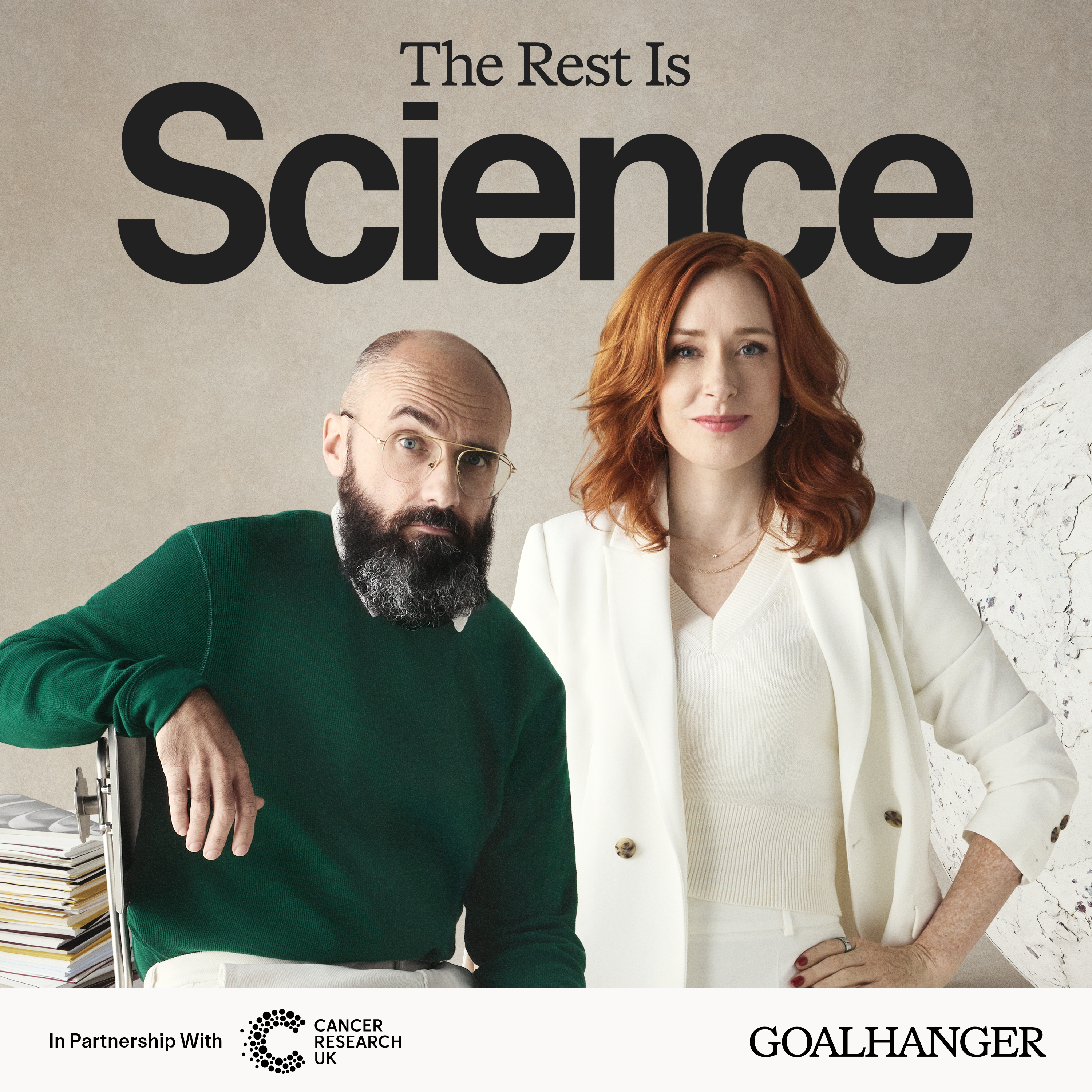
Join mathematician Professor Hannah Fry and science creator Michael Stevens (Vsauce) as they dig into the weird scientific questions that often go unexplored. Welcome to The Rest Is Science, a show that sits in the fascinating space between what we think we know, and what we actually know. Why do we assume we understand things like time, randomness, or even gravity? Once you start questioning these familiar ideas, reality becomes astonishingly strange and completely fragile. Whether you're a lifelong science fan or just naturally curious, The Rest Is Science will change your perception of reality, and prove that the biggest questions are always the most fun.