Episode Summary
Executive Summary: The episode argues that Supreme Court decisions shape capitalism far beyond social issues, especially through business, antitrust, regulation, securities, white-collar crime, and corruption cases. Bethany McLean, Luigi Zingales, and guest Roman Martinez debate how ideology, legal training, and statutory interpretation influence rulings, while warning that a more conservative Court could reshape agency power and business accountability.
Main Topics: Supreme Court and capitalism: The hosts argue that the Court’s business and economic decisions materially affect markets, corporate accountability, regulation, and the rule of law—often more than is publicly recognized. Ideology versus statutory interpretation: Roman Martinez says many business cases turn on statutory text rather than pure ideology, but the hosts note that judicial philosophy and values still affect outcomes. Pro-business drift across the Court: The discussion highlights scholarship suggesting the Court has become more uniformly pro-business over time, including among Democratic appointees. Administrative state and agency power: A major focus is whether a conservative Court will curb independent agencies, revive non-delegation ideas, and limit deference to regulators. White-collar crime and narrowing criminal law: The conversation covers Skilling, Yates, Arthur Andersen, and other cases showing the Court’s tendency to narrow federal criminal liability and limit overbroad prosecutions. Court composition, schooling, and elite influence: The hosts debate whether shared elite legal training and East Coast institutional culture create homogeneity in economic thinking among justices. Public scrutiny and Court behavior: They discuss how the Court is influenced by public opinion and how lesser scrutiny of business cases may affect outcomes differently than high-profile civil-rights cases.
Key Arguments: Supreme Court decisions on business, antitrust, regulation, and white-collar crime are foundational to how capitalism works and who bears costs in disputes. The Court’s business rulings are often framed as statutory interpretation, but judicial philosophy, training, and broader economic ideology still shape outcomes. A recent scholarly study cited in the episode finds that pro-business decisions have increased over time, including among Democratic-appointed justices. Judges trained in law-and-economics-heavy environments tend to use more economic reasoning and are more likely to issue pro-business regulatory decisions. Cases like Enron litigation, Skilling, Yates, and Arthur Andersen show that Supreme Court rulings can sharply reduce prosecutorial reach and chill future enforcement. Independent agencies such as the CFPB may face significant constitutional challenges if the Court expands separation-of-powers doctrines. Even when the Court does not strike down entire statutes, narrow remedies can preserve laws while still reshaping how agencies and prosecutors operate. The nomination process overweights social issues like abortion and underweights economic and rule-of-law questions that strongly affect markets and regulation. The Court’s composition is also shaped by elite educational backgrounds, potentially limiting diversity of economic perspectives. Greater scrutiny of business and economic views during nominations could better inform the public about how justices may rule on capitalism-related issues.
Data Points: Supreme Court nominations discussed: Robert Bork nomination rejected 58 to 42 - Referenced as the first highly contested failed nomination and a turning point in politicized confirmation battles. Number of Supreme Court cases argued by Roman Martinez: 9 - Martinez’s background before rejoining Latham & Watkins. Number of justices discussed as Harvard/Yale-trained: 9 justices before Barrett’s appointment - The hosts note that the Court was entirely composed of Harvard/Yale graduates prior to Justice Barrett. Fish case vote split: 5-4 - Yates-style destruction-of-evidence case involving a fisherman and undersized grouper. Supreme Court treatment of Arthur Andersen: 9-0 - Referenced as a unanimous decision reversing the obstruction-of-justice conviction tied to document destruction. Administrative agency example: CFPB single-director structure held unconstitutional - Used to illustrate the Court’s willingness to constrain independent agencies while preserving the statute narrowly. White-collar statute interpretation: Skilling narrowed honest-services fraud to bribery/kickbacks - Discussed as a major limitation on overbroad fraud prosecutions.
Pivotal Quotes: "We have socialism for the very rich, rugged individualism for the poor." — Luigi Zingales: Opening framing of the podcast’s critique of how capitalism operates in practice. "I think that in economics, there is more a training that is important." — Bethany McLean: On how legal education and economics training may shape justices’ business rulings more than party labels. "The Supreme Court sits atop the hierarchy of federal courts and is really the guardian of the rule of law." — Roman Martinez: Explaining why the Court matters to business and the economy, not just social issues.
Implications: Listeners should expect Supreme Court decisions to keep shaping corporate power, regulation, and enforcement. Future nominations and agency battles may matter as much for capitalism as for civil liberties, making economic/legal views more important in confirmation debates.
About Capitalisnt
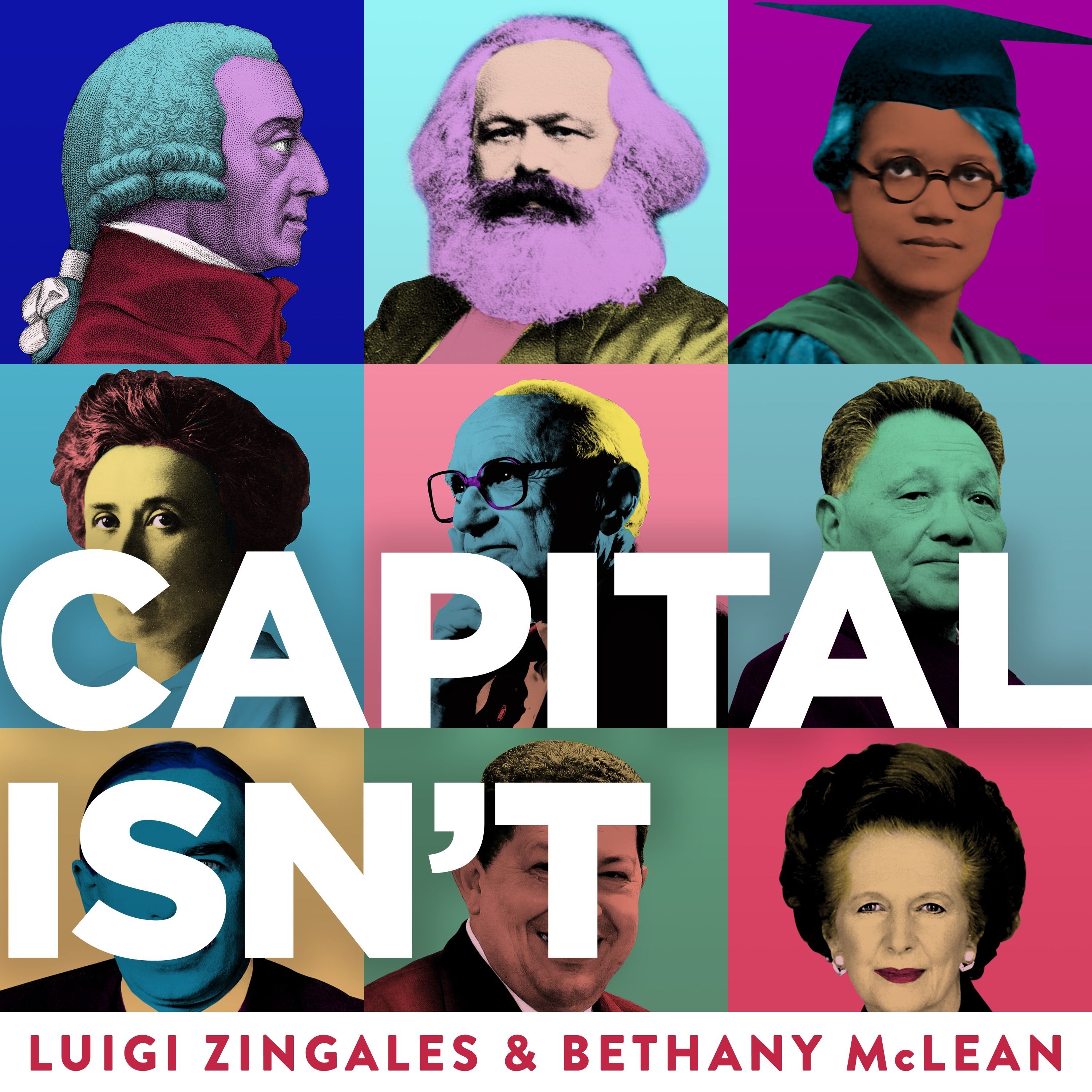
Is capitalism the engine of destruction or the engine of prosperity? On this podcast we talk about the ways capitalism is—or more often isn’t—working in our world today. Hosted by Vanity Fair contributing editor, Bethany McLean and world renowned economics professor Luigi Zingales, we explain how capitalism can go wrong, and what we can do to fix it. Cover photo attributions: https://www.chicagobooth.edu/research/stigler/about/capitalisnt. If you would like to send us feedback, suggestions fo...