Episode Summary
Executive Summary: The episode argues that Adam Smith has been oversimplified into a champion of the invisible hand, when his work was actually a nuanced analysis of power, institutions, inequality, and moral life. The guests contend Smith saw commerce as emancipatory but also vulnerable to capture by wealthy interests, making his ideas highly relevant to modern debates about lobbying, corporate influence, and the limits of value-free economics.
Main Topics: Adam Smith beyond the invisible hand: The conversation challenges the popular caricature of Smith as a simple free-market ideologue and emphasizes the breadth of The Wealth of Nations and his moral philosophy. Smith as a theorist of power: Smith is presented as someone who understood economic life as shaped by contests over power, especially between workers, employers, merchants, and the state. Institutional capture and regulatory distortion: The discussion highlights Smith’s awareness that laws, courts, and trade policy can be captured by powerful groups for private advantage. Chicago School and the narrowing of economics: The guests trace how later economists, especially the Chicago School, selectively used Smith to support a value-neutral, market-centered economics that downplayed power and morality. Commerce, freedom, and emancipation: Smith is described as seeing commercial society as liberating compared with feudal constraints, while the guests debate whether modern capitalism still expands freedom. Morality, values, and economics: The episode argues that economics is never truly value-free and that Smith’s moral sentiments should be reintegrated into how economics is taught and understood.
Key Arguments: Smith should be read as a theorist of power in the economy, not merely as an apostle of free markets. He saw workers and employers as having conflicting interests, with law often favoring masters and suppressing worker organization. Smith recognized that merchants and capitalists could convert wealth into political influence, shaping legislation to serve private interests. His analysis anticipates modern ideas of regulatory capture, including distortions in trade policy, taxation, land law, and judicial systems. The Chicago School helped canonize a selective Smith centered on the invisible hand while stripping away his concerns with sympathy, institutions, and inequality. Economics is not value-neutral; it has its own embedded values, especially efficiency, which should be recognized alongside equity, democracy, and humanism. Smith believed commerce could reduce arbitrary aristocratic domination and expand personal freedom, but modern capitalism’s effects on freedom are more ambiguous. A richer, more complex Smith is needed today to justify capitalism morally and to address inequality and corporate power.
Data Points: Publication year of The Wealth of Nations: 1776 - Referenced as the year Adam Smith published his major work. Length of The Wealth of Nations: More than 1,000 pages - Used to emphasize the book’s breadth and complexity. Number of times 'invisible hand' appears in Smith’s work: A handful of times - Mentioned to show how overcentralized the phrase has become in Smith’s reputation. Timeframe of Smith’s jurisprudence lectures: 1760s - Cited as an important source for understanding Smith’s political and institutional thinking. Historical period discussed: Mid to late 18th century - Used to describe the rise of merchants and capitalists as a new source of power. Trade liberalization milestone: 20th century, post-Bretton Woods - Mentioned as a period when Smith’s free-trade hopes were realized more than he expected.
Pivotal Quotes: "Smith sees economic life not as these abstract and impersonal market forces, but really about contests and power and how power and institutions structure who gets what." — Narrator/host framing: Introduces the episode’s central interpretation of Smith. "I see Smith as a theorist of power and specifically a theorist of power in the economy." — Glory Liu: Core thesis of the guest’s interpretation of Smith. "The law is often on the side of the masters." — Glory Liu: Used to illustrate Smith’s view of labor conflict and institutional bias.
Implications: Listeners are encouraged to rethink Smith as a guide for today’s debates on inequality, lobbying, and corporate power. The episode suggests capitalism needs moral and institutional scrutiny, not just efficiency metrics.
About Capitalisnt
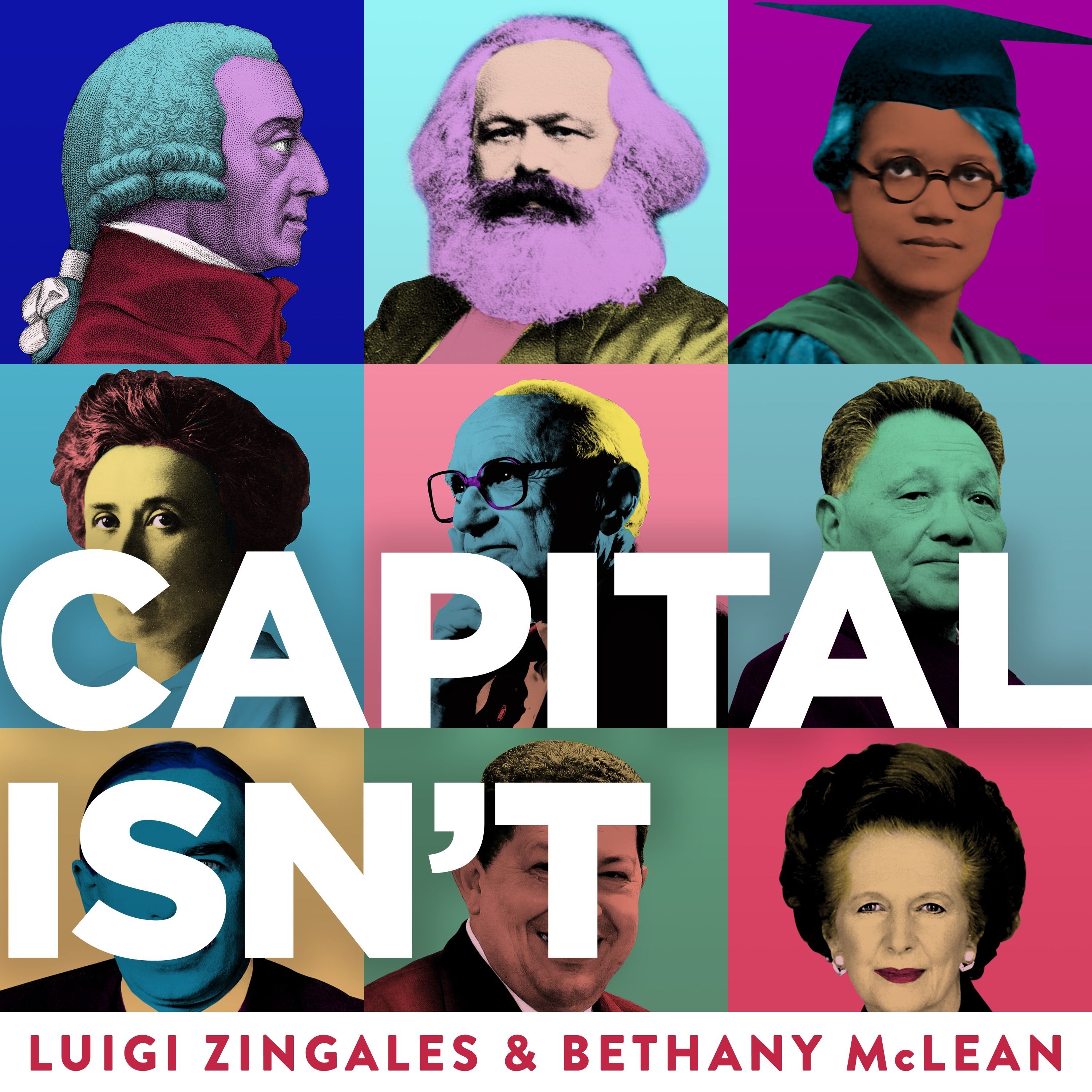
Is capitalism the engine of destruction or the engine of prosperity? On this podcast we talk about the ways capitalism is—or more often isn’t—working in our world today. Hosted by Vanity Fair contributing editor, Bethany McLean and world renowned economics professor Luigi Zingales, we explain how capitalism can go wrong, and what we can do to fix it. Cover photo attributions: https://www.chicagobooth.edu/research/stigler/about/capitalisnt. If you would like to send us feedback, suggestions fo...