Episode Summary
Executive Summary: The episode examines the rise of dark enlightenment and accelerationist ideas in Silicon Valley and Trump-world, arguing that they justify authoritarian governance in the name of speeding technological progress. The hosts connect thinkers like Nick Land and Curtis Yarvin to Peter Thiel, J.D. Vance, Marc Andreessen, and Project 2025, warning that anti-democratic techno-optimism risks fascistic outcomes and neglects people displaced by AI and deregulation.
Main Topics: Dark Enlightenment and accelerationism: The conversation explains dark enlightenment as an anti-liberal ideology that favors authoritarian rule and radical technological acceleration, even if society breaks in the process. Silicon Valley’s political shift: The hosts discuss how influential tech figures, including Peter Thiel and Marc Andreessen, have moved from mainstream Democratic politics toward anti-democratic, deregulatory, and pro-authoritarian ideas. Curtis Yarvin, Nick Land, and intellectual influence: They trace how Yarvin and Land’s writings—about CEO-monarchies, patchworks, and speeding up change—have seeped into elite political and tech circles. Technology versus democracy: A central debate is whether technology can be accelerated responsibly within democracy, or whether these thinkers see democracy itself as the obstacle to innovation. Freedom cities, patchworks, and deregulated enclaves: The episode critiques proposals for special zones with minimal regulation, arguing they may become gated communities for the rich rather than true experiments in freedom. AI, labor displacement, and social consequences: The hosts worry that rapid AI deployment will create social disruption, and that accelerationists ignore the problem of what happens to workers left behind. Prestige, immortality, and elite motives: The discussion ends by speculating that money alone cannot explain the movement; some tech leaders may be chasing status, legacy, or even life extension via AGI and biotech.
Key Arguments: Dark enlightenment and accelerationism provide intellectual cover for anti-democratic politics by framing authoritarianism as necessary for technological progress. Silicon Valley leaders such as Peter Thiel and Marc Andreessen are not merely being pragmatic; they appear to genuinely believe technology should be unleashed with minimal democratic interference. The comparison of governments to firms is misleading because states are not competitive like companies, cannot be easily exited, and must balance many public duties beyond profit. Freedom cities or patchworks may sound like experimental governance, but in practice they risk becoming tax-light, arbitration-heavy enclaves that favor wealthy insiders. The push for faster AI development reflects a willingness to sacrifice social stability and labor protections in exchange for reaching technological milestones sooner. The appeal of these ideas is partly emotional and ideological: elites resent democratic friction, want prestige, and may imagine themselves as superior rulers rather than ordinary market participants. A more benign techno-optimism, like that associated with Ezra Klein and the abundance agenda, can still share the same anti-bureaucratic impulse without openly embracing authoritarianism. Some of the movement’s rhetoric echoes fascism by elevating a superior class, dismissing the weak, and treating human costs as acceptable collateral.
Data Points: Federal employees targeted by Project 2025: estimated 500,000 - Referenced as part of the blueprint to fire federal workers and dismantle agencies Year Yarvin articulated RAGE: 2012 - RAGE stood for 'Retire All Government Employees' AI disruption horizon mentioned: 2 to 3 years; 5 to 10 years - Used to describe how soon AI could cause major social disruption Year of Andreessen manifesto reference: a couple of years ago - The manifesto was discussed as part of techno-optimist thinking; exact year not given in transcript Year of Trump inaugural gala attendance: January 2025 - Curtis Yarvin reportedly attended as an informal guest of honor
Pivotal Quotes: "superficial analyses of why certain tech billionaires are aligning with Trump tend to fixate on issues like taxes and regulations. But that's only part of the story." — Narrator: Introduces the episode’s central thesis that ideology, not just economics, drives the alignment "we believe a universal basic income would turn people into zoo animals to be farmed by the state." — Marc Andreessen: Cited as an example of the harsh social assumptions embedded in techno-optimist rhetoric "freedom to the wolves has often meant death to the sheep" — Bethany McLean: Used to frame the danger of anti-democratic liberty as protection for the powerful rather than the public
Implications: Listeners should see that some tech and political elites are pairing rapid innovation with anti-democratic governance ideas. If unchecked, these trends could deepen inequality, weaken institutions, and normalize authoritarian solutions to technological change.
About Capitalisnt
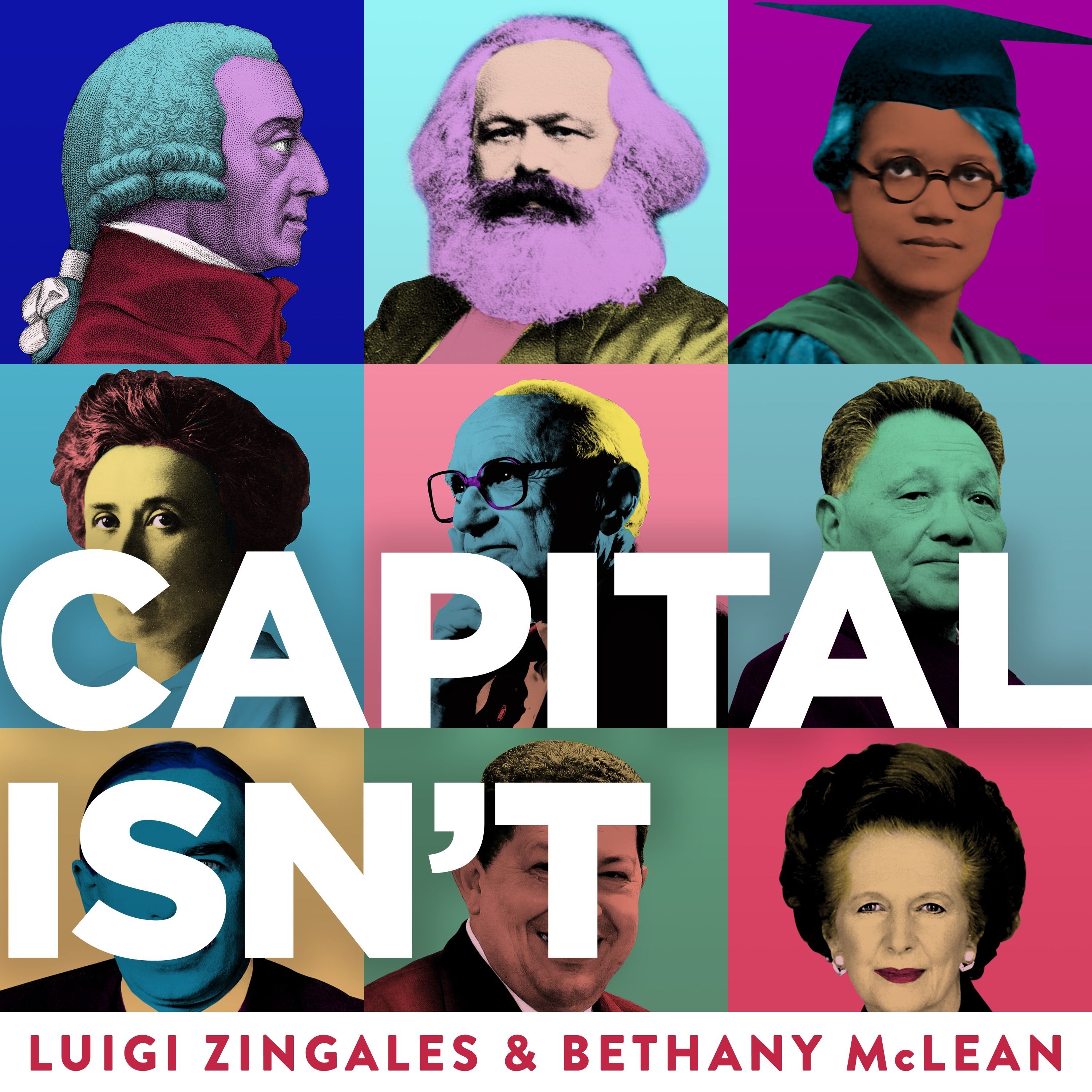
Is capitalism the engine of destruction or the engine of prosperity? On this podcast we talk about the ways capitalism is—or more often isn’t—working in our world today. Hosted by Vanity Fair contributing editor, Bethany McLean and world renowned economics professor Luigi Zingales, we explain how capitalism can go wrong, and what we can do to fix it. Cover photo attributions: https://www.chicagobooth.edu/research/stigler/about/capitalisnt. If you would like to send us feedback, suggestions fo...