Episode Summary
Executive Summary: The episode centers on Joseph Stiglitz’s critique of neoliberal capitalism and his case for “progressive capitalism,” arguing that markets often fail under information asymmetries, externalities, and monopoly power. The discussion spans health insurance, COVID vaccines, corporate governance, globalization, populism, and misinformation, emphasizing that economic freedom should be measured by broad well-being, not just GDP or shareholder returns.
Main Topics: Stiglitz’s influence and information asymmetry: The conversation explains Stiglitz’s Nobel-winning work showing that markets with unequal information often fail to achieve efficient outcomes, challenging the invisible-hand ideal. Progressive capitalism vs. neoliberalism: Stiglitz argues that deregulation, lower taxes, and market fundamentalism promised broad prosperity but instead delivered slower growth, higher inequality, and weaker shared well-being. Freedom, externalities, and collective action: A core theme is that individual freedom can harm others through pollution, pandemic behavior, and other externalities, making regulation and public action essential. Corporate governance and stakeholder capitalism: The discussion contrasts Friedman’s shareholder-primacy doctrine with stakeholder capitalism, arguing firms should consider workers, communities, customers, and the environment. Globalization, intellectual property, and vaccine apartheid: The episode critiques the WTO intellectual-property regime during COVID-19, focusing on how patent protections limited vaccine access in poorer countries. Populism, nationalism, and democratic backsliding: The speakers distinguish economic populism from authoritarian political populism, warning that failure of neoliberalism has fed right-wing nationalism and anti-democratic movements. Mis/disinformation and modern information power: Stiglitz updates his framework for a digital world in which platforms, insurers, and companies can know more about consumers than consumers know about themselves, while misinformation undermines markets and democracy.
Key Arguments: Markets do not reliably produce efficient outcomes when information is asymmetric; Stiglitz’s work helped formalize this critique. Health insurance illustrates adverse selection: without intervention, only sicker people buy coverage, premiums rise, and overall insurance coverage falls below efficient levels. Government action can expand freedom, not just restrict it; examples include stoplights, taxes funding vaccine research, and regulation that prevents harmful externalities. GDP growth alone is an inadequate measure of success; life expectancy, stress, working conditions, and shared prosperity matter more for judging social well-being. The neoliberal era promised faster growth through deregulation and tax cuts, but the episode argues it produced slower growth and concentrated gains at the top. Shareholder-value maximization is not equivalent to societal welfare; firms should account for stakeholders and social costs such as pollution and labor conditions. International patent rules during pandemics can protect corporate rents at the expense of public health; compulsory licensing or waivers may be necessary in crises. Populism should be split into economic populism (pro-ordinary people policy) and political populism (anti-democratic authoritarianism); the latter poses the bigger threat today. Information asymmetries persist in labor, lending, and insurance, but modern platforms also create new power imbalances via surveillance, price discrimination, and misinformation. Class actions and liability rules are important tools for internalizing externalities because they reduce transaction costs that otherwise prevent enforcement.
Data Points: Nobel Prize year: 2001 - Stiglitz, Akerlof, and Spence shared the Nobel Prize for work on information asymmetry. Growth comparison: about two-thirds - Stiglitz claims growth in the neoliberal era fell to about two-thirds of the earlier period. Time frame of neoliberal capitalism: 40–45 years since 1980 - Used to describe the deregulation/tax-cut era in the U.S. and broadly in the West. Life expectancy ranking: lowest among advanced countries - Stiglitz says U.S. life expectancy is the lowest among advanced economies. Life expectancy inequality: largest among advanced countries - He argues U.S. disparities in life expectancy are also the largest. Countries mentioned in WTO waiver opposition: Germany, UK, Switzerland - These countries did not support the COVID-era intellectual-property waiver. Support for waiver: >100 countries - More than 100 countries backed the U.S. position in favor of the waiver, but WTO consensus blocked it. Population size: almost 9 billion - Used to underscore the scale of modern externalities and interdependence. Year of Capitalism and Freedom: 1962 - Milton Friedman’s book is cited as the source of his shareholder-primacy influence.
Pivotal Quotes: "Freedom for the wolves has often meant death to the sheep." — Isaiah Berlin (quoted by Stiglitz): Used to frame the argument that unrestrained freedom for some can harm others through externalities and abuse of power. "Neoliberal capitalism has thus failed its own economic terms. It has not delivered growth, let alone shared prosperity." — Joseph Stiglitz (quoted): Central thesis of The Road to Freedom, attacking neoliberalism on both efficiency and equity grounds. "The question is, has U.S. been as successful as it really claims in terms of what should be our objective, which is maximizing the well-being of most citizens in our society?" — Host: Sets the episode’s core evaluative standard beyond GDP and toward broad well-being.
Implications: The episode urges listeners to rethink “freedom” as a social concept tied to public health, climate, and fair markets. For policy and business, it supports stronger regulation, stakeholder governance, and better controls on monopoly power, misinformation, and inequality.
About Capitalisnt
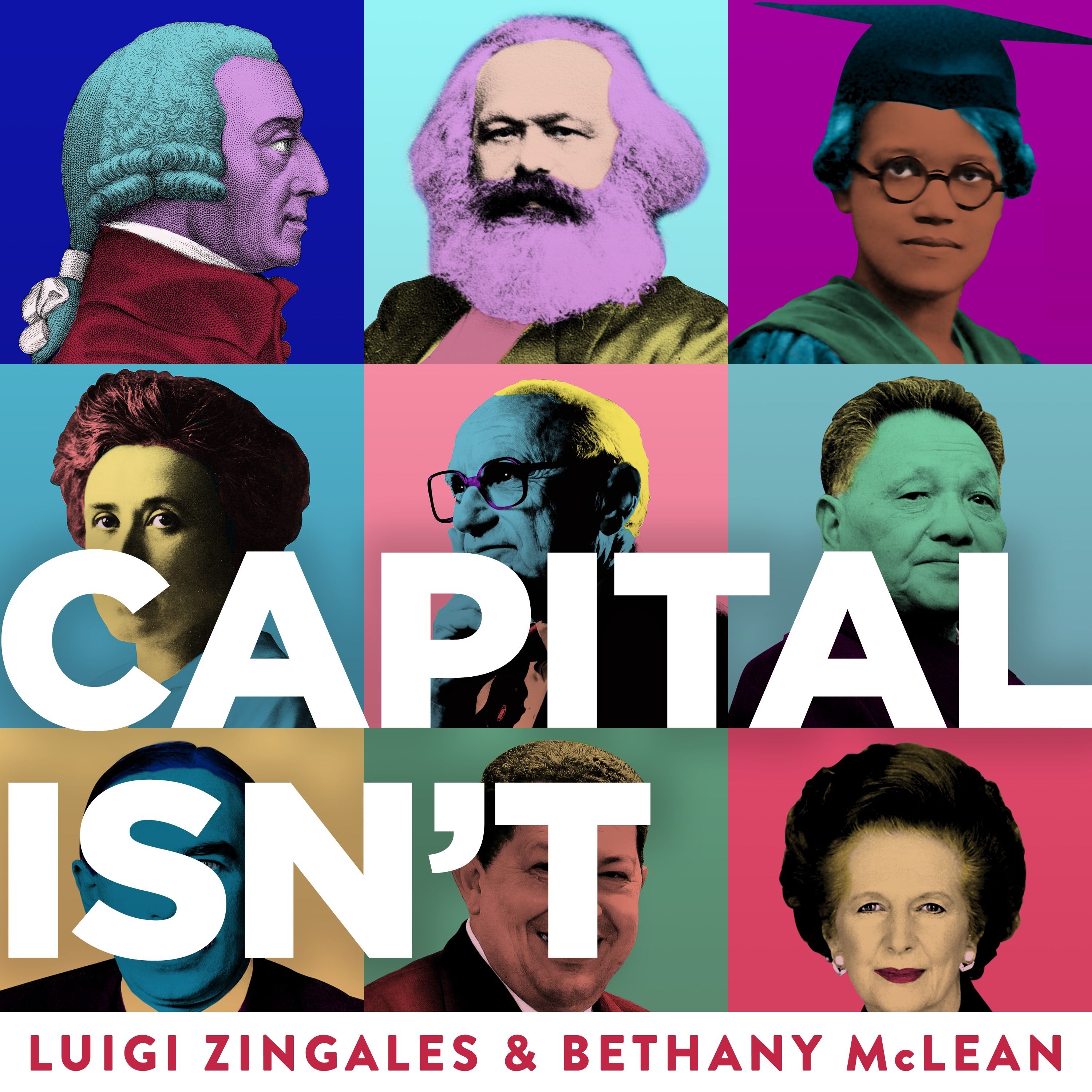
Is capitalism the engine of destruction or the engine of prosperity? On this podcast we talk about the ways capitalism is—or more often isn’t—working in our world today. Hosted by Vanity Fair contributing editor, Bethany McLean and world renowned economics professor Luigi Zingales, we explain how capitalism can go wrong, and what we can do to fix it. Cover photo attributions: https://www.chicagobooth.edu/research/stigler/about/capitalisnt. If you would like to send us feedback, suggestions fo...