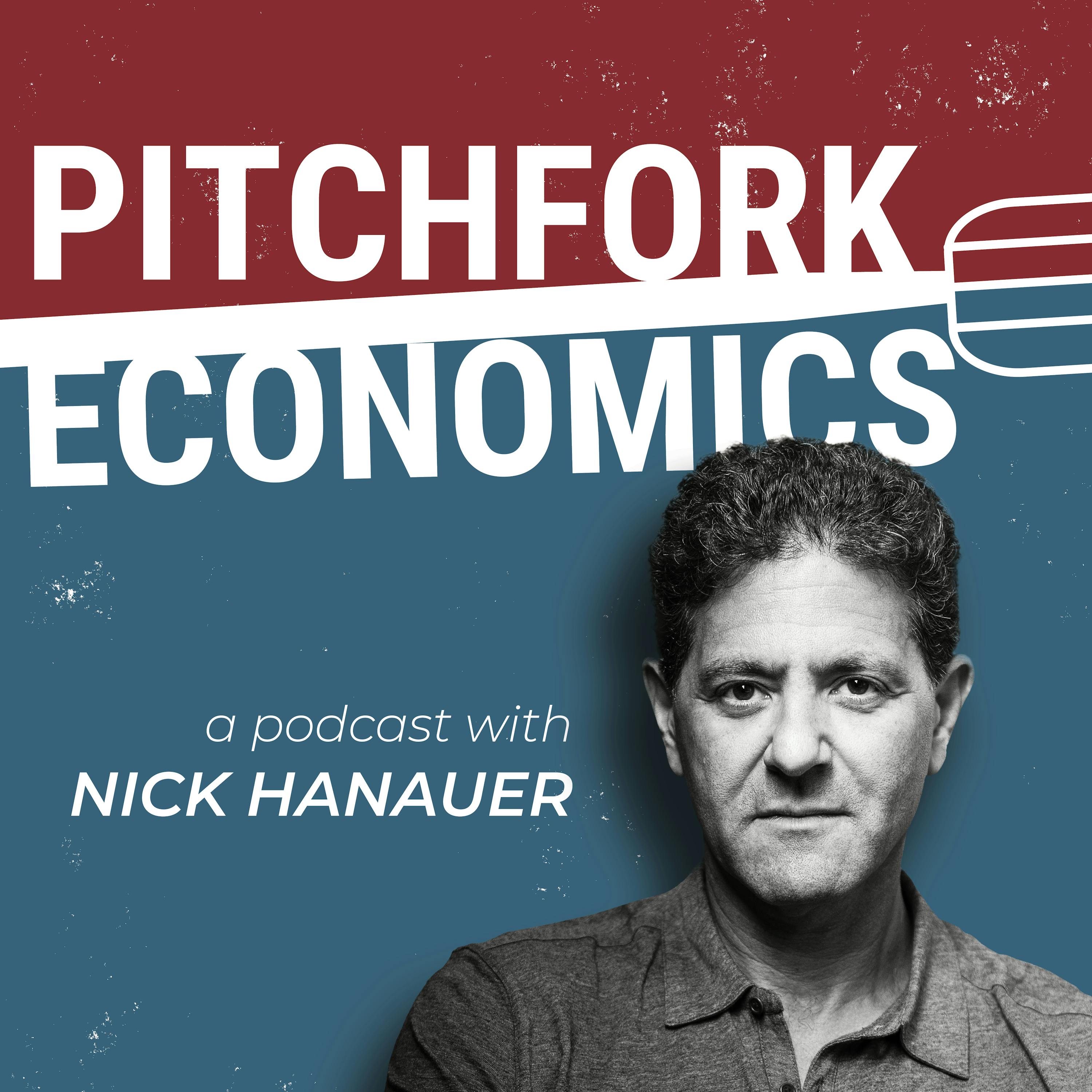
Episode Summary
Executive Summary: Pitchfork Economics interviews Paul Krugman about his book Arguing with Zombies and the persistence of discredited economic ideas. The discussion centers on why tax cuts for the rich, climate denial, austerity, and anti-minimum-wage claims keep surviving despite evidence, and how ideology, institutional incentives, and simplistic economic models help keep them alive.
Main Topics: Zombie ideas and the book's core thesis: Krugman explains that "zombie ideas" are policy beliefs repeatedly disproven by evidence but still alive in politics and media, because they continue serving powerful interests. Tax cuts for the rich and supply-side economics: The conversation identifies the claim that tax cuts pay for themselves as a leading zombie idea, with no real-world cases where the promised revenue gains materialized. Minimum wage myths and labor market evidence: The hosts challenge Krugman on the claim that raising the minimum wage kills jobs, arguing that decades of federal, state, and local experiments show little to no negative employment effect at common wage levels. Climate denial and existential risk: Krugman frames climate change denial as one of the most dangerous zombie ideas because it blocks policy responses to an evidence-backed global threat. Economic modeling, Econ 101, and intellectual bias: A major segment debates whether neoclassical models, with their idealized assumptions about rational actors and equilibrium, help generate zombie ideas by oversimplifying reality. Who benefits from zombie ideas: The episode argues that many bad ideas survive because they are financed and amplified by billionaires, donor-backed institutions, and the broader incentives of the economics profession. How to fight zombies politically: Rather than trying to eliminate zombie ideas entirely, the speakers discuss inoculating the public and policymakers against them through evidence, transparency, and better policy narratives.
Key Arguments: Ideas like "tax cuts pay for themselves" persist not because they are true, but because they serve the interests of wealthy donors and institutions that finance their circulation. Climate denial is a zombie idea with enormous consequences because it prevents action on an existential threat despite overwhelming scientific evidence. The claim that minimum wage increases destroy jobs is not supported by decades of U.S. federal, state, and city experiments; in the common range of increases, employment effects are minimal or absent. Economic debates often favor elegant models over messy reality; when models assume perfect markets and rational actors, they can mislead policymakers. The economics profession has structural and sociological biases, including conservatism and overrepresentation of wealthy white men, that shape which questions get studied. Bad ideas are often easiest to combat by revealing that they are not good-faith arguments but strategic claims that intimidate and mislead. Progressive policy gains are possible even without fully eliminating zombie ideas; examples include ACA coverage expansion, green energy investment, and resisting Social Security privatization. The hosts argue that orthodox models themselves are part of the problem because they create the intellectual conditions that allow zombie ideas to reappear. Krugman emphasizes that evidence should be updated over time: if new facts contradict old theories, the theory should change.
Data Points: Voicemail deadline: End of the day on March 31st - Ashley asks listeners to submit AMA questions for an upcoming episode. Voicemail phone number: 731-388-9334 - Listeners are told to call in questions about the economic effects of the coronavirus crisis. Republican Senate climate denial: 73% - Krugman cites a survey showing most Senate Republicans denied man-made climate change. Seattle minimum wage: $16.39 plus tips - The hosts reference Seattle as a real-world test case for higher minimum wages. Seattle wage policy: $15 minimum wage - Nick and David refer to Seattle's landmark minimum wage campaign and its real-world outcomes. Federal minimum wage history: 22 raises - Nick says the U.S. federal minimum wage has been raised 22 times in history. Health insurance expansion: 20 million people - Krugman notes that the Affordable Care Act got roughly 20 million people health insurance. Spanish labor market example: Labor costs fell relative to Germany over several years - Krugman uses Spain to show that wage adjustments can matter for competitiveness under the euro. Estimated income share shift: 23% vs 8% - Nick says rich people’s share of income rose to 23% instead of the 8% share seen in 1980. Estimated additional income: $2.5 trillion - Nick estimates that keeping the 1980 income share would leave an extra $2.5 trillion to spread through the economy.
Pivotal Quotes: "Why is it that when poor people get richer, that's Threatens the economy, but when rich people get richer, that must be an unalloyed good." — Nick Hanauer: He frames the show’s critique of asymmetrical treatment of inequality and labor policy. "The marketplace for ideas is pretty thinly financed, and it really only takes a handful of malign billionaires to keep bad ideas in circulation." — Paul Krugman: Krugman explains why harmful economic myths can persist despite weak evidence. "I mean, the whole point about Zombies actually you really can never fully kill them." — Paul Krugman: He describes why the goal is to argue against zombie ideas rather than expect permanent eradication.
Implications: Listeners are encouraged to question economic claims that favor the powerful, demand evidence over ideology, and recognize that policy fights are also fights over narratives, models, and who gets to define common sense.
About Pitchfork Economics
We are living through a paradigm shift from trickle-down neoliberalism to middle-out economics — a new understanding of who gets what and why. Join zillionaire class-traitor Nick Hanauer and some of the world’s leading economic and political thinkers as they explore the latest thinking on how the economy actually works.