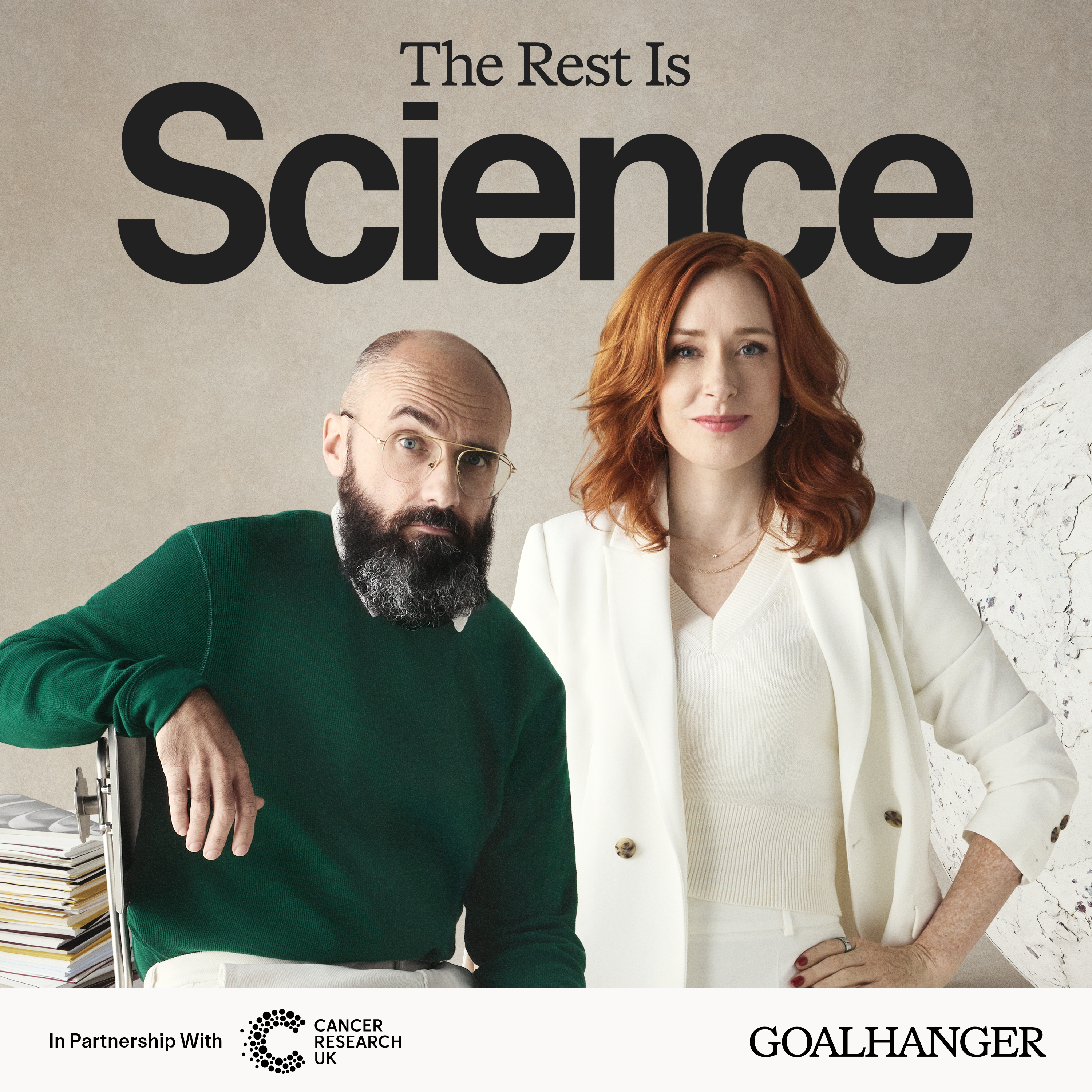
Episode Summary
Executive Summary: The hosts explain how the Navier–Stokes equations model fluid motion, why assumptions such as continuous, Newtonian fluids make them tractable, and why mathematicians study whether their solutions can become singular. They discuss OpenAI's reported AI-generated blow-up result, its technical caveats and disputed significance, and the wider tension between producing answers and gaining human-understandable mathematical insight. A later update notes hundreds of further AI manuscripts remain unchecked.
Main Topics: How the Navier–Stokes equations describe fluids: The equations extend Newton's force–mass–acceleration framework to fluids, using density, velocity, pressure, viscosity and external forces. Their broad usefulness ranges from blood flow to aerodynamics. Model assumptions and their limits: The continuum approximation treats fluid as smooth rather than molecular, and the standard equations simplify matters by focusing on Newtonian fluids with constant viscosity. These assumptions can fail at very small scales or in rarefied air, such as during spacecraft re-entry. Special fluid-flow cases: The hosts illustrate Stokes flow, where high viscosity and slow motion make flow reversible in a demonstration, and discuss boundary layers near surfaces. They also describe Euler equations as the inviscid, zero-viscosity case. The smoothness and blow-up question: A central mathematical question is whether initially smooth Navier–Stokes flows always remain well-behaved or can develop a singularity in finite time. The nonlinear velocity-feedback term can amplify motion, while viscosity acts as a brake. OpenAI's reported result and its caveats: The episode reports that OpenAI used a large swarm of AI agents to produce a finite-time blow-up result, but the hosts say the proof relied on a highly convoluted external-force term. They distinguish satisfying a formal problem statement from resolving the fluid-dynamics question mathematicians care about. AI, mathematical insight and research incentives: The speakers debate possible model contamination or shared research, the difficulty of checking opaque proofs, and whether AI advances should be judged by answers alone or by the understanding they provide. A later recording update says more than 700 manuscripts were released and had not yet been fully verified.
Key Arguments: Navier–Stokes equations are powerful because a compact mathematical model can describe many fluid and gas phenomena, but their usefulness depends on assumptions such as continuity and constant viscosity. The nonlinear velocity-dependent term can feed motion back into itself; viscosity counters this effect. The smoothness problem asks whether that counterforce always prevents finite-time blow-up. The hosts report that OpenAI's claimed result used external forces in a way that made the result technically relevant to the stated problem but, in their view, did not answer the underlying question about ordinary fluid behavior. A formally checkable proof is not necessarily an illuminating explanation: the speakers argue that mathematical progress also depends on understanding why a result holds and what it reveals about the world. The speakers describe AI research as progressing from interpolation of existing work, to extrapolation beyond it, and potentially to abstraction that identifies deeper patterns; they consider the last stage a more meaningful form of scientific insight. The transcript raises concerns about AI systems potentially absorbing or reproducing other researchers' work, while acknowledging that shared AI tools could also create a form of collaboration. The allegation is presented as a controversy, not established fact.
Data Points: Clay Mathematics Institute prize: $1 million - The prize was announced in 2000 for solving the Navier–Stokes problem. Air molecule spacing: About 10 times the width of the molecules - The host uses this as an illustration of why air is not literally continuous at the molecular scale, despite the continuum approximation often being useful. OpenAI agent swarm: Approximately 10,000 agents - The episode says the agents coordinated on the reported Navier–Stokes work. Reported AI work duration: 88 hours (about 3.5 days) - Time attributed to the OpenAI run described in the episode. Messages exchanged by agents: 2.7 million - The reported volume of communication among the AI agents. Estimated computational cost: Up to $15 million in some estimates - The host presents this as an estimate of the resources used, not a confirmed cost. Later OpenAI manuscript release: More than 700 manuscripts - In a later update, the hosts say the manuscripts claimed progress or solutions to many problems and had not yet all been checked by mathematicians. Cancer survival in the UK: Doubled over the past 50 years - A sponsor message attributes this improvement to Cancer Research UK's work; it is not part of the fluid-dynamics discussion.
Pivotal Quotes: "You can write that down on a single line on a sheet of A4 paper, and that can describe to you everything that is liquidy or fluidy or gas-like in the entire universe." — Hannah: She conveys the expressive power and broad applicability of the Navier–Stokes equations. "It was always about the insight that it gave you." — Hannah: She explains why mathematicians may care about understanding a proof, not merely obtaining a formal result. "Is it for the intellectual delight of it? Is it because we want deep insights around the world? Or is it just because we want answers?" — Hannah: She frames the wider question about the purpose and values of AI-assisted scientific discovery.
Implications: AI may accelerate mathematical discovery, but opaque or narrowly constructed proofs can be hard to verify and may offer little explanatory insight. The episode suggests that researchers and the public will need to distinguish formal correctness, genuine understanding and the incentives driving AI claims.
About The Rest is Science
Join mathematician Professor Hannah Fry and science creator Michael Stevens (Vsauce) as they dig into the weird scientific questions that often go unexplored. Welcome to The Rest Is Science, a show that sits in the fascinating space between what we think we know, and what we actually know. Why do we assume we understand things like time, randomness, or even gravity? Once you start questioning these familiar ideas, reality becomes astonishingly strange and completely fragile. Whether you're a lifelong science fan or just naturally curious, The Rest Is Science will change your perception of reality, and prove that the biggest questions are always the most fun.