Episode Summary
Executive Summary: The episode argues that Silicon Valley Bank’s collapse was not just a one-off failure of management or pandemic-era policy, but the result of a long build-up of liquidity from QE that left banks with volatile deposits and hidden leverage. As QT removed that liquidity, fragility surfaced, exposing limits of Fed supervision, the dangers of “financial dominance,” and the likelihood of tighter regulation and slower disinflation.
Main Topics: QE, QT, and the build-up of banking fragility: Raghuram Rajan argues that quantitative easing expanded bank balance sheets through reserves and deposits, while quantitative tightening removed liquidity faster than banks could absorb it, making the system unstable. Silicon Valley Bank as a symptom, not an anomaly: SVB’s collapse is framed as part of a broader pattern affecting regional banks, with uninsured deposits, long-duration securities, and interest-rate risk reflecting a system-wide dynamic rather than isolated mismanagement. Limits of monetary policy and supervision: The conversation stresses that the Fed cannot safely use aggressive rate hikes while assuming supervision will contain the risks, because easy money encourages risk-taking and weakens regulatory vigilance. Financial dominance and market feedback loops: The hosts discuss how markets react to Fed signals, sometimes loosening conditions when the Fed tries to tighten, which can blunt inflation control and constrain policy choices. Banking structure and implicit guarantees: The episode suggests the U.S. banking system may be drifting toward stronger guarantees for deposits, which could require more intrusive regulation and possibly a structural rethink of banking. Technology, faster runs, and new payment rails: Mobile banking, brokerage integration, and FedNow are portrayed as accelerating deposit flight and making bank runs faster, increasing the pressure to redesign safe deposit provision.
Key Arguments: QE created a banking system with lots of reserves on the asset side but highly runnable deposits and other short-term claims on the liability side. When the Fed switched to QT, it removed liquidity from banks without removing the liabilities they had written, making the system far less liquid. SVB’s failure was driven not only by rate hikes but by a longer liquidity cycle that encouraged banks to take on duration risk while funding themselves with uninsured deposits. The Fed’s low-rate environment and large-scale asset purchases incentivized a search for yield across many banks, not just SVB. Supervision tends to weaken during easy-money periods precisely when risk-taking is rising, so it cannot be relied on as a separate fix. Fed policy now interacts with markets in a self-defeating way: rate pauses can trigger market rallies, which ease financial conditions and slow disinflation. The likely result of recent crises is a system with stronger regulation and less tolerance for mid-sized bank failures, especially when deposit guarantees are effectively expanded. New technology may worsen run dynamics by making outflows faster and more continuous, reducing the time regulators have to respond.
Data Points: SVB uninsured deposits: up to 97% - Described as a sign of extremely runnable funding during the pandemic liquidity boom. Repo market stress: September 2019 - Cited as the first major warning that liquidity had been drained too far from the system. Pandemic QE scale: trillions of dollars - The Fed’s massive 2020 liquidity injection was linked to deposit growth and bank balance-sheet expansion. Regional-bank deposit change: $120 billion lost - Mentioned in the discussion of deposit migration away from regional banks. Large-bank deposit change: $66 billion gained - Shows deposit flight from regional banks to larger institutions. Net deposit shift: $54 billion moved to the rest - Derived from the regional-bank losses minus large-bank gains. Interest-rate sensitivity with traditional bank: 400 bps rise in policy rate → 12% decline in deposits - From Rajan’s cited research on deposit sensitivity. Interest-rate sensitivity with mobile app + brokerage account: 400 bps rise in policy rate → 24% decline in deposits - Shows faster depositor responsiveness at digitally integrated banks. Inflation benchmark: 2% target - Used as the Fed’s long-run inflation objective. Current inflation range discussed: 4% to 5% - Used to indicate inflation remained above target at the time of discussion. Potential inflation outcome: around 3% - Rajan’s rough best-case estimate for the next year. Rate hike step under consideration: 25 basis points - Discussed as the likely increment before the banking stress intensified. Possible larger hike: 50 basis points - Mentioned as a stronger option the Fed had begun signaling before SVB-related stress. FedNow timing: end of June - Referenced as a new payment system that could speed up runs by enabling 24/7 transfers.
Pivotal Quotes: "The earlier view was we've flooded the system with liquidity. If we take it out, no big deal. The problem is the financial system, the banks had gotten used to it, and you're trying to remove something from an addict. It is painful." — Raghuram Rajan: Core explanation for why QT is destabilizing after years of QE. "We have socialism for the very rich, rugged individualism for the poor." — Luigi Zingales: Opening line framing the show’s critique of capitalist inconsistency and bailouts. "The bottom line is clear. As it reexamines bank behavior and supervision, the Fed cannot afford to ignore the role that its own monetary policies, especially QE, played in creating today's difficult conditions." — Bethany McLean quoting Rajan's paper: Summarizes the show’s central thesis about the Fed’s responsibility.
Implications: The episode suggests future crises may come faster and require heavier regulation, narrower tolerance for bank risk, and possibly new public safe-deposit mechanisms. It also warns that the Fed’s anti-inflation path will stay constrained by financial fragility.
About Capitalisnt
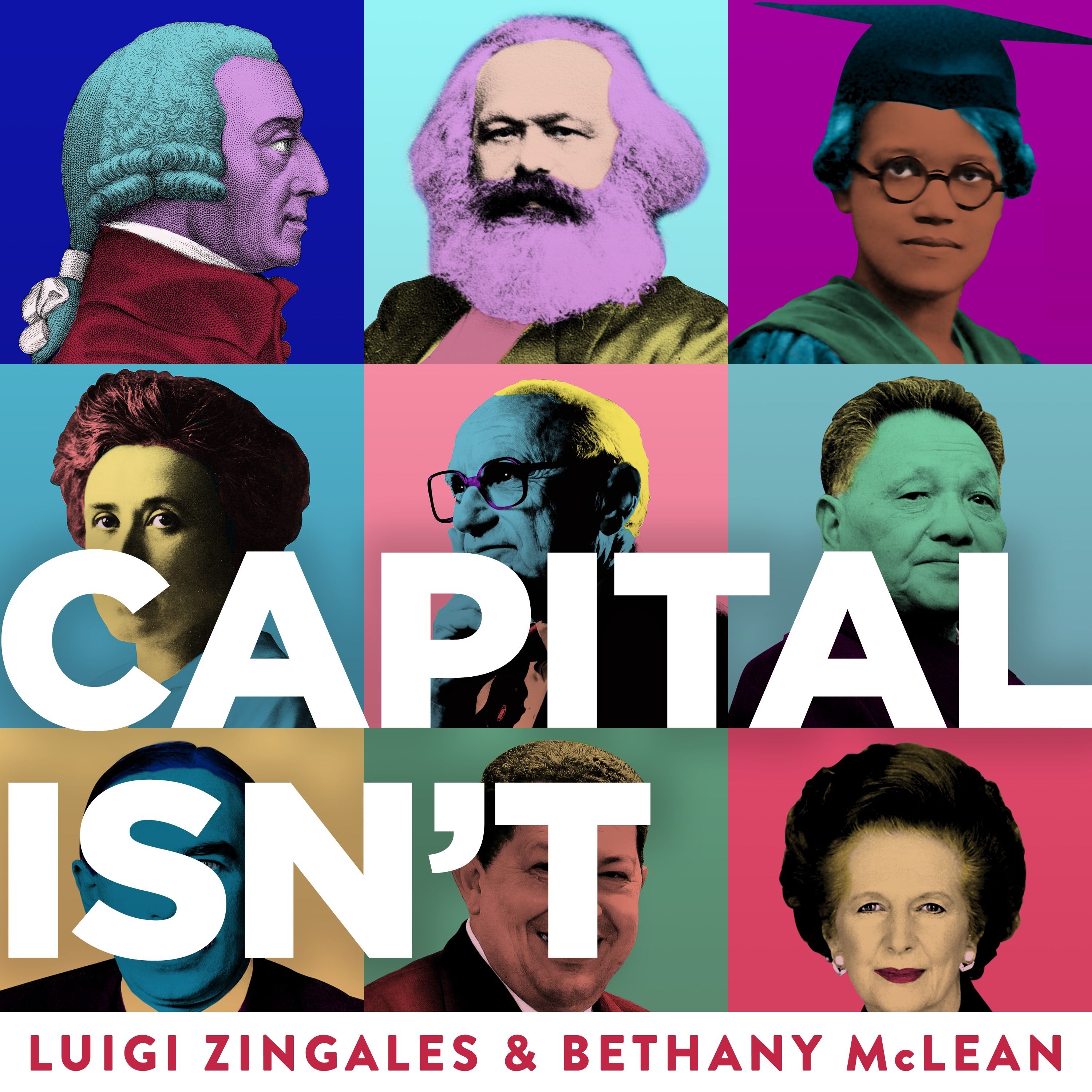
Is capitalism the engine of destruction or the engine of prosperity? On this podcast we talk about the ways capitalism is—or more often isn’t—working in our world today. Hosted by Vanity Fair contributing editor, Bethany McLean and world renowned economics professor Luigi Zingales, we explain how capitalism can go wrong, and what we can do to fix it. Cover photo attributions: https://www.chicagobooth.edu/research/stigler/about/capitalisnt. If you would like to send us feedback, suggestions fo...