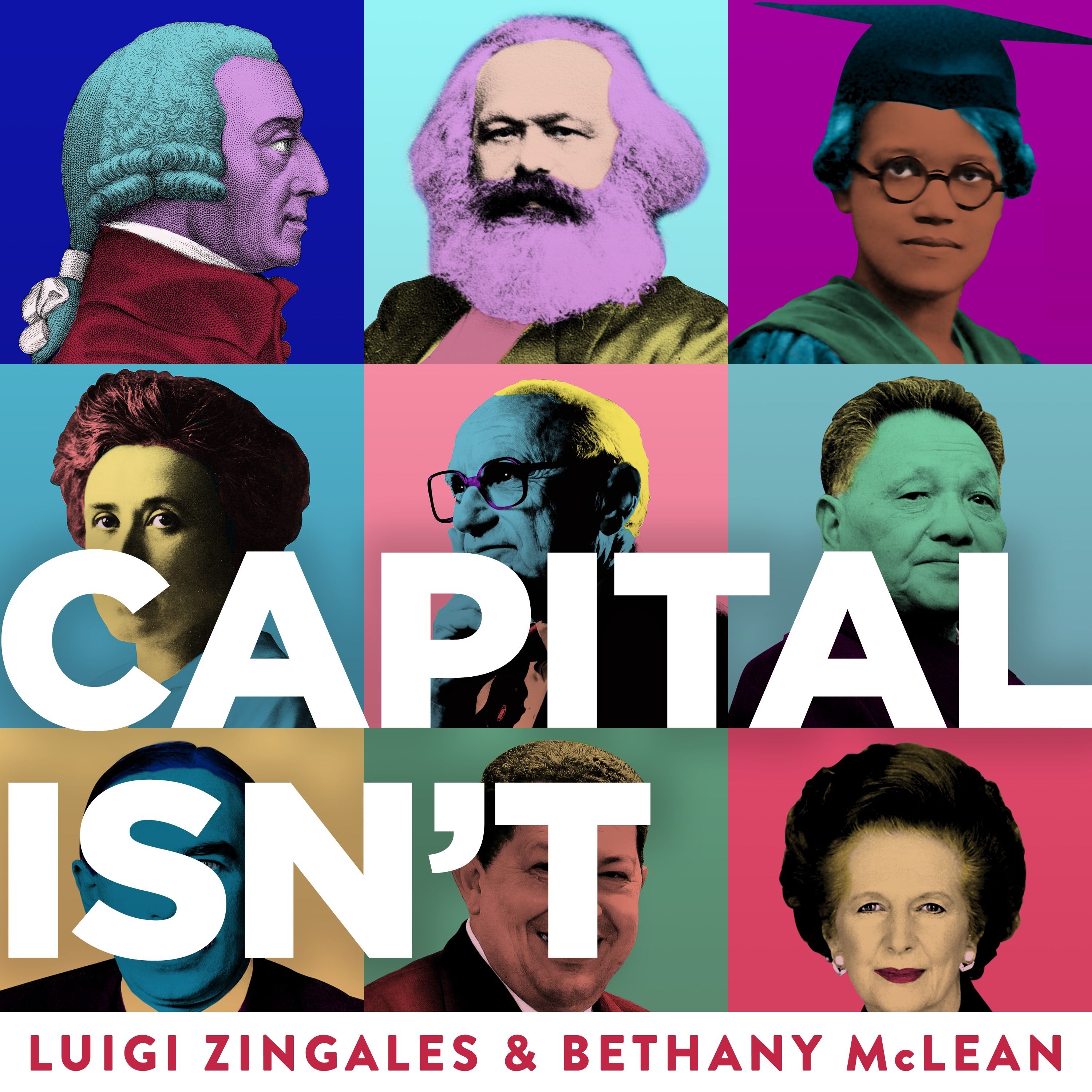
Episode Summary
Executive Summary: Bethany McLean and Luigi Zingales debate whether neoliberalism failed because of bad design, bad implementation, or bad timing. They conclude that markets need rules, state capacity, redistribution, and democratic correction, while warning that global free trade, weak education, and rising private power weakened liberal democracy and the American middle class.
Main Topics: Defining neoliberalism vs. political liberalism: The hosts distinguish economic neoliberalism—light regulation, free trade, and market primacy—from political liberalism, arguing that confusion over definitions obscures the real debate. Why neoliberalism failed in practice: They argue neoliberalism’s promises of broad prosperity were not fulfilled, especially after the financial crisis and decades of stagnant median wages for many workers. Globalization, China, and the labor shock: A major theme is that China’s WTO entry and accelerated globalization created an abrupt, absolute decline in manufacturing jobs, making retraining far harder than earlier structural shifts. Nation-states, democracy, and the trilemma: Zingales emphasizes that free markets, democracy, and strong nation-states cannot all be maximized at once; societies must choose trade-offs to preserve social contracts and safety nets. Private power, antitrust, and state capacity: The conversation argues neoliberalism elevated private-sector power too far and undermined the state, when in reality robust public institutions and antitrust are necessary to protect competition and democracy. Education, inequality, and democratic finance: They stress that failing schools, money in politics, and weak democratic responsiveness prevent inclusive growth and block needed reforms. Toward a rethought liberalism: The episode ends by proposing a new, messier liberalism: one that preserves individual freedom while explicitly correcting for inequality, private monopoly, and the social costs of market integration.
Key Arguments: Neoliberalism’s central promise was shared prosperity, but that promise did not materialize for many Americans, especially the median worker. The 2008 financial crisis exposed the fragility of the neoliberal model and accelerated skepticism about its assumptions. Free trade was not the core problem by itself; the problem was the failure to redistribute gains and to manage the transition costs of globalization. China’s WTO entry intensified an abrupt loss of manufacturing jobs, making adjustment harder because workers had to move from shrinking absolute employment, not just a shrinking share. Liberal democracy depends on some level of economic equality and state capacity; extreme inequality makes sustaining democratic legitimacy difficult. A nation-state cannot offer a meaningful safety net if capital and labor move completely freely across borders; boundaries and social contracts matter. Neoliberalism became a pro-business ideology rather than a pro-competitive one, often empowering multinationals and weakening market competition. The state should not be vilified: it is essential for regulation, redistribution, and countering monopoly power. Democracy must periodically correct market excesses, because formal rules alone will still bias outcomes toward the wealthy. Education reform and political finance reform are seen as prerequisites for any durable economic redesign. Debt and consumer credit may have deepened inequality rather than broadly expanding opportunity. A better framework would be a renewed liberalism that balances freedom with rules, redistribution, and institutional restraint on both government and private power.
Data Points: Time period of neoliberal predominance: 1990 to at least 2007 - Described as the era when economic liberalism/free trade with few rules dominated policy. Median wage stagnation: 40 to 50 years - Used to illustrate that many workers saw little real wage growth despite promised prosperity. Manufacturing employment drop: 20 million to 13 million jobs - Example of an absolute decline in U.S. manufacturing employment that made retraining much harder. Postwar boom period: 1945 to 1975 - The '30 glorious years' when Western workers, especially Americans, benefited from favorable global conditions. Share of U.S. workforce with high school education: 43% - Cited to show the U.S. educational advantage around 1945.
Pivotal Quotes: "What we need is to guarantee everybody a real shot at the American Dream." — Luigi Zingales: On why redistribution and inclusion matter more than symbolic safety nets. "The major mistake that was done at the beginning of the 2000s was to let China enter the WTO without some form of soft landing." — Luigi Zingales: On globalization’s abrupt labor-market shock and the failure to manage adjustment costs. "I think that there is no alternative to the political liberalism, or at least the alternatives are much, much worse than what is out there." — Luigi Zingales: On defending liberal democracy while arguing it needs stronger economic support.
Implications: The episode argues that capitalism’s future depends on a redesigned liberalism: stronger education, antitrust, redistribution, and democratic accountability, with less faith in pure markets and more attention to who bears globalization’s costs.
About Capitalisnt
Is capitalism the engine of destruction or the engine of prosperity? On this podcast we talk about the ways capitalism is—or more often isn’t—working in our world today. Hosted by Vanity Fair contributing editor, Bethany McLean and world renowned economics professor Luigi Zingales, we explain how capitalism can go wrong, and what we can do to fix it. Cover photo attributions: https://www.chicagobooth.edu/research/stigler/about/capitalisnt. If you would like to send us feedback, suggestions fo...