Episode Summary
Executive Summary: The episode examines how money shapes U.S. politics, especially amid the 2020 Democratic primary and Bloomberg’s ad-heavy entry. The hosts argue that campaign finance is neither simply too much nor too little money, but a distorted system where billionaire spending, super PACs, dark money, and disclosure loopholes create unfairness, radicalization, and weak oversight—without guaranteeing electoral success.
Main Topics: Bloomberg’s entry and the visibility of political money: The hosts use Michael Bloomberg’s sudden flood of political ads to illustrate how billionaire spending can dramatically change the media environment and make campaign finance feel real to ordinary viewers. Citizens United and corporate political spending: They explain that Citizens United did not make corporations 'people,' but it weakened limits on independent expenditures and altered the legal meaning of corruption, expanding space for outside spending. Super PACs, dark money, and disclosure loopholes: The discussion emphasizes how nonprofits, trade associations, and timing loopholes allow large, opaque political spending with little transparency, often exploiting weak FEC enforcement. Is there too much or too little money in politics?: One speaker argues democracy is expensive and spending can be rational given the stakes, while the other stresses that the current system is badly designed and inequitable rather than merely costly. Lottery/return-on-investment theory of elections: A theoretical argument compares elections to buying lottery tickets: if you could buy enough influence, the payout from controlling government would dwarf campaign costs—but the other speaker rejects the assumption that elections work like simple auctions. Small-donor fundraising and polarization: The hosts note that campaigns reliant on small donations often push candidates toward ideological extremes, since moderation can reduce fundraising, while billionaire-backed campaigns preserve business-friendly options. Limits, fairness, and campaign finance reform: They conclude that contribution limits alone are insufficient; expenditure limits and stronger disclosure are needed to level the playing field and reduce distortions, though constitutional barriers make reform difficult.
Key Arguments: Citizens United mattered less for direct corporate giving than for expanding independent spending and weakening the concept of corruption to exclude access and ingratiation. Dark money groups exploit nonprofit and trade-association rules to spend heavily without disclosing donors, creating asymmetric transparency and unfair influence. Election spending is high, but not obviously irrational when compared with the scale of corporate advertising and the stakes of governing a $trillion-scale state. The 'lottery' model of elections is too simplistic because money does not guarantee victory; overspending can fail, as seen with candidates like Jeb Bush versus Donald Trump. A serious problem is not just total spending, but unequal starting positions: billionaires can self-fund without contribution limits and dominate the field. Campaign finance rules have generated a shifting ecosystem of 527s, super PACs, 501(c)(4)s, and other conduits that make indirect spending hard to regulate. The threat of last-minute super PAC spending can influence officeholders even if no money is actually spent, because candidates fear sudden attacks on their seats. Small-donor models can be effective because they signal broad support and make contributors feel individually meaningful, as seen with Bernie Sanders's fundraising. Money can push candidates toward extremes: moderates may lose access to both large donors and energized small donors, while radicals can mobilize donations and media attention. Better reform would include limits on expenditures close to elections, stronger disclosure, and rules that cover independent groups, not just candidates.
Data Points: Total cost of a presidential election cycle: north of $2 billion - Estimated cost of a presidential race mentioned early in the discussion Total cost of congressional and Senate races: another $4 billion - Added to presidential spending for a full election year Total cost of a major election year: north of $6 billion - Combined spending estimate for a year like 2016 AT&T annual ad spending: $5.4 billion - Used to contextualize how election spending compares with corporate advertising Federal discretionary spending over two years: $2.6 trillion - Used in the lottery/ROI thought experiment about controlling government Possible return from capturing 20% of discretionary spending: $520 billion - Illustrates the theoretical payoff in the election-as-investment analogy Federal budget per year: $4.4 trillion - Cited to show the scale of government finances Time window for disclosure loophole: few days before the election - Super PACs can avoid donor disclosure if spending occurs very close to Election Day Bernie Sanders donor count: something like 4 million individual donors - Used to explain successful small-donor signaling and fundraising Campaign ad visibility change: Bloomberg ads replaced shoe/hair/makeup ads - Anecdotal example of how billionaire spending changes the media environment
Pivotal Quotes: "Can you buy your way into the presidency?" — Host: Frames the central question after discussing Bloomberg’s spending surge "The sunlight is the best disinfectant" — Kate: Used to argue strongly for transparency and disclosure in campaign finance "We want to have everything for sales except the office of all the office of the government. And I fear that in the United States, those are for sales too." — Luigi: Closing normative statement about markets, democracy, and the risk of selling political power
Implications: The episode suggests campaign finance reform must target indirect spending, dark money, and disclosure gaps—not just direct candidate donations. Without that, money will keep distorting competition, rewarding billionaires, and pushing politics toward polarization.
About Capitalisnt
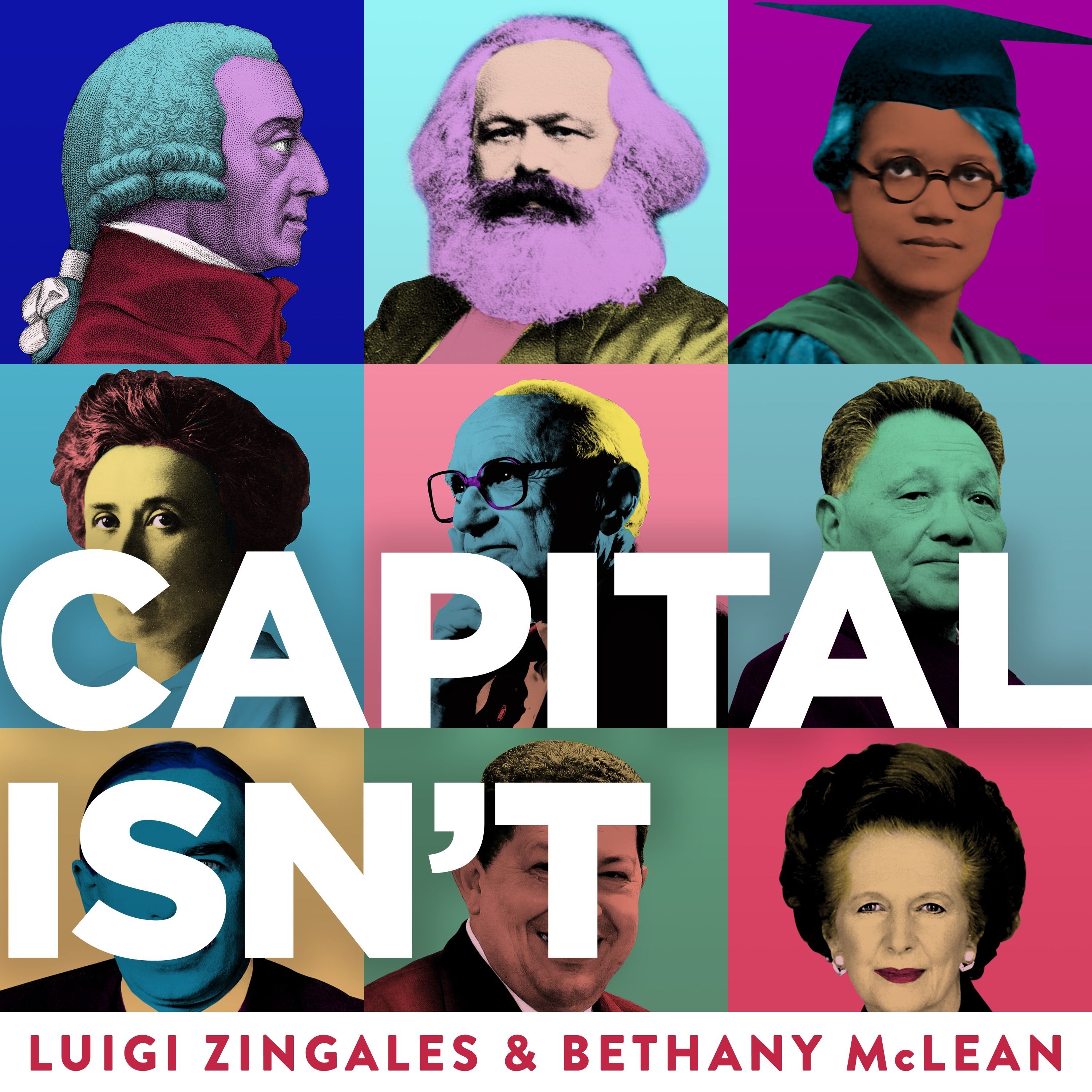
Is capitalism the engine of destruction or the engine of prosperity? On this podcast we talk about the ways capitalism is—or more often isn’t—working in our world today. Hosted by Vanity Fair contributing editor, Bethany McLean and world renowned economics professor Luigi Zingales, we explain how capitalism can go wrong, and what we can do to fix it. Cover photo attributions: https://www.chicagobooth.edu/research/stigler/about/capitalisnt. If you would like to send us feedback, suggestions fo...