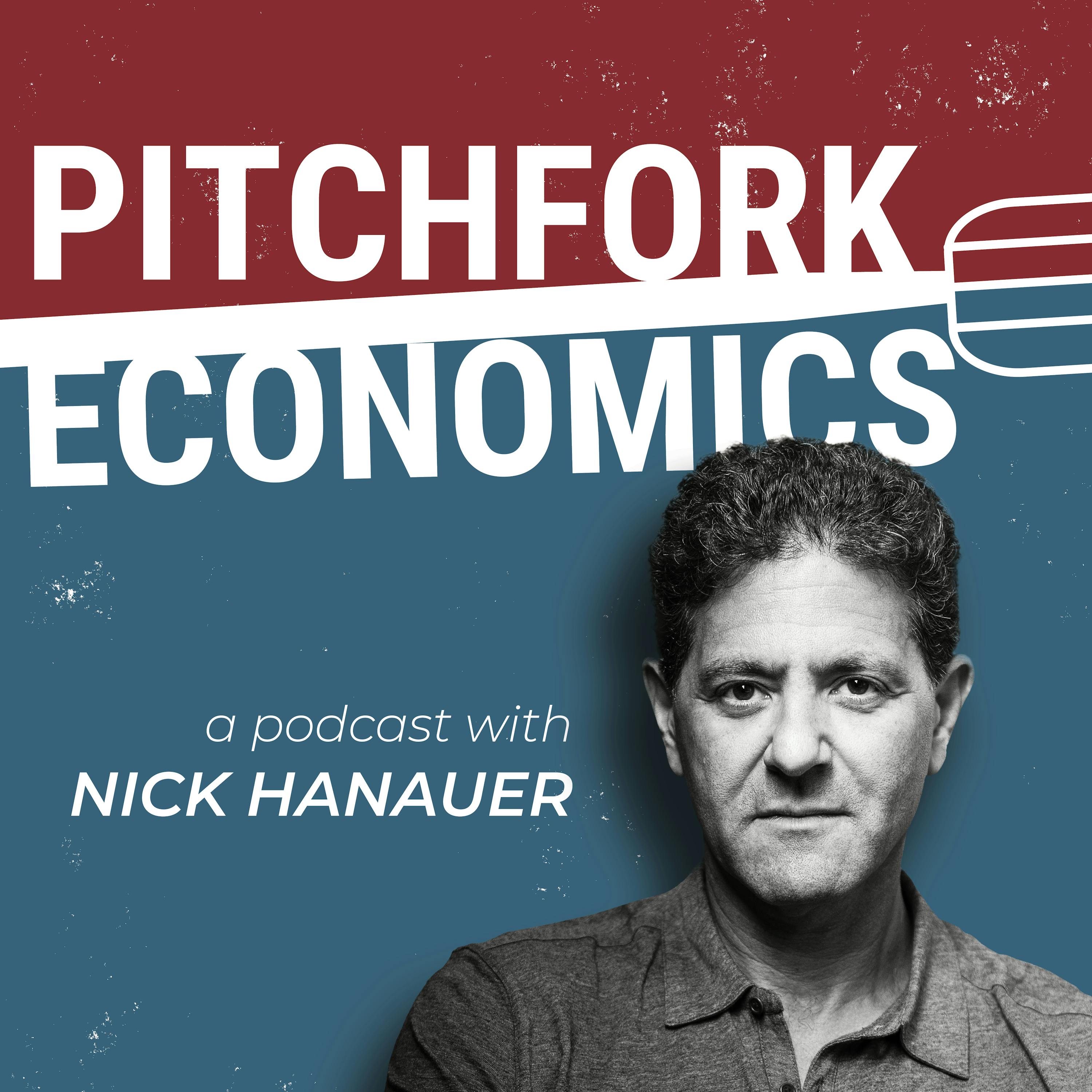
Episode Summary
Executive Summary: The episode argues that voting rights are inseparable from economic outcomes: broad political participation drives inclusive growth, while voter suppression entrenches inequality. Host Nick Hanauer and David Goldstein speak with Andrea Haley of Vote.org about rising youth engagement, state-by-state barriers, vote-by-mail, corporate support, and why making voting easy and accessible is essential to democracy and prosperity.
Main Topics: Voting rights as an economic issue: The hosts frame voting access as foundational to economic inclusion, arguing that economies thrive when political power is broadly shared rather than concentrated at the top. Current voter registration and youth engagement trends: Andrea Haley shares that registration surged in 2019-2020, especially among young voters, and that voting becomes habitual after people participate a few times. Legislative voter suppression and access barriers: The discussion highlights coordinated state-level efforts to restrict registration, early voting, mail ballots, polling hours, and other voting conveniences, often with disproportionate effects on young voters and communities of color. Vote-by-mail and early voting: The conversation defends vote-by-mail as a long-standing, effective, and accessible method that expanded participation during the pandemic and should be more widely available, while preserving in-person options. State-by-state disparities in voting access: Examples like Colorado and California are contrasted with Texas, Mississippi, Indiana, and Georgia, where polling access, long lines, and administrative hurdles make voting much harder. Business and institutional role in democracy: Haley argues corporations, media, schools, and other trusted institutions can promote registration, voting information, paid time off to vote, and support federal voting-rights legislation. Personal and historical stakes of voting rights: Haley explains that her work is personal, rooted in family history and the long struggle of Black Americans to secure and defend the ballot, underscoring that present-day suppression is part of a long pattern.
Key Arguments: Political inclusion precedes economic inclusion; a healthy economy depends on a political system responsive to broad public needs. Voter suppression is not only anti-democratic but also economically harmful because it reduces participation from the very people whose labor and consumption support growth. Many restrictive election policies are intentional and designed to reduce turnout among young voters, people of color, and lower-income citizens. Automatic voter registration and online registration significantly increase participation and should be expanded. Vote-by-mail is a proven, cost-effective way to increase access and should be broadly available nationwide, alongside in-person early voting for those who need it. Long lines, limited polling places, and restrictions on assistance like water or food are policy choices, not inevitabilities, and should be eliminated. Businesses have both a civic responsibility and practical ability to support democratic participation through employee education, paid time off, and advocacy for pro-voter legislation. The right to vote remains fragile and has historically expanded only when elites faced pressure from ordinary people demanding access. High turnout and engagement in 2020 show that many Americans are paying attention and are willing to fight for their voice to be heard.
Data Points: Voters registered by Vote.org last year: Over 4 million - Andrea Haley describes Vote.org's voter registration output during the prior election cycle. People turning 18 each year: 4 million - Haley notes the annual influx of new eligible voters. Eligible population using Vote.org last year: About 16% - Haley estimates Vote.org reached roughly one-sixth of eligible voters during the 2020 cycle. People registered by Vote.org so far this year: About 70,000 - Haley contrasts off-cycle registration levels with the prior presidential cycle. Increase in young voter participation in 2020: 11% jump - Haley says youth turnout rose sharply in the last election cycle. States with automatic voter registration: 20 states plus Washington, D.C. - Haley identifies jurisdictions where government interaction can opt people into registration unless they opt out. Voter-suppression bills introduced: 400 bills - Haley cites coordinated post-2020 legislative efforts to restrict voting access nationwide. Waiting time disparity in Georgia: White voters wait about an hour less than Black voters - Haley uses this as an example of policy-driven inequity in access to polling places. Polling places opened in Indiana: Five polling places for over a million people - Haley describes severe under-provision of polling locations as a cause of long lines. Early voting line in Indiana: Seven-hour line - Haley recounts her own experience trying to vote in Indiana. Line difference in Carmel, Indiana: 10 minutes - A nearby, less diverse suburb had dramatically shorter wait times than her area. Corporate partners working with Vote.org: Over 1,000 - Haley says many companies partnered with Vote.org to encourage voting. Voters registered through USA Today partnership: Over 100,000 - Haley cites a media partnership that added registration links to articles.
Pivotal Quotes: "The rising inequality and growing political instability that we see today are the direct result of decades of bad economic theory." — Nick Hanauer: Opening framing for why voting rights matter to economics and democracy. "We had 400 bills that were introduced in a coordinated fashion all across the country, looking to roll back people's ability to participate." — Andrea Haley: Haley summarizes the scale of post-2020 voter-restriction efforts. "It really would be so easy to not create this situation at all." — Andrea Haley: Haley argues that long lines and barriers are policy failures, not necessary features of elections.
Implications: The episode urges listeners to treat voting access as a core economic and civic issue. Expanding registration, vote-by-mail, and turnout protections could strengthen democracy, reduce inequality, and improve long-term economic performance.
About Pitchfork Economics
We are living through a paradigm shift from trickle-down neoliberalism to middle-out economics — a new understanding of who gets what and why. Join zillionaire class-traitor Nick Hanauer and some of the world’s leading economic and political thinkers as they explore the latest thinking on how the economy actually works.