Episode Summary
Executive Summary: The episode revisits a conversation with political economist Mark Blyth about why trickle-down economics persists despite repeated failure. Blyth argues that inequality, precarity, and weak social safety nets have fueled anger and instability, while middle-out, state-enabled transition strategies—especially for decarbonization—offer a more workable path than austerity, tax cuts, or simplistic market fixes.
Main Topics: Why trickle-down economics won’t die (Priority: 5/5): The hosts and Blyth discuss how conservative governments in the UK and US continue recycling failed supply-side ideas even as evidence and public criticism mount. Anger, inequality, and political instability (Priority: 5/5): Blyth explains anger as both moral outrage and tribal identity, linking it to inequality, insecurity, and institutions that no longer feel fair or protective. Macro-angrenomics and precarious labor (Priority: 5/5): He distinguishes financial crisis management that protects asset holders from labor-market precarity that leaves workers insecure, volatile, and politically alienated. Growth models and financialized economies (Priority: 4/5): Blyth outlines his growth-model framework, emphasizing that modern growth depends on international finance, exchange rates, and political coalitions rather than simple domestic productivity stories. UK political and economic dysfunction (Priority: 5/5): The conversation criticizes Brexit, austerity, and the Truss-era tax-cut agenda as fantasy economics that ignore the weakened state and intensify instability. Energy transition and decarbonization strategy (Priority: 5/5): Blyth argues for state capacity, public finance, and coordinated climate policy to speed the energy transition, warning that delay increases total cost and risk. Economics as a language of power (Priority: 4/5): Blyth frames economics not just as analysis but as a political tool used to define efficiency, justify distributional choices, and shape public policy.
Key Arguments: Trickle-down policies have repeatedly failed and now face broader public skepticism than they did decades ago. Long-term inequality and weakened reciprocity norms undermine social cohesion and make democratic systems more fragile. Anger in politics can stem from moral outrage, tribal identity, and lived precarity; it is not simply irrational. Financial crises often protect top asset holders at the expense of taxpayers and lower-income households, deepening distrust. Precarious work, income volatility, and weak public insurance create stress that no minimum-wage increase alone can fix. The UK’s current problems stem from austerity, Brexit, and a fantasy that tax cuts can solve supply-driven inflation. Decarbonization is unavoidable; the real choice is whether to do it quickly and cheaply or slowly and at greater cost. A successful transition requires state capacity and private finance working together, not just nudges or pure public ownership. Carbon taxes at the “right” level are politically unrealistic; targeted investment, phaseouts, and public coordination are more feasible. Economics is often used to rationalize who gets what and why, giving political power to whoever defines ‘efficiency.’
Data Points: Time span of trickle-down era: 50 years - Hosts and guest refer to decades of trickle-down economics and its failures. Minimum wage example: Double the national minimum wage - Blyth says wage hikes alone do not solve precarity if contracts remain unstable. UK banking bonus cap history: Post-2008 financial crisis - Blyth references Gordon Brown’s cap on bankers’ bonuses and the later rollback under Truss. Public debt financing window: Early 2000s - Blyth says governments missed a chance to refinance debt at negative real rates. Renewable investment yield: Around 6% - Used to illustrate the potential for sovereign wealth fund-backed green investment. Inflation assumption in transition example: Drops to 4% - Blyth describes how lower inflation would improve the economics of targeted green lending. Heat pump quote: $22,000 bid - Goldstein cites his own home electrification estimate to discuss transition costs. Inflation Reduction Act rebate: $8,000 tax credit/rebate - Used as an example of public support for decarbonization investment. Mining lead time: 7 years - Blyth says mines can take years to develop, slowing clean-energy supply chains. Refinery lead time: 10 years - He notes refining capacity takes even longer to build than extraction. Watford-Everton match: Bottom of the barrel - A humorous anecdote Blyth uses to explain anger, group identity, and regulation. Share of exports to EU (Nissan factory example): 90% - Used to show why Brexit-related economic claims rang hollow to workers. Irish GDP concentration: 50% of GDP comes out of Dublin - Blyth uses Ireland to illustrate how growth is increasingly geographically concentrated.
Pivotal Quotes: "The last five decades of trickle-down economics haven't worked. But what's the alternative? Middle-out economics is the answer." — Intro narration: Sets up the episode’s central economic contrast and the reason for re-airing the interview. "If you build an economy that systematically makes things tougher for the bottom nine deciles every single year for 40 or 50 years, it should not surprise you that at some point they want to burn the whole damn thing down." — Mark Blyth: Explains the link between long-run inequality and political anger/instability. "You can't print a new planet, but you can print money." — Mark Blyth: Argues that climate action should not be blocked by overly narrow fiscal fears.
Implications: Listeners should see inequality, insecurity, and climate policy as linked political-economy problems, not isolated issues. The episode argues for stronger public capacity, faster decarbonization, and abandoning failed supply-side myths.
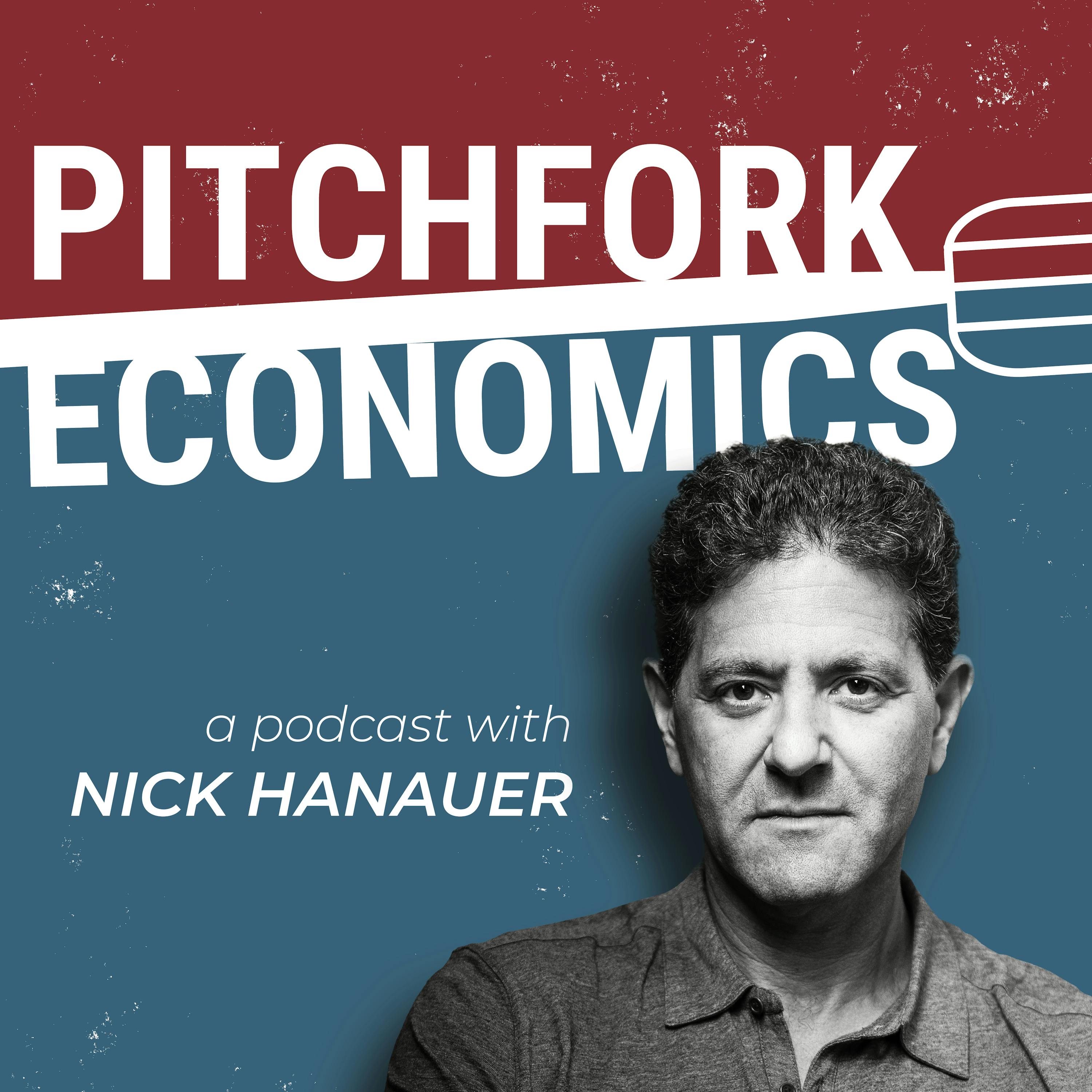
About Pitchfork Economics
We are living through a paradigm shift from trickle-down neoliberalism to middle-out economics — a new understanding of who gets what and why. Join zillionaire class-traitor Nick Hanauer and some of the world’s leading economic and political thinkers as they explore the latest thinking on how the economy actually works.