Episode Summary
Executive Summary: The episode examines how George Floyd’s murder exposed deep mistrust between Black Americans and police, then explores governance failures, union power, and reform options through interviews with a police board chair, economists, and a police-behavior researcher. The consensus: policing is a monopoly with weak accountability, but solutions are complex and require better oversight, data, and potentially a reallocation of tasks and funding.
Main Topics: George Floyd, protests, and anti-Black policing: The episode opens by framing Floyd’s killing as a catalyst for global protests and a reminder that policing is experienced very differently by Black Americans, for whom police often represent fear rather than safety. Police governance and disciplinary oversight in Chicago: Guillaume Foreman explains the Chicago Police Board’s role in major discipline cases and how traumatic complaint processes, procedural rules, and limited access to records constrain oversight. Police unions and accountability constraints: The conversation argues that police unions can hinder discipline, shape what oversight bodies can review, and increase the political power of officers and unions over mayors and city governments. Defunding as reallocation and social investment: Guests debate what “defund the police” means, often reframing it as shifting resources from policing to schools, parks, mental health, homelessness, and workforce supports to address root causes of violence. Public-sector unions as a monopoly problem: Caroline Hoxby and Luigi Zingales argue that public-sector unions differ from private-sector unions because taxpayers are fragmented and cannot effectively counter union power, creating governance failures. Empirical research on policing, race, and outcomes: Bokar Ba discusses Chicago research on race-matched policing, officer behavior, drug arrests, complaint data, depolicing, and the difficulty of linking police and court data to measure true productivity. Potential reform models: specialization, competition, and federal oversight: The hosts suggest breaking policing into specialized forces and/or creating stronger centralized standards to benchmark departments and reduce local capture and racial bias.
Key Arguments: Police often function as a source of anxiety for Black Americans rather than a protective public service, making everyday life feel shaped by risk and surveillance. Police boards face structural limits because union contracts and state rules can prevent them from seeing older disciplinary histories or using all available evidence. The police union and similar public-sector unions can become more focused on protecting members than serving the public, weakening accountability. Defunding is better understood as reallocating some public-safety spending to social services that may reduce the conditions that generate crime. Public-sector unions are fundamentally different from private-sector unions because taxpayers are diffuse and cannot discipline monopoly power through market competition. Police departments hold a local monopoly on violence, which gives them strong leverage over elected officials who fear crime increases and electoral punishment if they push too hard. Research suggests officer race can matter, but effects are multidimensional: Black officers may be less aggressive toward Black civilians, while Hispanic officers may not behave the same way as Black officers. Arrest counts are an imperfect measure of police productivity because they do not reveal whether arrests were justified, dismissed, or lead to convictions. Data access is a major barrier to oversight and research because police departments and prosecutors control separate datasets and often resist transparency. More centralized oversight and competition among policing units could improve accountability and reduce capture by any single department or local political coalition.
Data Points: George Floyd timeline: Two and a half weeks ago - The episode begins by situating the discussion shortly after Floyd’s killing and the ensuing protests. Charge against Derek Chauvin: Second-degree murder - Mentioned early as the criminal charge filed after Floyd’s death. Chicago Police Board disciplinary threshold: 30 days of suspension to termination - Foreman explains the board handles the most serious discipline cases. Record lookback limit: 5 years - The board cannot review disciplinary history older than five years in certain cases. Serious terminations handled yearly in Chicago: About 15 to 20 a year - Foreman gives an estimate of the number of termination cases reaching the board. Chicago police force size: 13,000 - Foreman states the size of the police core when discussing termination volume. Chicago public safety budget (2018): $2.5 billion - Bokar Ba cites total public-safety spending in Chicago. Share of public safety budget going to police: 62% - Ba says most public safety funding goes to the Chicago Police Department. Chicago Police Department budget (2018): $1.5 billion - Derived from the public-safety budget figure and explicitly stated by Ba. Chicago community services budget (2018): $640 million - Ba compares this to police spending when discussing defunding/reallocation. Local election turnout: 15% to 20% - Hoxby argues low turnout makes local politicians vulnerable to public-sector union influence. Officer race and assignment pattern: Black officers to Black neighborhoods, white officers to white neighborhoods, Hispanic officers to Hispanic neighborhoods - Ba describes observational patterns in Chicago policing.
Pivotal Quotes: "“The police are the reason not to go for a run or a walk in certain streets.”" — Narrator/host: Used to illustrate how policing shapes Black Americans’ daily behavior and sense of safety. "“The police are an absolute monopoly and monopoly with guns, which is the worst kind of monopoly.”" — Luigi Zingales: Core framing of police power as a governance and competition problem. "“I think we ought to defund the police and I don’t trust them.”" — Caroline Hoxby: Her blunt position on policing and her argument for reallocating funding to alternatives.
Implications: The episode suggests reform will require more than symbolic condemnation: better data, stronger oversight, reduced union capture, and redesigned public-safety systems that shift some work away from armed policing.
About Capitalisnt
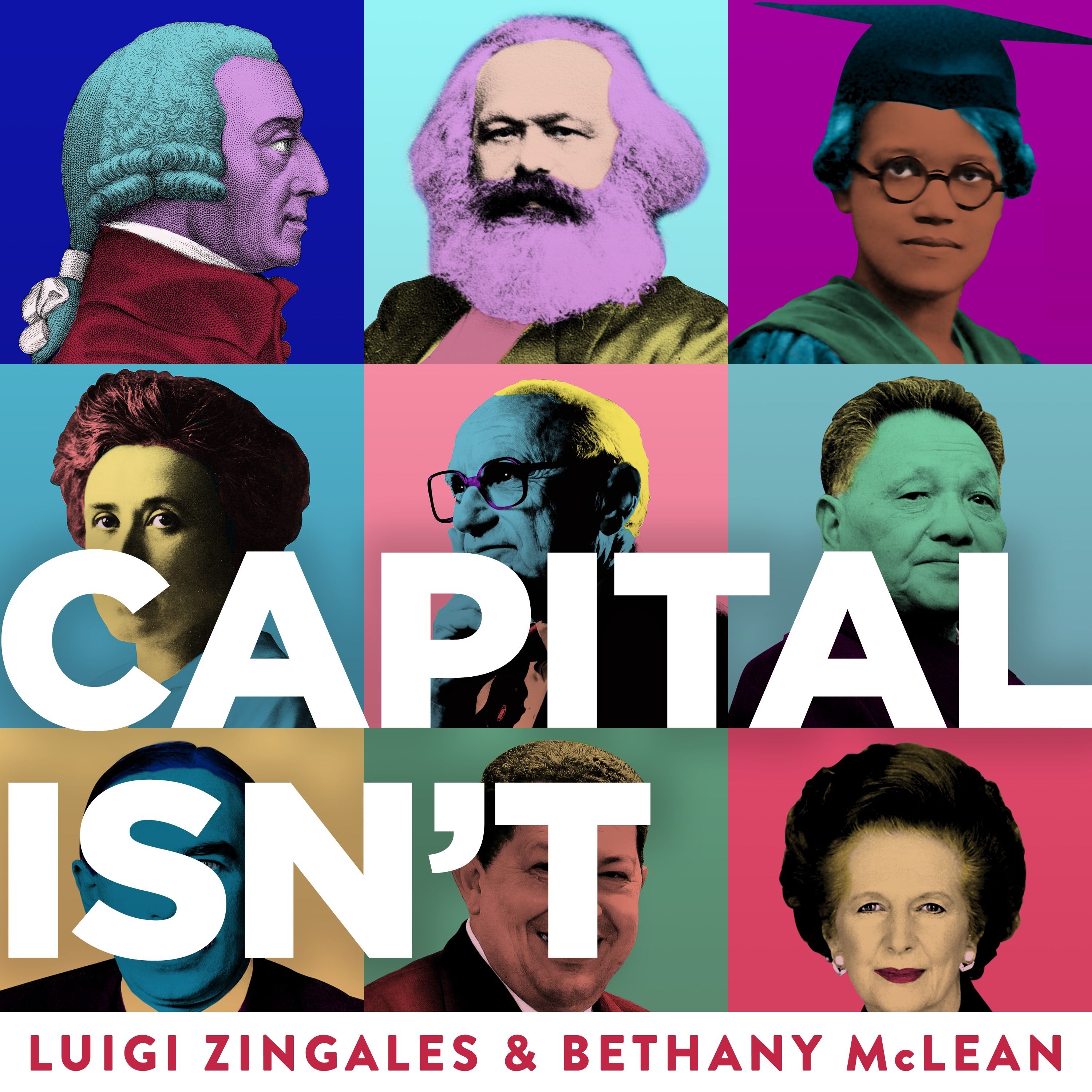
Is capitalism the engine of destruction or the engine of prosperity? On this podcast we talk about the ways capitalism is—or more often isn’t—working in our world today. Hosted by Vanity Fair contributing editor, Bethany McLean and world renowned economics professor Luigi Zingales, we explain how capitalism can go wrong, and what we can do to fix it. Cover photo attributions: https://www.chicagobooth.edu/research/stigler/about/capitalisnt. If you would like to send us feedback, suggestions fo...