Episode Summary
Executive Summary: The episode argues that coronavirus should be treated as a public-health emergency, not a reason to prioritize markets or profits. Luigi and Kate discuss Italy’s lockdown, hospital capacity, supply-chain disruptions, panic-driven market declines, and the need for rapid targeted government intervention, testing, paid leave, and social distancing. They also note possible long-term shifts toward remote work and virtual meetings.
Main Topics: Public health must take precedence over economic panic: The hosts argue that early, strict intervention is justified because delayed action raises deaths and overloads hospitals; economic losses are serious but smaller than the value of lives saved. Italy as an early warning case: Luigi describes northern Italy’s isolation, especially around Padova and Lombardia, as a real-time example of how fast the crisis is spreading and why ICU capacity matters. Market turmoil and economic uncertainty: They discuss stock sell-offs, fear effects, and how uncertainty can freeze investment and consumer spending, with particular concern about credit markets. Supply chains vs. demand shock: The conversation weighs whether the larger U.S. impact will come from supply disruptions linked to China or from reduced travel, retail activity, and consumer demand. Government intervention and social policy: They debate targeted fiscal policy, paid sick leave, testing, masks, hand sanitizer, and government provision of critical goods as necessary responses when markets fail. Political incentives and public trust: The hosts criticize the U.S. response as shaped by special interests and the political cycle, contrasting it with more decisive action in countries like Singapore, Taiwan, Korea, and China. Long-term behavioral changes and opportunities: They suggest the crisis could normalize telecommuting, virtual conferences, and less travel, potentially producing environmental benefits and lasting workplace changes.
Key Arguments: Rapid intervention is economically rational because uncontrolled spread overwhelms ICU capacity and increases mortality sharply. The official response in the U.S. has been too slow and too influenced by political and business interests. A purely market-based response fails in shortages of masks and sanitizer because equitable access, not bidding power, is the efficient outcome in a pandemic. The main U.S. economic damage is likely to come from demand shock, travel declines, service-sector weakness, and fear-induced delays in spending and investment. Credit-market stress is more alarming than stock-market volatility because frozen lending can cripple small and medium-sized firms. Targeted fiscal relief should focus first on paid leave, business continuity, and health spending rather than broad stimulus packages. Testing has a positive externality, so public funding and universal health coverage are important for controlling spread. The pandemic may accelerate remote work, online teaching, and virtual meetings, with possible climate benefits from reduced travel.
Data Points: Northern Italy spread rate: 25% a day - Luigi says the epidemic was growing fast enough to justify emergency restrictions. Lombardia mortality rate: 6.4% - Compared with the rest of Italy, this was cited as evidence that overwhelmed hospitals raise deaths. Rest of Italy mortality rate: 2.8% - Used as contrast to Lombardia in the hospital-capacity argument. U.S. deaths at 1% fatality among infected: 400,000 - Luigi’s back-of-the-envelope estimate for a less severe U.S. outbreak scenario. Additional U.S. deaths at 3% fatality: 800,000 more - Estimate if hospital capacity is overwhelmed like Wuhan. Statistical value of a life: $9 million - Used to translate mortality into economic cost. Estimated economic value of extra deaths: $7.2 trillion - Luigi’s calculation based on 800,000 additional deaths times $9 million each. GDP loss, mild outbreak: 0.7% - World Bank estimate for high-income countries, compared to the 1968 Hong Kong flu. GDP loss, moderate outbreak: 2% - World Bank estimate for high-income countries, based on the 1957 Asian flu. GDP loss, severe outbreak: 5% - World Bank estimate for high-income countries, based on Spanish flu scenarios. Likely GDP loss estimate: ~1.5% - Luigi’s midpoint guess between mild and moderate historical scenarios. U.S. coronavirus cases at earlier planning stage: around 100 - Kate says this was the level a couple of weeks earlier when the seriousness was less clear. SARS Hong Kong stock decline: about 2% - Kate cites this as evidence markets can recover quickly after outbreaks. Hong Kong tourism decline during SARS: 63% - Used to illustrate near-term economic damage from disease outbreaks. Hong Kong retail sales decline during SARS: 15% - Another example of outbreak-related demand weakness. Fed rate cut: 50 basis points - The episode references the emergency rate cut to counter coronavirus effects. 30-year U.S. Treasury yield: less than 1% - Cited to argue the government can borrow cheaply for emergency spending.
Pivotal Quotes: "if you take this as a war, in time of war, you do extreme measures, and we are in a war to slow down this disease." — Luigi: Explaining why aggressive public-health interventions are justified despite economic costs. "I think the response in the United States has not been, in my view, effective and prompt, and I think has been quite contaminated by special interests." — Luigi: His critique of the U.S. response and policy priorities. "We are in a state of panic. And so, the longer we go before taking extreme measures, the worse it's going to get." — Kate: Arguing that delays in social distancing worsen both health and economic outcomes.
Implications: The episode frames coronavirus as a test of governance: act early, protect health, support workers and firms, and accept short-term economic pain to avoid a much larger crisis. It also hints that remote work and virtual coordination may become permanent.
About Capitalisnt
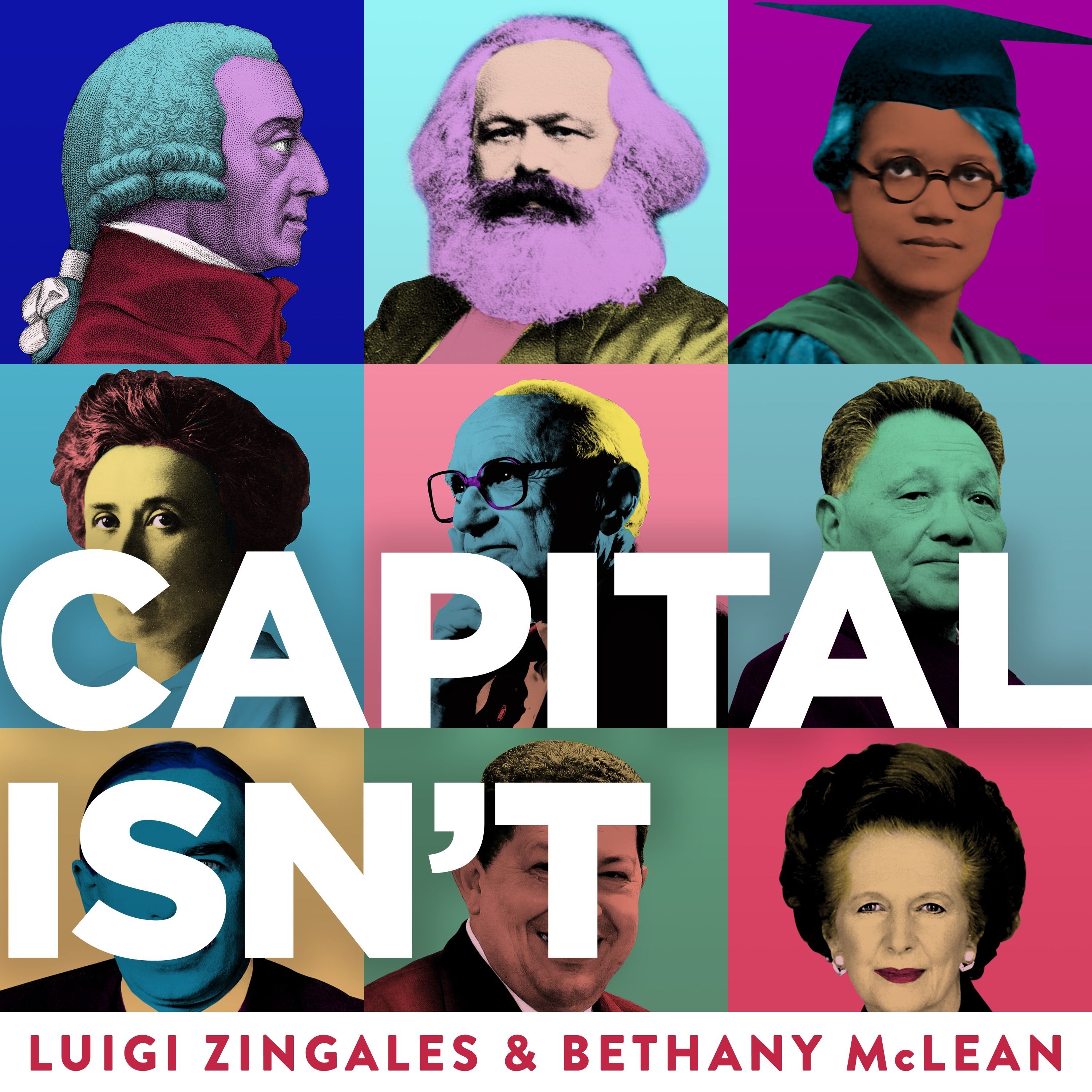
Is capitalism the engine of destruction or the engine of prosperity? On this podcast we talk about the ways capitalism is—or more often isn’t—working in our world today. Hosted by Vanity Fair contributing editor, Bethany McLean and world renowned economics professor Luigi Zingales, we explain how capitalism can go wrong, and what we can do to fix it. Cover photo attributions: https://www.chicagobooth.edu/research/stigler/about/capitalisnt. If you would like to send us feedback, suggestions fo...