Episode Summary
Executive Summary: The episode debates whether Elon Musk's purchase of Twitter improves society, weighing free-speech and product-innovation promises against debt pressure, advertiser flight, moderation risks, and conflicts of interest. The hosts conclude Musk may make Twitter a more revealing experiment about social media's problems, but it's unclear whether that makes the world better or simply more interesting.
Main Topics: Musk's Twitter acquisition: better product or risky takeover?: The hosts frame the central question around whether Musk can improve Twitter's user experience and public value, or whether his unpredictable style and unclear strategy will damage the platform. Profit pressure and the debt burden: A major theme is that the $44 billion deal leaves Musk under heavy financial pressure, making profitability a necessity rather than a choice and constraining his ability to pursue a pure 'speech' agenda. Content moderation and advertiser incentives: They argue that moderation decisions are shaped by business realities: advertisers want a pleasant, brand-safe environment, while toxic engagement can raise activity but hurt long-term trust. Blue checks, identity, and platform design: The proposed $8 blue-check subscription is debated as both a democratizing tool and a possible threat to Twitter's status-driven ecosystem and celebrity participation. Transparency, data use, and conflicts of interest: The discussion raises concerns that Musk's ownership could create opaque incentives involving Tesla, China, and Twitter data, even as he promises algorithmic transparency. Social media culture, truth, and diversity of viewpoints: The hosts compare Twitter with Facebook, YouTube, and Instagram, arguing that moderation failures, toxicity, and political bias are broader platform-wide issues, not uniquely Twitter's.
Key Arguments: Musk must maximize profits because the deal structure and debt service leave him little choice; this will shape every major Twitter decision. Even a profit-maximizing Twitter would still care about moderation because advertisers will avoid a toxic environment and users need a pleasant experience. The $8 blue-check fee could reduce bots, create revenue, and let users filter out accounts they don't want to see, but it may also alienate celebrities and shrink the platform's core influence. Blue-check verification may not stop manipulation by foreign actors if they can pay and pass identity checks, so the benefit is partial rather than absolute. Musk's public commitment to transparency should be treated skeptically because he is a storyteller and may not fully reveal how algorithms or data are used. Twitter's value is partly in cross-disciplinary conversation and discovery, but much of its engagement also comes from toxicity and celebrity attention, both of which are fragile business inputs. The acquisition could expose problems common to all social media platforms and make moderation debates more honest, even if Twitter itself suffers. Musk's ownership raises special concerns because of his other businesses, especially Tesla's exposure to China, where Twitter decisions could be influenced in ways outsiders cannot easily detect.
Data Points: Deal value: $44 billion - Purchase price for Twitter discussed as the scale of the acquisition. Twitter daily losses: $4 million a day - Musk disclosed this as a sign of immediate financial pressure. Advertising share of revenue: 90% - Twitter's revenue dependence on advertising was cited to explain why advertisers matter so much. Employee layoffs: about half of 7,500 employees - Reported layoffs shortly after Musk took control were discussed as a cost-cutting signal. Debt amount: $13 billion - Bank-financed debt tied to the transaction was raised as a major risk. Blue-check fee: $8 per month - Musk's proposed charge for verification was debated as a new business model. Potential subscriber base: 150 million people - Used in discussion of how much revenue the blue-check model could generate if widely adopted. User pay rate scenario: 10% paying regularly - A hypothetical used to argue the subscription could cover interest expenses.
Pivotal Quotes: "Does Musk's acquisition of Twitter make the world a better place?" — Bethany McLean: The episode's central framing question at the start of the discussion. "I follow the money, don't follow the story, follow the money." — Luigi Zingales: Used to argue that debt and profitability will drive Musk's behavior more than his public narrative. "I think the world is a better place, in my view, because, number one, as you said, he's going to try different routes, which are desperately needed." — Luigi Zingales: Final defense of the acquisition as a useful experiment in platform diversity and moderation reform.
Implications: For listeners and the industry, the episode suggests Musk's Twitter will test whether profit-driven moderation, subscription verification, and transparency can fix social media's flaws—or whether financial pressure and opaque incentives make things worse.
About Capitalisnt
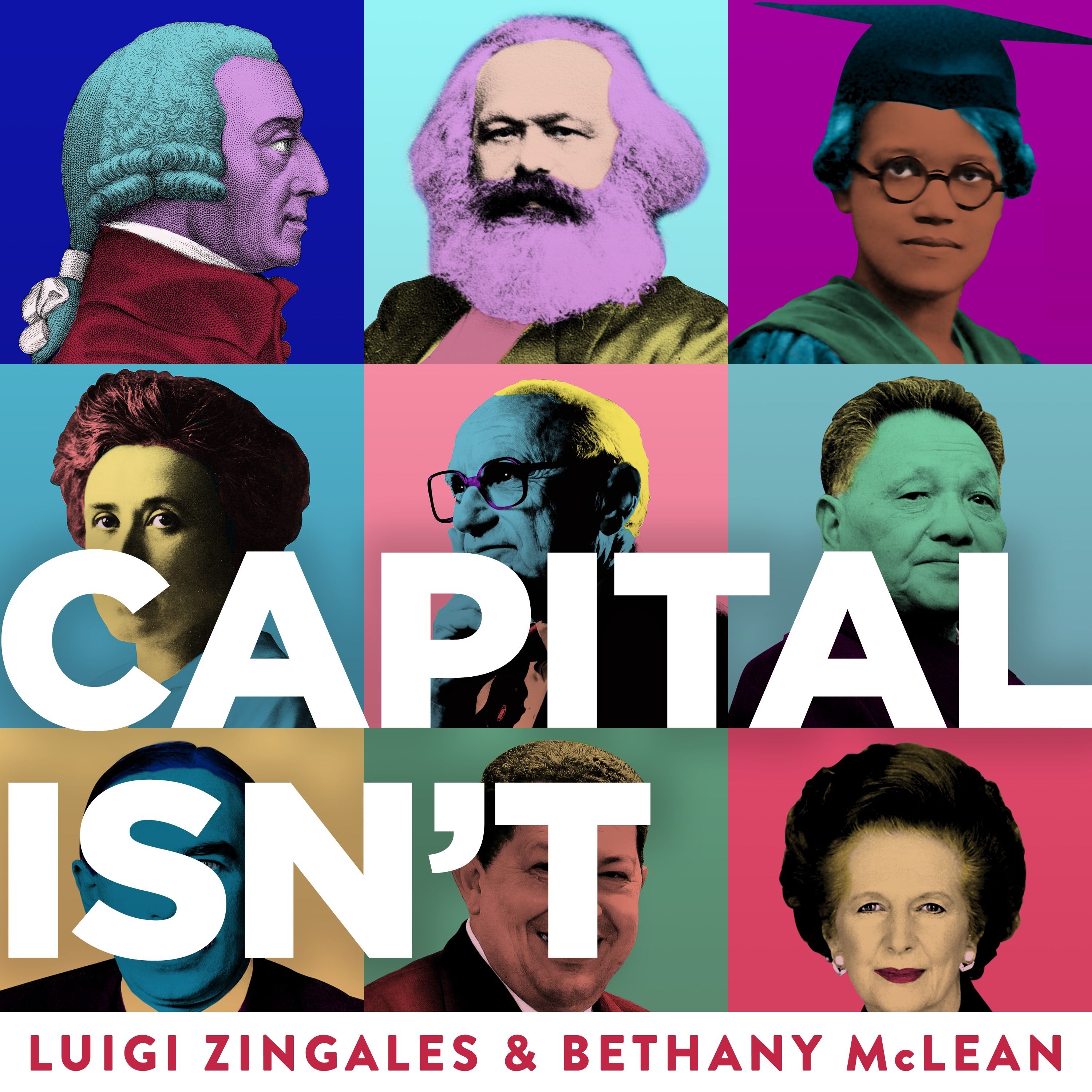
Is capitalism the engine of destruction or the engine of prosperity? On this podcast we talk about the ways capitalism is—or more often isn’t—working in our world today. Hosted by Vanity Fair contributing editor, Bethany McLean and world renowned economics professor Luigi Zingales, we explain how capitalism can go wrong, and what we can do to fix it. Cover photo attributions: https://www.chicagobooth.edu/research/stigler/about/capitalisnt. If you would like to send us feedback, suggestions fo...