Episode Summary
Executive Summary: The episode examines whether the U.S. tax system is truly progressive once all taxes are counted, not just income taxes. Drawing on Saez and Zucman’s research, the guests debate why billionaires may face lower effective rates than upper-middle-class households, how corporate and wealth taxes could restore progressivity, and whether multinationals’ profit shifting is the bigger scandal. They also weigh risks to innovation, antitrust as an alternative tool, and the politics of taxing the ultra-rich.
Main Topics: Measuring total tax burden beyond income tax: The discussion explains that effective tax rates should include payroll, sales, property, excise, corporate, and local taxes—not just federal income tax—because those are ultimately borne by individuals across the income distribution. Why billionaire effective tax rates can be lower: Saez argues that at the very top, especially among the top 400 households, wealth comes from unrealized gains and corporate ownership, so income taxes can be low or near zero unless assets are sold or dividends are received. Wealth tax and restoring progressivity: The guests debate whether an annual wealth tax is the best tool to raise top-end tax burdens and whether a combined package could push top average rates materially higher without relying solely on income tax. Multinational tax avoidance and profit shifting: A major focus is how multinationals shift profits to tax havens, allowing companies like Amazon, Google, and Skype-related structures to pay far less than statutory rates imply; Saez/Zucman propose a remedial global minimum-style tax. Taxation versus antitrust and competition policy: Zingales argues that competition policy may be a better way to reduce durable wealth concentration by eliminating rents, while Saez says taxation and competition are complementary tools. Innovation, entrepreneurship, and tax incentives: The speakers debate whether wealth taxes and higher top-end taxes would deter entrepreneurs or innovators, with Saez arguing taxes mostly hit after success and Zingales noting evidence that talent does respond to tax differences. Political backlash, think tanks, and academic debate: Saez describes intense criticism and rapid-response attacks from think tanks, while the hosts discuss how media exclusives and the pace of public debate can outrun peer review.
Key Arguments: Effective tax rates should be measured comprehensively, because payroll, sales, property, excise, and corporate taxes materially change who bears the burden. The U.S. tax system is flatter than commonly assumed; after all taxes are counted, middle- and upper-middle-income households can face rates similar to or higher than those of some billionaires. Billionaires often pay low taxes because they can defer realization of capital gains, receive no dividends, and benefit from loopholes like step-up in basis at inheritance. Corporate tax avoidance is a major driver of low top-end taxation, and existing data would allow governments to impose remedial taxes on profits shifted to tax havens. A wealth tax is presented as the most direct way to tax those whose wealth is tied up in appreciating assets rather than current taxable income. Antitrust and competition policy can reduce concentrated wealth by breaking rents and forcing oligarchic wealth to erode through market competition. Concerns about innovation and entrepreneurship are real but uncertain; Saez argues the wealth tax would mostly affect people after they have already succeeded. Critics’ strongest point is that taxation is only the revenue side of government; redistribution also depends on how the proceeds are spent. The controversy around the book reflects both methodological disputes and the political organization of think tanks and interest groups. The current multinational tax system is dysfunctional, but not technically inevitable; policy could force firms to pay a minimum level of tax wherever they earn profits.
Data Points: Luigi Zingales estimated total tax rate: 31% - He says his ballpark combined tax burden last year was about 31%. Kate Waldock estimated total tax rate: 30% - She says her combined tax burden was maybe around 30%. Saez/Zucman estimate for richest 400 households: 23% - They estimate the overall tax rate on the richest 400 households in 2018. Comparable tax rate for households around $100,000: ~30% - Used as a contrast to the richest 400 households. Payroll tax rate: 15% - Saez says payroll taxes start on the first dollar, creating a significant burden even at low wages. Total tax rate at bottom of distribution: ~25% - Saez summarizes that tax rates at the bottom are in the low-to-mid 20s once all taxes are included. Average economy-wide tax rate: 28% - Saez refers to this as the macro average. Corporate tax rate before Trump tax cut: 35% - Zingales references the pre-cut statutory corporate rate. Corporate tax rate after Trump tax cut: 21% - Used to illustrate lower corporate taxation on profits. Capital gains tax rate: 20% - Zingales notes this rate applies when billionaires realize gains. Potential combined statutory burden on Bezos-like income: ~36% - Zingales calculates 21% corporate tax plus 20% capital gains as roughly 36% in a no-loophole scenario. Tax on Cristiano Ronaldo in Italy: €100,000 - Used as an example of a special low-tax regime for foreign players and executives. Skype IP transfer price: €25,000 - Example of multinationals shifting value into a tax haven before a multibillion sale. Skype sale value: $3+ billion - Used to show the scale of profit shifting through intellectual property transfers. Potential wealth tax rate discussed: 1%–3% or more - Saez says an annual wealth tax at these levels would meaningfully raise top-end taxes. Proposed graduated wealth tax scale: 1% to 8% (up to $10 billion threshold) - Zingales references Bernie Sanders-style graduated wealth tax proposals.
Pivotal Quotes: "the overall tax rate on the richest 400 households in 2018 was only 23%" — Luisa Zingales: Introductory setup highlighting why the topic caused controversy. "if you wanted, you know, to increase the tax rate, the average tax rate at the top to about 60%, which corresponds, roughly speaking, to a 75% marginal tax rate, you could do it through a combination" — Emmanuel Saez: Saez explains how a package of corporate tax reform, wealth tax, and income-tax fixes could raise top-end burden. "the current system of taxation, especially a corporation, is definitely a capital isn't" — Emmanuel Saez: Final verdict on whether current tax rules support capitalism.
Implications: The episode suggests top-end taxation is less progressive than many assume, and that reform may require wealth taxes, stronger corporate enforcement, and anti-avoidance rules. It also shows that tax policy is politically contested and tied to broader debates over inequality, innovation, and market power.
About Capitalisnt
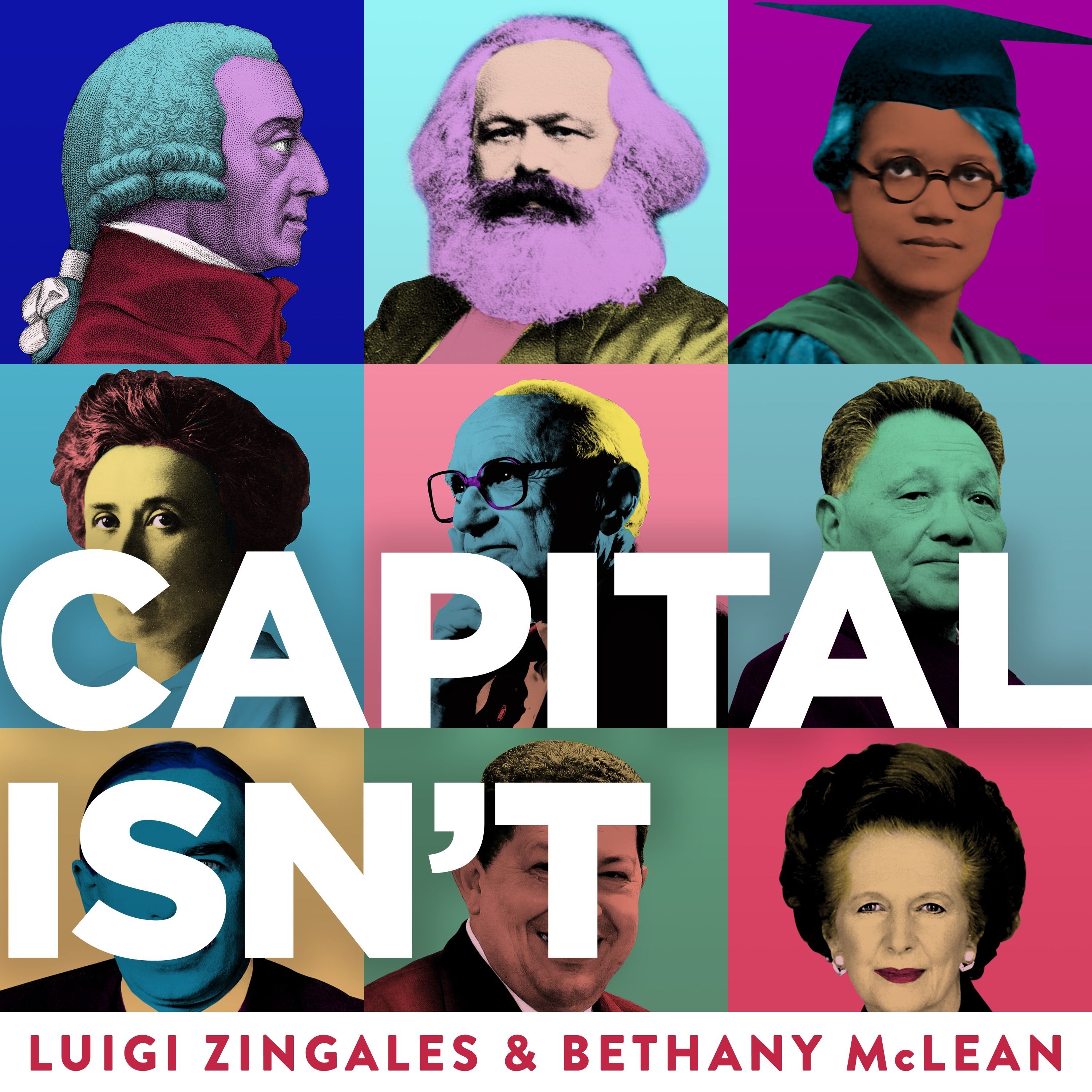
Is capitalism the engine of destruction or the engine of prosperity? On this podcast we talk about the ways capitalism is—or more often isn’t—working in our world today. Hosted by Vanity Fair contributing editor, Bethany McLean and world renowned economics professor Luigi Zingales, we explain how capitalism can go wrong, and what we can do to fix it. Cover photo attributions: https://www.chicagobooth.edu/research/stigler/about/capitalisnt. If you would like to send us feedback, suggestions fo...