Episode Summary
Executive Summary: The episode examines the DOJ’s antitrust case against Google’s advertising business, arguing it may be stronger than the search case because it targets Google’s control over the ad-tech stack, opaque auction practices, and alleged bid manipulation. Dina Srinivasan explains how Google’s buy-side, sell-side, and exchange roles let it influence prices, harm publishers and advertisers, and potentially raise costs across the internet.
Main Topics: Google’s ad-tech market structure: Explains how online ads are bought and sold through exchanges, with Google controlling major buy-side tools, the dominant sell-side tool, and the largest ad exchange. Antitrust conduct and alleged self-dealing: Details DOJ allegations that Google tied products together, routed traffic to its own exchange, and used hidden auction rules to advantage itself over rivals and customers. Header bidding versus Google restrictions: Describes how publishers used header bidding to bypass Google’s controls, and how Google allegedly responded with Dynamic Allocation, Open Bidding, and other tactics to suppress competition. Project Bernanke and bid manipulation: Discusses allegations that Google secretly altered bids—sometimes through multiple bids—to reduce publisher revenue and improve its own auction outcomes. Jedi Blue and the smoking gun: Covers the alleged Google-Facebook agreement that appears to divide market behavior and fix quantities, presented as particularly strong evidence of collusion. Consumer harm and broader market effects: Connects ad-tech pricing to higher consumer prices, worse publisher economics, paywalls, and the weakening of journalism and free internet content. Remedies, breakup, and broader antitrust consequences: Considers divestiture, the difficulty of unwinding integrated ad-tech systems, and historical parallels to Microsoft, IBM, and Standard Oil.
Key Arguments: Google’s control of buy-side, sell-side, and exchange functions creates an inherent conflict of interest and enables self-preferencing in auctions. The ad market is highly opaque; advertisers often cannot tell whether they are getting fair prices or quality, which weakens competitive discipline. Google allegedly increased its publisher-side dominance from about 60% to 90% by tying advertiser tools to publisher tools and steering inventory into its own exchange. Header bidding increased publisher revenue by allowing simultaneous bidding across exchanges, which suggests Google’s prior restrictions suppressed competition. Project Bernanke allegedly manipulated bids, sometimes downward by as much as 90%, to make Google’s bids appear noncompetitive or to reduce publisher payouts. The DOJ alleges Google’s conduct causes consumer harm by increasing ad costs, which are passed through to consumers in higher prices and to publishers in weaker monetization. Jedi Blue is portrayed as unusually strong evidence because it suggests Google and Facebook coordinated market behavior, including quantity allocation and information-sharing. The case is framed as stronger than the search case because the conduct, harm, and intent are easier to explain to a jury and supported by clearer documentary evidence. A breakup is not necessarily destructive; historical antitrust interventions are argued to have spurred innovation and market growth rather than harmed the economy. Google’s ad dominance may also threaten democratic discourse by giving it leverage over which publishers and news organizations can monetize their content.
Data Points: Google ad business share of profits: 80% - Introduced as the portion of Google’s profits represented by its advertising business. DOJ complaint time span: 15 years - The complaint alleges Google pursued anticompetitive conduct over this period to block rival technologies. Google sell-side market share before/after acquisition: 60% to 90% - Publisher ad-server market share allegedly rose from about 60% after acquiring DoubleClick to 90% through tied practices. DOJ referenced expression: black box four times - Used to describe the opacity of Google’s ad-buying system and its effects on competition. Google cut of ad dollars: up to 35 cents per dollar - Described as the DOJ’s view of the amount Google may take from each ad dollar spent. Ad market share on small-ad buying side: 80% - Mentioned as Google’s control of the small advertiser market through Google Ads. Bid suppression in Project Poirot: up to 90% - Google allegedly reduced bids by as much as 90% to make them noncompetitive in certain auctions. DoubleClick market share at acquisition: about 60% - DoubleClick was described as the largest publisher inventory management tool before Google acquired it.
Pivotal Quotes: "This is the economic engine of a free internet." — Dina Srinivasan: On why ad-tech pricing and auction integrity matter beyond Google and affect the broader web economy. "The analogy would be if Goldman or Citibank owned the New York Stock Exchange." — DOJ/Google internal analogy cited by Dina Srinivasan: Used to illustrate the conflict created by Google owning both major sides of the ad market and the exchange. "The truth of the matter is if you want to explain something, you can find a way to do it. And if you don't want to explain something, then you take refuge in complexity." — Luigi Zingales: On how complexity may help Google obscure auction practices and avoid public scrutiny.
Implications: If the DOJ wins, Google could face major divestiture or conduct remedies that reshape ad-tech, lower costs, and restore publisher leverage. More broadly, the case could redefine limits on platform self-dealing and influence the future of digital media, competition, and democracy.
About Capitalisnt
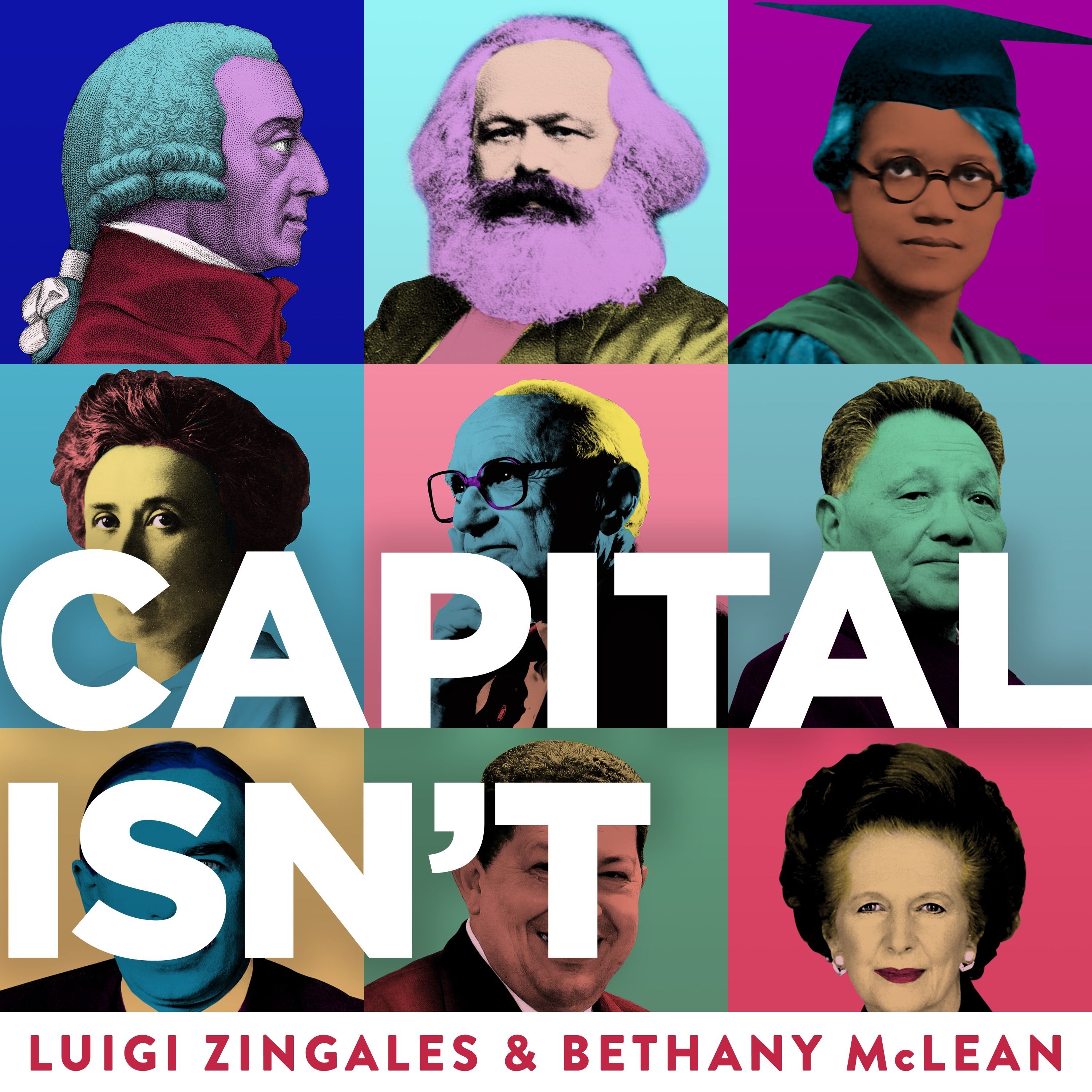
Is capitalism the engine of destruction or the engine of prosperity? On this podcast we talk about the ways capitalism is—or more often isn’t—working in our world today. Hosted by Vanity Fair contributing editor, Bethany McLean and world renowned economics professor Luigi Zingales, we explain how capitalism can go wrong, and what we can do to fix it. Cover photo attributions: https://www.chicagobooth.edu/research/stigler/about/capitalisnt. If you would like to send us feedback, suggestions fo...