Episode Summary
Executive Summary: The episode examines Jonathan Haskel and Stian Westlake’s thesis that capitalism is shifting from tangible to intangible assets, creating winner-take-all firms, slower growth, and new frictions around financing, competition, IP, and governance. The hosts and guest debate how governments, markets, and institutions should adapt—while also arguing corporate America should avoid partisan activism and instead support employees directly when needed.
Main Topics: The rise of the intangible economy: Haskel explains that growth increasingly depends on intangibles like software, design, R&D, branding, and internal organization rather than plant and equipment. Spillovers vs. synergies: Intangibles create broad spillovers through copying, but also powerful synergies that concentrate rewards in the best-combined firms, amplifying inequality and market power. Competition policy and large firms: The discussion weighs antitrust concerns against the need for scale to realize synergies, while emphasizing better enforcement of interoperability, price-comparison tools, and targeted regulation. Government’s role in research and public goods: The speakers argue government should support basic research and other public-good investments where spillovers are too large for private firms to capture fully. IP, patents, and rent-seeking: Patents can encourage innovation but also enable litigation and strategic blocking; the group debates narrower patent systems and more open collaboration models. Prestige, incentives, and inequality: The conversation explores non-monetary incentives such as prestige, prizes, academia, medals, and public service as ways to motivate innovation without extreme concentration of wealth. Corporate political speech: The episode closes by arguing companies should generally avoid making political stances, because they are unaccountable political actors; if they act, they should do so concretely for employees rather than lobbying on contested issues.
Key Arguments: The economy has shifted from tangible capital to intangible assets, and this changes how firms grow, compete, and finance investment. Intangibles produce both spillovers and synergies; spillovers democratize knowledge, but synergies create concentrated winner-take-all outcomes. Startup firms struggle to borrow against intangible assets, which can entrench incumbents and reduce dynamism. Large firms are not automatically evidence of anti-competitive behavior because scale may be necessary to combine complementary intangibles. Policy should focus on interoperability, price transparency, and specific bottlenecks rather than reflexively blocking every merger. Government is better suited than private firms to fund basic research and other public goods with large spillovers, such as space-related research or lighthouse-like infrastructure. Patent systems should reward invention but be narrower and less litigation-prone to avoid rent-seeking and blocking behavior. Non-monetary rewards like prestige can support innovation and public service, but they may need to be mixed with financial incentives to remain viable. Extreme inequality weakens institutions by eroding the prestige and practical standing of public-sector roles. Corporations should not become political decision-makers; their lack of democratic accountability makes their speech and lobbying problematic. If companies want to respond to political or legal changes, they should support employees directly through benefits rather than issuing broad political statements.
Data Points: Time frame for intangible shift: 20–30 years - Haskel describes a gradual move toward intangible investment over the last two to three decades. Smartphone imitation window: 18 months - Example of how quickly the iPhone’s design spilled over to other smartphones. Royal Commission year: 1851 - British commission examined lighthouse provision and how technology changed the institutional solution. Historic innovation example: Fresnel lens/prism technology - New lighthouse illumination made ocean navigation possible and changed funding from private to public goods. Prize value: $3 million - The Breakthrough Prize is cited as an attempt to create prestige-based incentives for science. Prize value: $6.3 million - A second figure mentioned for the Breakthrough Prize awards. Public-sector pay threshold: less than $200,000 a year - Used to illustrate how public-service prestige may no longer compensate for private-sector pay gaps in major cities. Number of top firms: Top 100 firms - Comparison made between equity-partner compensation in large law firms and public office pay.
Pivotal Quotes: "“It’s not that we’re removing all the frictions, it’s just that there’s going to be a different set of frictions in this new economy.”" — Jonathan Haskel: Describing how intangible capitalism changes, rather than eliminates, economic constraints. "“The beauty of academia is that once I give you proper credit, I can do whatever I want with that and combine the way I want.”" — Luigi Zingales: Arguing that attribution-based systems can promote collaboration and synergy better than restrictive IP regimes. "“I agree with everything you just said.”" — Luigi Zingales: Concluding agreement that corporate America should generally stay out of political activism.
Implications: Listeners are left with a policy agenda centered on better antitrust nuance, more public research support, narrower IP rules, and stronger non-monetary incentives. The episode also warns that corporate political activism may undermine democracy unless companies act through concrete employee support.
About Capitalisnt
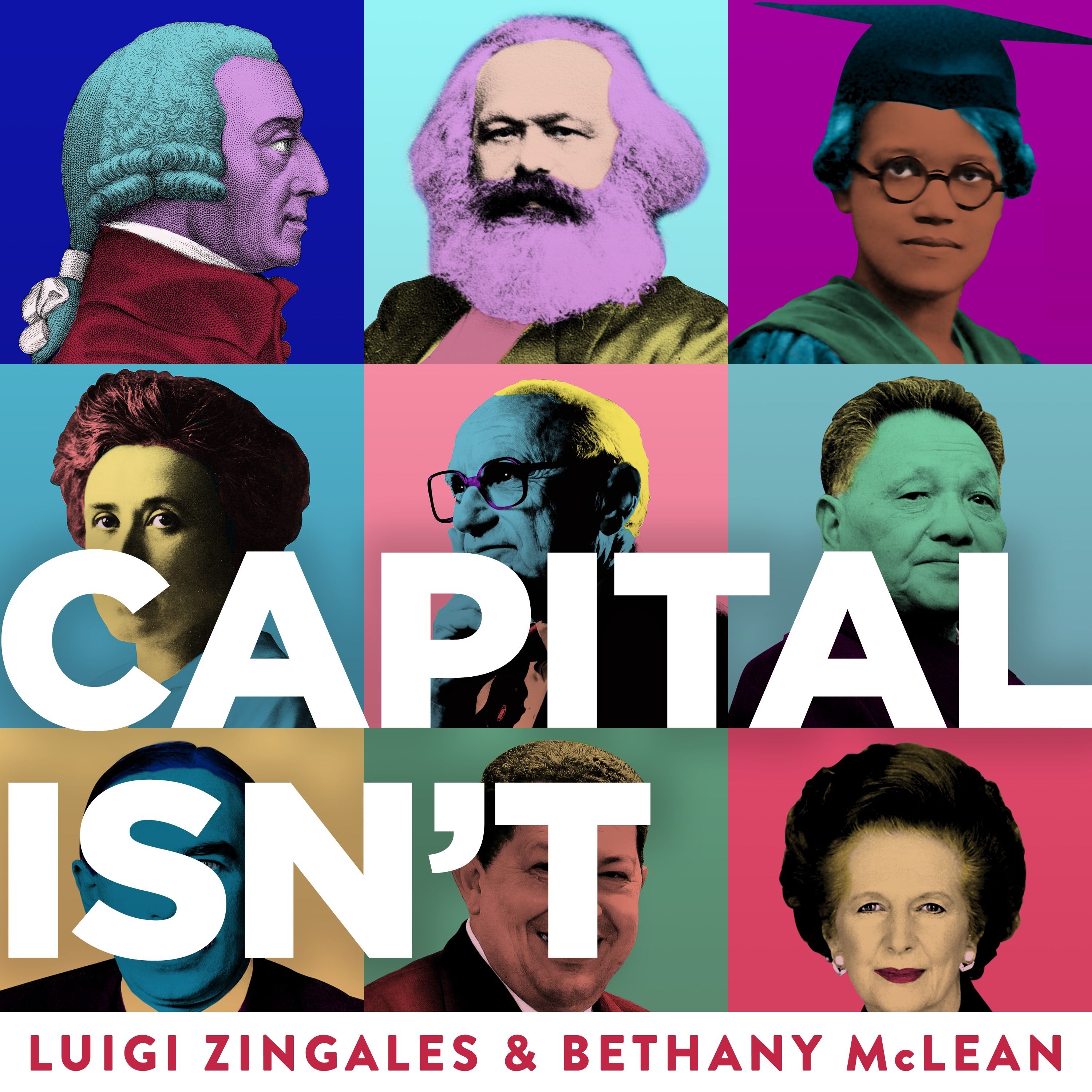
Is capitalism the engine of destruction or the engine of prosperity? On this podcast we talk about the ways capitalism is—or more often isn’t—working in our world today. Hosted by Vanity Fair contributing editor, Bethany McLean and world renowned economics professor Luigi Zingales, we explain how capitalism can go wrong, and what we can do to fix it. Cover photo attributions: https://www.chicagobooth.edu/research/stigler/about/capitalisnt. If you would like to send us feedback, suggestions fo...