Episode Summary
Executive Summary: The episode examines Modern Monetary Theory (MMT), its rising popularity in U.S. politics, and whether deficits matter when a country has monetary sovereignty. Bethany McLean, Luigi Zingales, and guest John Cochrane debate whether MMT is a useful corrective to overly timid fiscal policy or a dangerous political fantasy that ignores inflation, practical constraints, and the realities of government spending.
Main Topics: What MMT Claims: The hosts outline MMT’s core idea: governments with monetary sovereignty can finance spending by creating money until full employment is reached, with inflation serving as the main limit. Inflation, Deficits, and Monetary Sovereignty: The discussion explains the traditional view that money creation raises prices and weakens currency value, while MMT argues inflation can be managed and deficits need not be feared in the same way. Political Appeal and Progressive Policy: The hosts connect MMT’s popularity to demand for large-scale public spending on healthcare, green investment, infrastructure, and jobs, especially when politicians want to avoid explicit funding debates. John Cochrane’s Critique of MMT: Cochrane argues MMT chains together true statements into false conclusions, claiming that money creation still requires future taxation if inflation is to be avoided. MMT as Economic Theory vs. Political Story: The episode repeatedly contrasts whether MMT is a coherent economic framework or a politically useful narrative that justifies spending priorities. Limits, Risk, and Timing: The speakers debate whether low or negative real interest rates justify more borrowing now, and whether changing conditions can render today’s policies dangerous later. Infrastructure and Productive Spending: By the end, the hosts converge somewhat on the idea that deficit-financed spending may be more defensible if directed toward clearly productive long-term investments like infrastructure and education.
Key Arguments: MMT argues that a sovereign government can print money and run larger deficits until inflation appears; inflation is the binding constraint, not the deficit itself. Traditional economics says excessive money creation reduces money’s value, raises inflation, and eventually worsens fiscal problems because people hold less cash. MMT’s practical value may lie in pushing governments toward more aggressive spending when interest rates are low and economies are weak. Cochrane argues that if money is printed to avoid debt repayment, inflation must still be controlled by taxes, so MMT does not eliminate fiscal constraints. MMT is as much a political argument as an economic one, because acceptable spending uses are determined by politics rather than neutral economics. Countries like the U.S. and Japan may have more room for deficit spending because global demand for their currencies supports monetary sovereignty. That room is limited and contingent; if the world loses confidence in the currency, the privilege can disappear quickly. Low or negative real interest rates make higher debt burdens more manageable, but relying on that condition is risky because rates can change suddenly. A jobs guarantee sounds appealing in theory, but critics say government jobs are often inefficient and do not solve the deeper issue of labor-market matching. The most defensible version of MMT-like policy may be disciplined, long-term borrowing for infrastructure, education, and other investments with high social return.
Data Points: Publication referenced: The Deficit Myth - Stephanie Kelton’s book is cited as a major reason MMT entered mainstream discussion. Institutional setting: University of Chicago’s Stigler Center and Chicago Booth Review - The podcast is produced by these institutions. Guest affiliation: Stony Brook University and the New School for Social Research - Stephanie Kelton’s academic positions are mentioned when introducing MMT. Bond maturity suggestion: 100 years - Luigi suggests issuing 100-year bonds to reduce interest-rate risk. Bond maturity example: perpetual bonds - A historical example from 19th-century England is mentioned as a way to lock in financing indefinitely. Government job wage example: $15 an hour - Cochrane discusses a hypothetical federal job guarantee with a fixed wage floor. Debt example: $30 trillion - Cochrane uses this figure to illustrate how debt plus money creation still implies future taxation if inflation rises. Federal job program scope: for anybody who wants a job - The critique frames MMT as funding large universal job guarantees through printed money. Historical reference: 1933–1939 - A discussion of Germany’s rearmament and recovery is used to argue that expansionary state financing can work in some contexts. Interest rate context: close to zero / negative - The conversation repeatedly notes that low or negative real interest rates create more fiscal room than high rates.
Pivotal Quotes: "We have socialism for the very rich, rugged individualism for the poor." — Lucia Zingales: Opening framing of the podcast’s critique of capitalism and inequality. "The theory is fine, but in practice it would get very ugly very quickly." — Bethany McLean: Bethany’s bottom-line concern about MMT’s implementation and political incentives. "The best economic theory in the world doesn't help you if you're dealing with bad politicians." — John Cochrane: Cochrane emphasizes that political behavior can undermine theoretically plausible policies.
Implications: Listeners are left with a nuanced caution: MMT may highlight real limits of austerity and open space for productive public investment, but without strict discipline it risks becoming a rationale for wasteful spending, inflation, and political wishful thinking.
About Capitalisnt
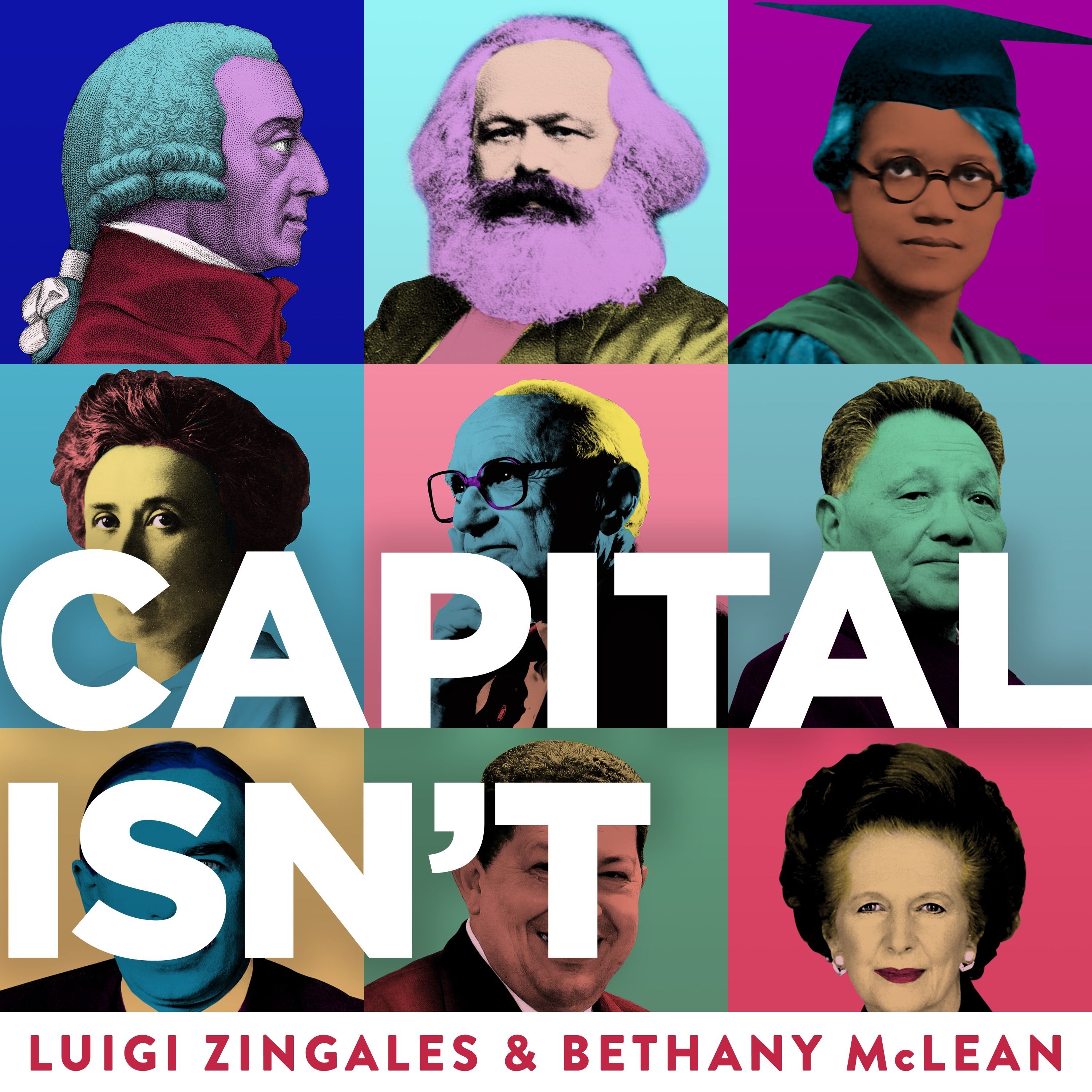
Is capitalism the engine of destruction or the engine of prosperity? On this podcast we talk about the ways capitalism is—or more often isn’t—working in our world today. Hosted by Vanity Fair contributing editor, Bethany McLean and world renowned economics professor Luigi Zingales, we explain how capitalism can go wrong, and what we can do to fix it. Cover photo attributions: https://www.chicagobooth.edu/research/stigler/about/capitalisnt. If you would like to send us feedback, suggestions fo...