Episode Summary
Executive Summary: The episode argues that U.S. student debt is driven less by borrower irresponsibility than by distorted incentives: government-backed loans, tuition inflation, for-profit colleges, and political cross-subsidies. Guest Konstantin Yanelis says blanket forgiveness is regressive and would worsen moral hazard; instead, he favors income-driven repayment, school risk-sharing, and better pricing targeted to borrower risk and outcomes.
Main Topics: How the student loan market became so large: The conversation traces explosive growth in student lending and explains how federal guarantees, weak underwriting, and policy encouragement expanded borrowing far beyond traditional consumer credit markets. For-profit colleges as a major source of defaults: The hosts and guest argue that for-profit schools account for a disproportionate share of defaults because incentives reward enrollment and tuition extraction rather than student outcomes. Why blanket loan forgiveness is criticized: They contend that broad debt cancellation would be regressive, mainly benefiting higher earners, while also encouraging future borrowing and tuition hikes. Fixing incentives through school accountability: The episode explores solutions that make schools share losses from student default and dropout, so institutions would be more careful about admissions and program quality. Income-driven repayment and targeted relief: Konstantin Yanelis argues that the system already contains a progressive forgiveness mechanism and that relief should be better targeted by income thresholds rather than universal cancellation. Cross-subsidies and risk-based pricing: The discussion highlights how uniform interest rates force some borrowers to subsidize others, while fintech lenders cherry-pick low-risk students, leaving the federal system with weaker borrowers. Political economy and lobbying: The hosts note that universities and for-profit firms have strong lobbying power, which helps explain why bad incentives persist despite being foreseeable for years.
Key Arguments: Student loan growth is driven by policy design: government guarantees reduce lender screening, and colleges benefit from pushing enrollment because tuition revenue rises. For-profit colleges are central to the crisis because they represent a small share of enrollment but a much larger share of defaults and debt problems. Default rates alone understate the problem because many borrowers use forbearance or income-driven repayment, which can mask non-repayment. Blanket loan forgiveness is regressive because high-debt, higher-income borrowers such as MDs, JDs, and MBAs capture much of the benefit, while low-income people often never attended college or have little debt. Forgiving debt without reform creates moral hazard: schools and students will expect future bailouts, pushing tuition and borrowing higher. A better system would require schools to have “skin in the game,” so they bear part of the cost when students drop out or default. Income-driven repayment already functions as a form of targeted forgiveness, so policy should expand and simplify it rather than use universal cancellation. Risk-based pricing could reduce cross-subsidies, but it must be designed carefully to avoid worsening inequality. Elite institutions already have near-zero defaults and often do not need loans, showing the problem is concentrated lower in the college market. Political incentives and lobbying have preserved a flawed structure that both borrowers and taxpayers pay for. Data Points: Federal student loan borrowers: 45 million - U.S. borrowers with federal student loans mentioned early in the episode Total student debt: Over $1.6 trillion - Aggregate federal student loan debt described as at a record high Biden campaign promise: Up to $50,000 per borrower - Referenced as the campaign-trail pledge contrasted with later policy announcements Growth in student loan volumes: More than 600% - Konstantin Yanelis describes the expansion in aggregate student lending Present value of the loan program: Around $800 billion - Estimate of the program’s value after accounting for expected losses and uncertainty Estimated losses implied by loan balances: About $600 billion - Derived from the comparison between roughly $1.4 trillion in loans and $800 billion present value For-profit colleges’ share of enrollment: About 10% - Konstantin says for-profit colleges account for roughly one-tenth of enrollment For-profit colleges’ share of borrowers: About 20% - Share of all student loan borrowers attributable to for-profit schools For-profit colleges’ share of defaults: Approximately 50% to 60% - They are repeatedly described as causing a disproportionately large share of defaults Median student wage gain at some for-profit colleges: Zero - Luigi cites research showing the median student may get no wage increase from attendance Income-driven repayment payment rate: 10% or 15% of income above 150% of the poverty line - Described as the current built-in forgiveness/insurance mechanism Time until remaining balances are forgiven under IDR: 20 or 25 years - Depending on the repayment plan Borrower repayment under IDR: About half of debt - Yanelis notes an Education Department analysis suggesting borrowers may repay only about half Benefit concentration under universal forgiveness: More than $100 billion to the top decile; less than $20 billion to the bottom decile - Used to argue universal forgiveness is regressive Black students taking out loans: 90% - CFPB statistic cited in the discussion of unequal borrowing burdens Latino students taking out loans: 72% - CFPB statistic cited in the discussion of unequal borrowing burdens White students taking out loans: 66% - CFPB statistic cited in the discussion of unequal borrowing burdens
Pivotal Quotes: "Forgiving a little bit of student loans is not a real solution." — Capital Isn't intro: Opening framing for the rebroadcast after Biden’s student-loan announcement "If you have a leakage faucet, you should not collect the water. The first thing you should do is prevent the faucet from leaking." — Luigi Zingales: Argument that relief without structural reform worsens the underlying problem "Universal loan forgiveness is an extremely regressive policy." — Konstantin Yanelis: Central claim supporting targeted rather than blanket cancellation
Implications: For listeners, the episode warns that student-loan forgiveness alone will not fix affordability. Future policy should prioritize income-based repayment, school accountability, and smarter targeting, or else tuition inflation, defaults, and taxpayer losses will continue.
About Capitalisnt
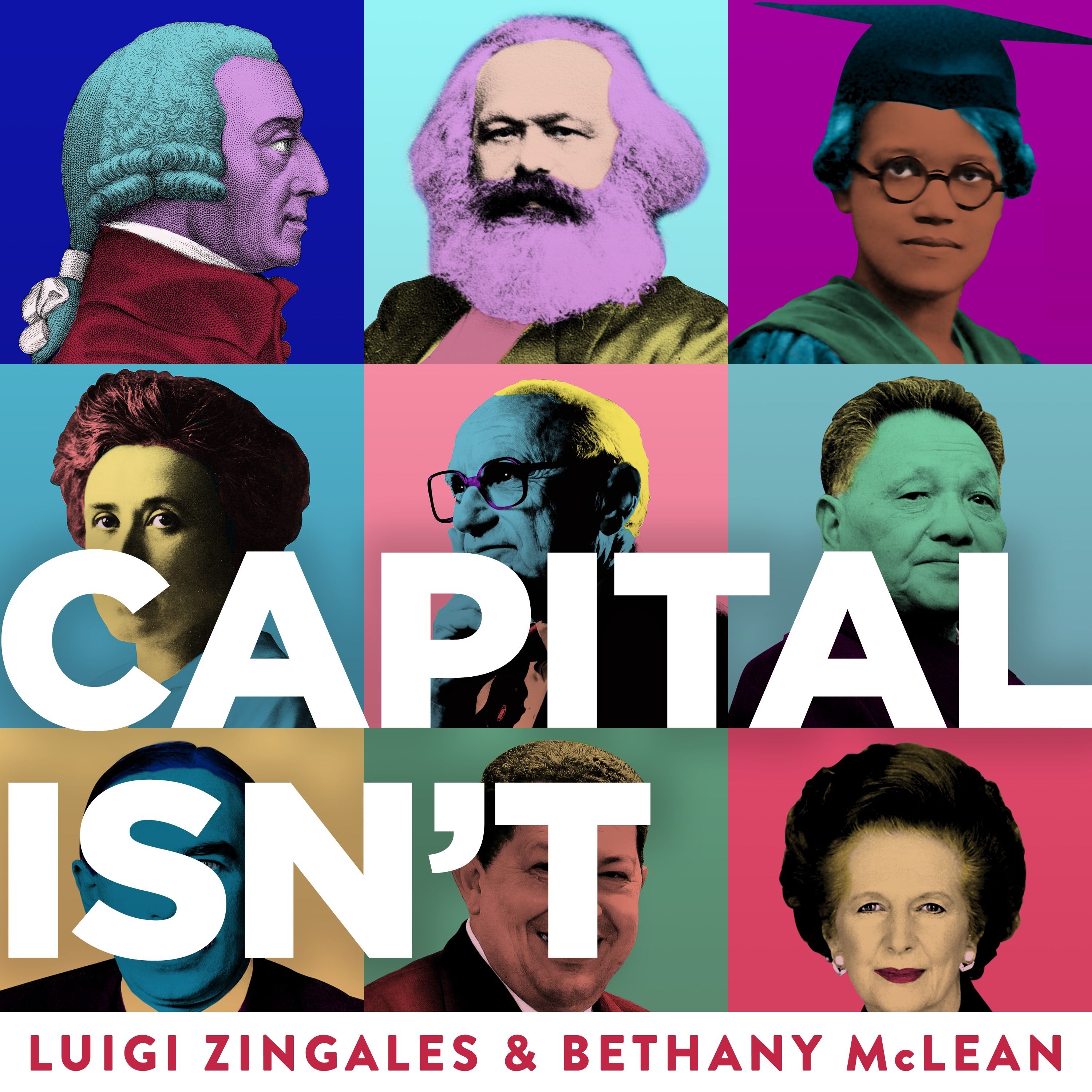
Is capitalism the engine of destruction or the engine of prosperity? On this podcast we talk about the ways capitalism is—or more often isn’t—working in our world today. Hosted by Vanity Fair contributing editor, Bethany McLean and world renowned economics professor Luigi Zingales, we explain how capitalism can go wrong, and what we can do to fix it. Cover photo attributions: https://www.chicagobooth.edu/research/stigler/about/capitalisnt. If you would like to send us feedback, suggestions fo...