Episode Summary
Executive Summary: The episode examines Visa’s alleged debit-network monopoly and broader “middleman economy” dynamics, using antitrust, regulation, and payment-system design to ask when intermediaries create value and when they entrench power. The guests compare Visa to real estate brokers, debate remedies versus structural reform, and consider alternatives like interoperability, Fed-led payments, and public payment rails.
Main Topics: Visa antitrust case and debit-network monopoly: The hosts outline the DOJ lawsuit alleging Visa illegally maintains monopoly power in debit transactions by restricting competition and coercing partners into its network. Middleman economy theory: Catherine Judge explains how intermediaries start by solving trust, information, and coordination problems, but can later use their central position to entrench power and influence regulation. Real estate broker analogy: The discussion uses U.S. real estate commissions and MLS control to show how one-sided subsidies and industry rules can lock in an intermediary’s dominance. Non-contestable transactions and network effects: Judge clarifies how Visa benefits from transactions where both consumer and merchant default to Visa, using those guaranteed routes to gain leverage over other transactions. Regulation, interoperability, and public payment rails: The speakers debate whether antitrust is enough or whether payment systems should be redesigned through interoperability, central-bank infrastructure, or a public standard like India’s UPI and Brazil’s PIX. Privacy, surveillance, and CBDC concerns: They explore concerns about central-bank digital currency, bank surveillance obligations, and whether a government-run payment system would be better or worse for privacy and oversight. Distributional effects of payments and banking: The conversation highlights how card rewards and payment fees can shift costs from richer card users to poorer cash users, and how bank deposit structures transfer value to banks.
Key Arguments: Visa resembles a classic middleman: it solved real coordination problems, but now uses network dominance to block rivals and raise fees. The DOJ’s theory depends on both Section 1 and Section 2: Visa allegedly pays partners not to compete and uses monopoly power to maintain its position. Non-contestable transactions give Visa leverage because it is the only network available on both sides of certain debit transactions, letting it pressure merchants on the rest. Technological change should have disrupted payment intermediaries; when it does not, that is a sign the middleman may be protected by market power or bad rules. Antitrust alone may be insufficient; interoperability or a shared standard may be a better way to lower switching costs and preserve network benefits. Real estate shows how a two-sided market can become locked in by subsidizing one side and using industry rules to suppress cheaper alternatives. The best remedy may depend less on punishment than on whether the process changes conduct, surfaces evidence, and disciplines future behavior. A government-run payment infrastructure could be preferable to a private monopoly because money and payment systems have strong network effects and public-policy stakes. There are tradeoffs in faster payment systems and CBDCs: more speed and access can come with privacy, surveillance, and fraud/discipline concerns. Card rewards and fee structures can be regressive, effectively shifting costs from cash users and poorer consumers to more affluent card holders.
Data Points: Visa share of U.S. debit transactions: more than 60% - Cited in the DOJ complaint as evidence of dominance in debit network markets. Visa annual fee revenue from debit processing: over $7 billion - The DOJ says Visa earns this each year from processing debit transactions. Visa global operating income: $18.8 billion - Referenced in the complaint to illustrate the company’s profitability. Visa global operating margin: 64% - Used to underscore the scale of Visa’s earnings. Visa North America operating margin (2022): 83% - Highlighted as exceptionally high profitability in its home market. Volume insulated from competition: at least 75% of Visa debit volume - Visa reportedly calculated that this portion was protected from competition by its contracts by end-2022. Real estate commission structure: 6% total, typically split 3%/3% - Used as an analogy for how seller-paid commissions subsidize buyer-side representation. States restricting commission rebates: 15 states - Judge notes that laws made commission rebates unlawful in 15 states at one point. FedNow launch timing: introduced only a year ago - Mentioned as a late U.S. response to faster-payment infrastructure compared with other countries. Deposit interest spread example: 5 basis points vs. 4.9% - Illustrated as the gap between what a depositor may receive and what banks earn on reserves at the Fed. Cash-user subsidy estimate: about $700 per year - A cited estimate that cash users subsidize credit card users through reward and fee structures.
Pivotal Quotes: "one of the indicia that I would look for of, is this an area where I want to dig a little deeper for a problem with the middleman economy, is it's an area where it seems like technological change should have really disrupted the role of the middleman, and it hasn't." — Bethany McLean: Framing the podcast’s thesis about when middlemen may be protected by power rather than value. "In many ways, it is classic in the sense it first arose to influence because it is providing a really useful service." — Catherine Judge: Judge’s explanation of why Visa fits the middleman model before becoming entrenched. "The better way to approach this, in my view, is on a regulatory matter by forcing interoperability or by creating a common standard and have everybody operate under the common standard." — Luigi Zingales: Argument that payment competition may require shared infrastructure rather than pure market rivalry.
Implications: The episode suggests Visa-style dominance may require more than antitrust: payment systems may need interoperability, public rails, or tighter regulation. It also warns that fees, rewards, and banking frictions can quietly redistribute wealth and power across consumers, merchants, and financial intermediaries.
About Capitalisnt
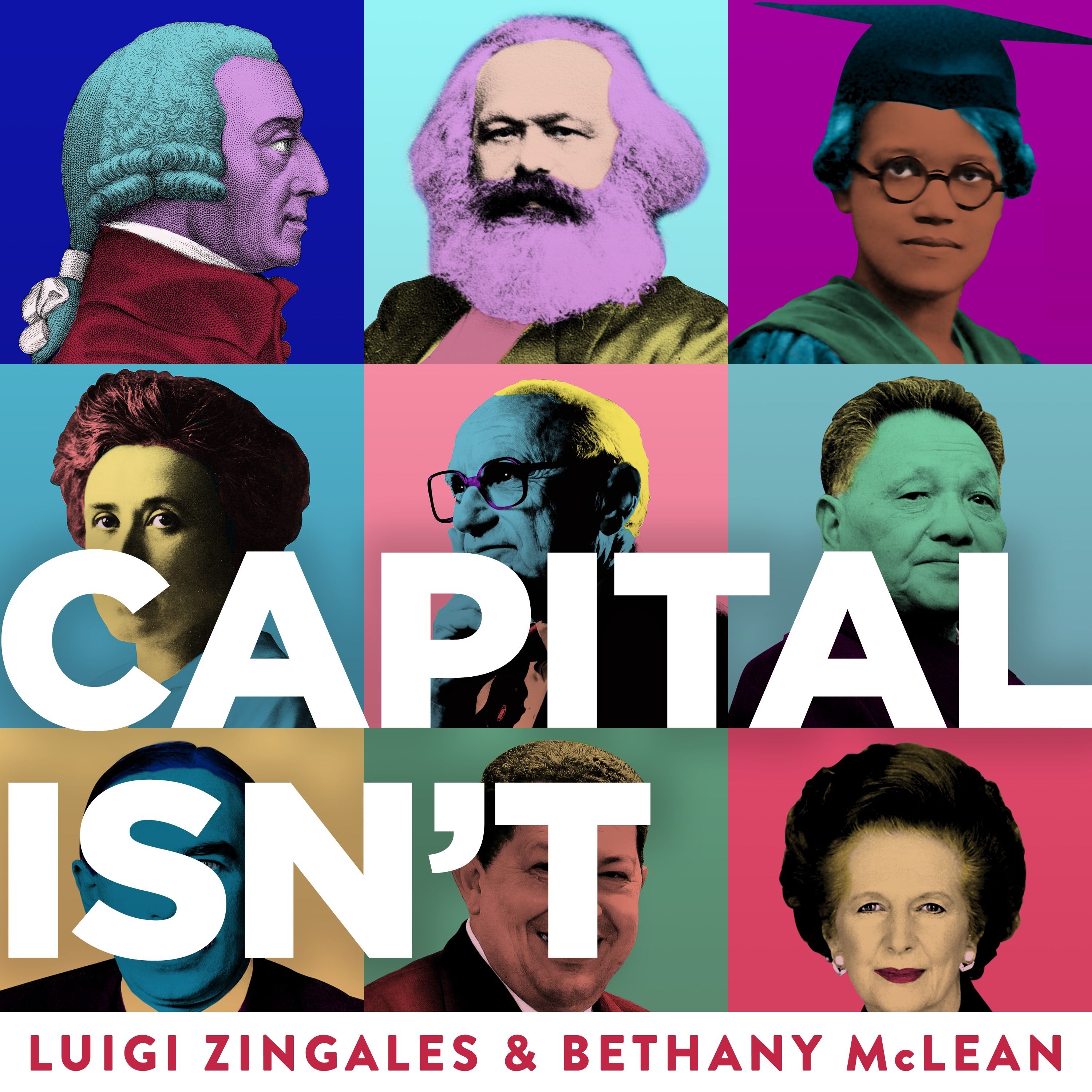
Is capitalism the engine of destruction or the engine of prosperity? On this podcast we talk about the ways capitalism is—or more often isn’t—working in our world today. Hosted by Vanity Fair contributing editor, Bethany McLean and world renowned economics professor Luigi Zingales, we explain how capitalism can go wrong, and what we can do to fix it. Cover photo attributions: https://www.chicagobooth.edu/research/stigler/about/capitalisnt. If you would like to send us feedback, suggestions fo...