Episode Summary
Executive Summary: The episode dissects cryptocurrencies—especially Bitcoin, stablecoins, and Trump’s meme coin—through Eugene Fama’s efficient-markets lens. The hosts and Fama argue crypto largely fails as money because its value is too volatile and demand-driven, though it may still serve as a speculative asset or a tool for censorship-resistant transfer. They debate regulation, debanking, consumer protection, and whether crypto’s political and financial influence makes it a real force even if its intrinsic value is dubious.
Main Topics: Crypto as an unreliable medium of exchange: Fama argues that cryptocurrencies violate core monetary properties because their prices fluctuate too wildly to function as money; users won’t transact in an asset whose value can destroy their own businesses. Bitcoin’s scarcity, speculation, and energy cost: Bitcoin’s fixed supply creates demand-driven price swings, while its proof-of-work model consumes huge amounts of energy, reinforcing the case against its use as currency. Stablecoins as a payment rail, not a cure-all: Stablecoins can mimic dollars on a blockchain and facilitate 24/7 payments, but Fama argues that if they are dollar-backed, the banking system can do the same job more efficiently. Efficient markets, bubbles, and intrinsic value: The conversation uses Fama’s market-efficiency framework to question bubble claims and intrinsic value, with Fama insisting a bubble should have a predictable ending and that intrinsic value is hard to operationalize. Regulation, debanking, and consumer protection: The hosts debate whether crypto is overregulated or underregulated, especially around debanking, scams, and whether clear rules are needed to prevent bailouts and protect retail investors. Crypto’s political power and legitimacy: Trump’s coin launch and the role of crypto money in politics show that even supposedly decentralized assets depend on political and institutional power to expand and survive.
Key Arguments: Cryptocurrencies are poor currencies because a medium of exchange must be stable enough that users can rely on it for pricing and payments. Bitcoin’s fixed supply makes its price almost entirely demand-driven, which creates self-reinforcing speculation and extreme volatility. Proof-of-work blockchains are too energy-intensive to scale as a financial system; a centralized, trusted computer would be more efficient for payments. If stablecoins are fully backed by dollars, they are mainly a payment wrapper around the banking system, not a fundamentally new monetary technology. A cryptocurrency’s value can be conventional rather than utility-based, but Fama remains skeptical that this is enough to sustain monetary theory. A possible use case for Bitcoin is wealth portability or escape from rapacious governments, especially for oligarchs or dissidents. Crypto markets may force eventual government intervention or bailout if they collapse, which argues for clearer regulation or separation from the traditional financial system. Consumer protection matters because many tokens resemble speculative or fraudulent offerings more than legitimate securities. Crypto’s success depends on growing its community of buyers; political support can expand that community and alter prices, making government involvement strategically important.
Data Points: Trump paper wealth from meme coin launch: more than $50 billion - As of Sunday morning after President-elect Trump launched his cryptocurrency. Melania Trump coin value: more than $5 billion - Worth within a couple of hours of launch on Sunday night. Bitcoin market ranking: 7th most valuable asset in the world - Mentioned as part of the opening setup for the episode. Bitcoin energy consumption: as much energy as the entire country of Poland in a year - Used to illustrate the costliness of Bitcoin’s proof-of-work system. Eugene Fama Nobel Prize year: 2013 - Introduced as the “father of modern finance.” Efficient market hypothesis age: introduced in 1970; 56 years ago from the discussion date - Fama corrects the host on the elapsed time since the hypothesis was introduced. Bitcoin long-term bet: close to one probability of going to zero within 10 years - Fama’s forecast when asked for a 10-year probability. Bitcoin market cap: $2 trillion - Referenced when discussing whether Bitcoin is a bubble.
Pivotal Quotes: "Cryptocurrencies are such a puzzle. It's because they violate all the rules of a medium of exchange." — Luigi Zingales: Framing the central theoretical problem of crypto as money. "What's the unit of account? What's the medium of exchange in there? That's where cryptocurrencies are such a puzzle." — Eugene Fama: Fama explains why crypto cannot easily function as currency. "I would say it's close to one." — Eugene Fama: His answer when asked the probability Bitcoin goes to zero within 10 years.
Implications: Crypto may persist as speculation, political leverage, or a censorship-resistant transfer tool, but its future as money remains weak. The episode suggests regulators should prioritize consumer protection, transparency, and ring-fencing risk from the traditional financial system.
About Capitalisnt
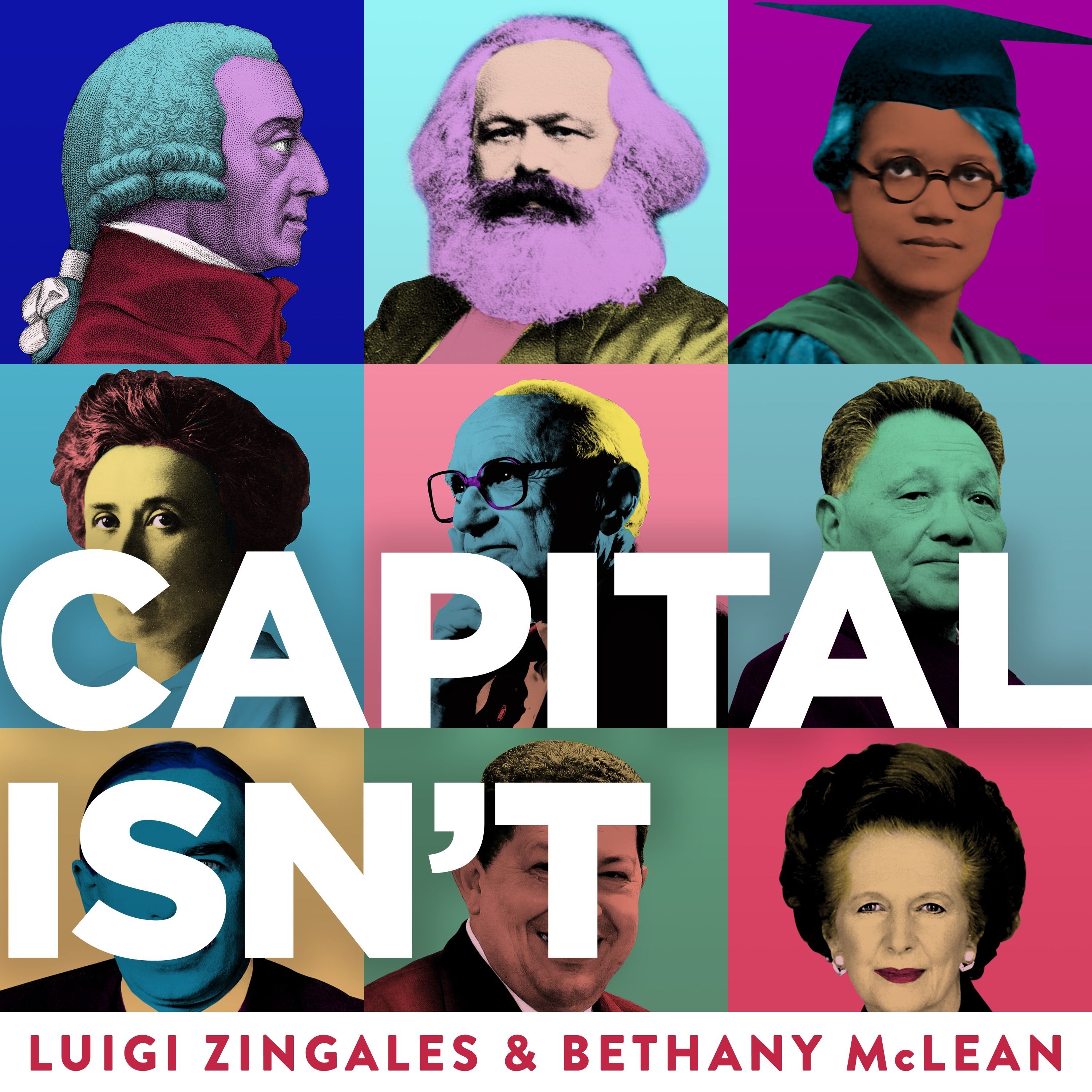
Is capitalism the engine of destruction or the engine of prosperity? On this podcast we talk about the ways capitalism is—or more often isn’t—working in our world today. Hosted by Vanity Fair contributing editor, Bethany McLean and world renowned economics professor Luigi Zingales, we explain how capitalism can go wrong, and what we can do to fix it. Cover photo attributions: https://www.chicagobooth.edu/research/stigler/about/capitalisnt. If you would like to send us feedback, suggestions fo...