Episode Summary
Executive Summary: The conversation centers on a conservative, Catholic-social-teaching-inflected critique of market fundamentalism: capitalism should serve human flourishing, family life, worker dignity, and national strength, not self-justifying profit. The guest argues for targeted industrial policy, stronger state capacity, labor empowerment, and pro-family supports, while warning against both neoliberal deregulation and heavy-handed statism.
Main Topics: Capitalism as a means, not an end: The guest frames the economy as an instrument whose purpose is human dignity and flourishing, citing Catholic social teaching and Aristotle’s teleological view of function and purpose. Labor, dignity, and worker power: He argues labor is another word for people, so workers should be treated as co-creators with agency rather than inputs, supporting unions, sectoral bargaining, and broader labor reforms. Critique of neoliberalism and free-market fundamentalism: The discussion rejects the idea that deregulation, tax cuts, and free trade automatically promote the common good; both speakers note the ideology has ossified and failed working-class communities. Industrial policy and state capacity: The guest supports strategic government intervention in sectors like semiconductors and critical minerals, but only with better institutions and durable, legislated rules rather than ad hoc executive discretion. Family formation and social stability: A major theme is that policy should make family life possible and attractive, including flexible cash benefits for children, because families support social cohesion, democracy, and long-term economic dynamism. Republican realignment and populist economics: The conversation explores the internal GOP split between libertarian market orthodoxy and a newer worker- and nation-oriented conservatism represented by figures like Rubio and Vance. Corporate power, citizenship, and national obligations: The guest argues corporations should have obligations alongside rights, and that firms should not prioritize short-term profits in ways that harm American workers, security, or supply chains.
Key Arguments: Capitalism is valuable because it channels capital to productive use; when it instead rewards financial engineering or offshoring, policy must redirect incentives. Labor should be understood as people, not just a factor input, so economic rules must protect worker dignity, voice, and family life. Neoliberalism responded to real 1970s stagnation, but its ideas became outdated and now fail to address deindustrialization, inequality, and democratic instability. Free markets are useful for discovering efficient solutions, but only when government sets the right rules of the game and boundaries on harmful profit-seeking. State capacity is essential: industrial policy can work only if institutions are capable, stable, and insulated from capture and executive whim. The U.S. needs targeted industrial strategy in sectors like semiconductors, critical minerals, and biotech to strengthen resilience, security, and competitiveness. Pro-family policy should be flexible and non-1950s in form; a monthly cash benefit for working families is preferred over one-size-fits-all childcare subsidies. Corporations are legal persons that should bear mutual obligations to the nation and public interest, not merely pursue quarterly earnings. A healthy democracy requires not only political rights like voting but also economic participation and agency for ordinary citizens and workers.
Data Points: Working/middle-class parents wanting more children: majority - The guest says polling shows most working and middle-class people say they do not have the number of children they want. College-to-career success rate: fewer than 1 in 5 - He criticizes the college-for-all model, saying fewer than 20% of American students move smoothly from on-time high school graduation to on-time four-year graduation to a degree-required job. Policy time horizon for tax-cut orthodoxy: 50 years out of date - He argues the old idea that lowering the top marginal tax rate is the best growth policy is decades behind current economic challenges. Timeline of globalization backlash: since 2000 and culminating in 2016 - He points to the China/WTO consensus in the 2000 election and later backlash in Bernie Sanders’s near-win and Trump’s victory. Semiconductor policy example: CHIPS and Science Act - Used as evidence that direct policy intervention is necessary to rebuild domestic advanced chip production. Family support preference: monthly cash benefit - He says this would be more flexible and preferred by most non-professional families over professionally provided childcare. Sectoral bargaining: industry-wide wage floor - Presented as a labor reform to stop a race to the bottom and shift competition toward quality and service. Production offshoring example: China - Referenced repeatedly as the destination for U.S. manufacturing and advanced semiconductor production under prior policy regimes.
Pivotal Quotes: "Economy is not an end unto itself. It's a tool, it's a means." — Guest: Explaining the core moral and philosophical premise of his economics. "Labor is just another word for people, for human beings." — Guest: Arguing that workers should be treated as persons with dignity, not inputs. "What is capitalism for? And I think it's for a bunch of things. One of them is channeling capital to productive use." — Bethany McLean: Framing the discussion around capitalism’s purpose and when policy intervention is needed.
Implications: The episode signals a growing right-of-center challenge to neoliberalism: more industrial policy, stronger labor voice, and pro-family economics. For listeners, it suggests capitalism will increasingly be judged by whether it supports dignity, resilience, and democratic stability—not just growth.
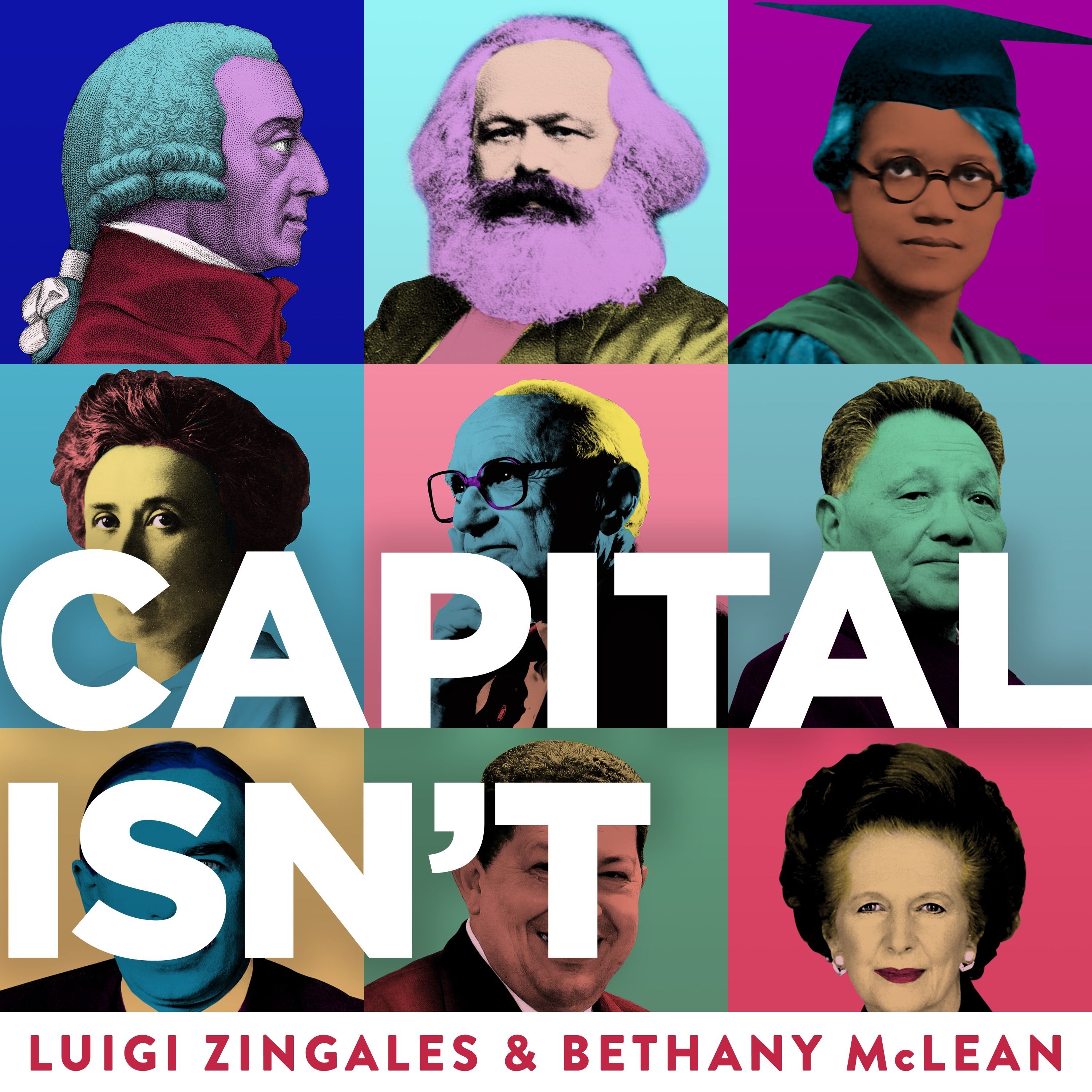
About Capitalisnt
Is capitalism the engine of destruction or the engine of prosperity? On this podcast we talk about the ways capitalism is—or more often isn’t—working in our world today. Hosted by Vanity Fair contributing editor, Bethany McLean and world renowned economics professor Luigi Zingales, we explain how capitalism can go wrong, and what we can do to fix it. Cover photo attributions: https://www.chicagobooth.edu/research/stigler/about/capitalisnt. If you would like to send us feedback, suggestions fo...