Episode Summary
Executive Summary: The episode argues that recent wage gains are encouraging but insufficient to solve long-running wage stagnation. It explores how employer market power—through monopsony, no-poach agreements, non-compete clauses, and reduced worker mobility—can suppress wages even in a growing economy, and highlights legal and policy efforts to curb anti-competitive labor practices.
Main Topics: Recent wage growth and why it matters: The hosts open with strong monthly job gains and the fastest wage growth since the recession, interpreting it as evidence of a tighter labor market and rising worker bargaining power, while cautioning that one month of improvement does not end decades of stagnation. Monopsony and local labor market power: The discussion introduces monopsony as the labor-market equivalent of monopoly, emphasizing that in many local labor markets firms have buying power over workers because mobility is costly and employers can be few. Worker mobility as a constraint on wages: The episode explains that moving for a better job is often difficult due to family ties, dual-career households, housing costs, and geographic frictions, which allows firms to maintain wage-setting power locally. No-poach agreements and labor collusion: The hosts examine high-profile legal cases, especially the Apple-Google no-poach arrangement, as evidence that firms may coordinate to avoid bidding up wages and that antitrust law is increasingly targeting such conduct. Non-compete clauses and labor market lock-in: The episode argues that non-compete clauses, though sometimes justified by trade-secret protection, often reduce worker mobility and depress wages, especially where they are widespread or difficult to challenge. Independent contractors and franchise labor restrictions: The conversation extends the anti-competition argument to franchise systems and independent contractors, questioning whether firms should restrict outside work or poaching if workers are not formal employees. Enforcement, lawsuits, and policy change: The speakers stress that legal enforcement has been weak relative to the gains from collusion, but note growing DOJ scrutiny, class-action litigation, and political pressure to strengthen labor antitrust enforcement.
Key Arguments: Wage growth is improving, but it is too early to declare victory over decades of stagnation; a short-lived uptick does not erase long-run weakness. Central bankers care about wage growth because sustained wage pressure is often needed to meet inflation targets near 2%. If labor markets were fully competitive, a booming economy should raise wages more strongly through employer competition for workers. Firms can suppress wages when they have monopsony power, especially in local labor markets with few employers and high moving costs. Labor-market concentration has increased in the U.S., making anti-competitive wage-setting more plausible in many industries and towns. No-poach agreements are a direct restraint of trade because they prevent firms from competing for workers and can keep pay below competitive levels. The Apple-Google email exchange is presented as strong evidence of intentional collusion, not just implicit market power. Non-compete clauses reduce outside options and mobility, lowering workers' bargaining power and potentially depressing wages across an entire labor market. Even if a worker group seems well paid, entry-level wage uniformity may reflect tacit collusion rather than pure competition. Legal and regulatory intervention is necessary because firms have incentives to collude unless explicitly restrained by antitrust enforcement. Class-action litigation is costly for affected workers, so financial support for plaintiffs may be needed to make enforcement feasible.
Data Points: Jobs added last month: 200,000 - Opening reference to strong monthly employment gains. Wage growth: 2.5% to 2.9% - The episode highlights a jump in wage growth as evidence of a tighter labor market. Wage growth pace: Fastest pace since the recession / about eight years - Described as the strongest wage growth in years. U.S. wages, 2009-2014: Up 8.7% - Nominal wage growth over five years. U.S. inflation, 2009-2014: Up 9.5% - Inflation outpaced nominal wage growth in the same period. Real wage change, 2009-2014: Down - Workers effectively lost purchasing power during an expansion. Initial damages in high-tech antitrust case: About $3 billion - Estimated damages in the Apple-Google no-poach litigation. Potential damages if plaintiffs won fully: Up to $9 billion - Maximum damages mentioned for the litigation. Original settlement amount: $325 million - First proposed settlement in the high-tech employee antitrust case. Final settlement amount: $415 million - Court-influenced final settlement after judge said the first amount was too low. Non-compete coverage: About 20% of the labor force - Share of workers reportedly covered by non-compete agreements.
Pivotal Quotes: "If you're somebody who is working in this American economy, you want your wages to go higher." — Luisa Zingales: Opening on why wage growth matters to workers. "There is only one buyer. And in particular, we're interested about when there is only one buyer of labor." — Luisa Zingales: Definition of monopsony and why it matters for wages. "if you are my employee, you cannot work for somebody else at the same time, if I hire you as an independent contractor, why do I have the right to restrict your outside activities?" — Luisa Zingales: Critique of restricting outside work for independent contractors.
Implications: The episode suggests wage growth depends not just on macroeconomic conditions but on labor-market competition. Stronger antitrust enforcement, limits on non-competes, and bans on no-poach agreements could raise wages and worker mobility.
About Capitalisnt
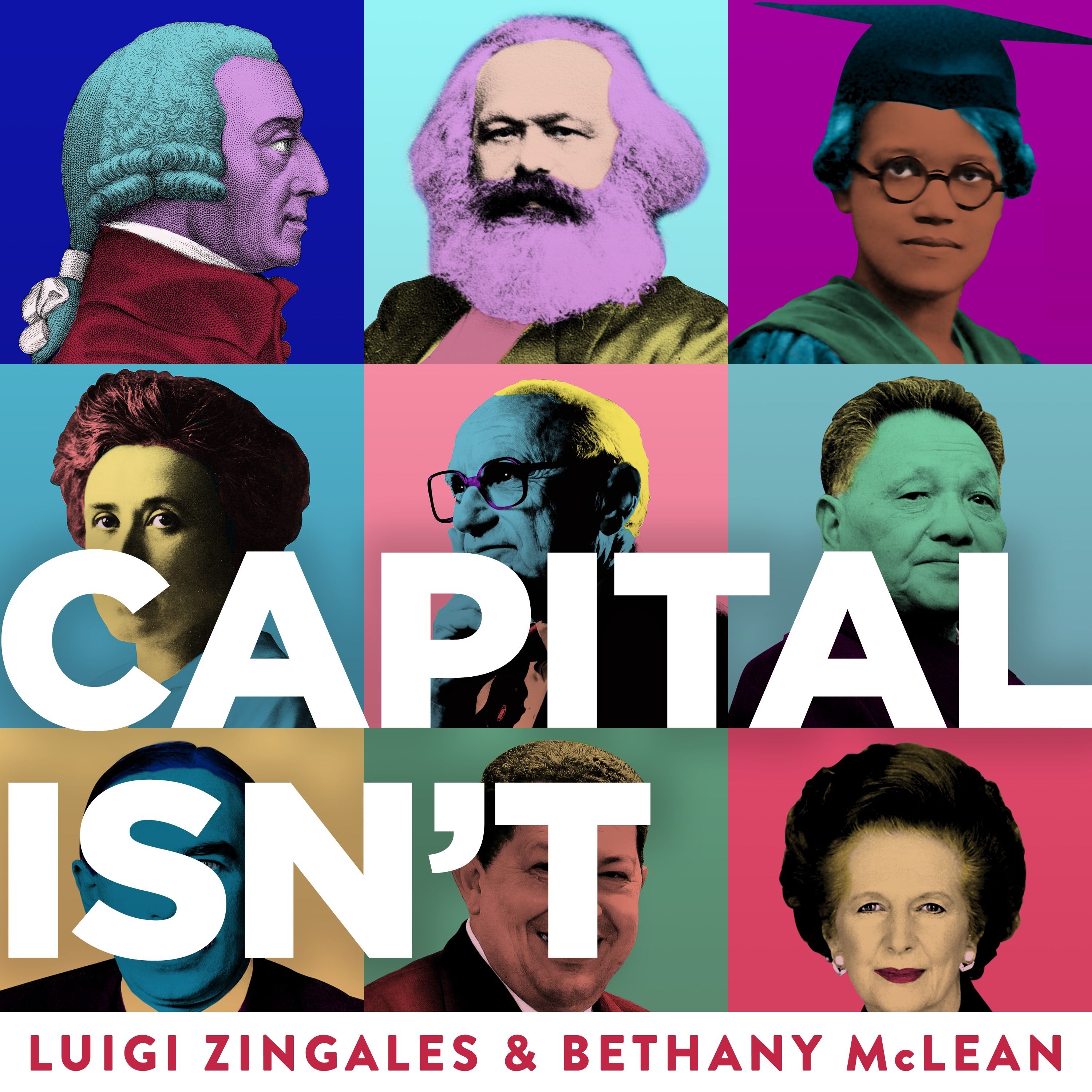
Is capitalism the engine of destruction or the engine of prosperity? On this podcast we talk about the ways capitalism is—or more often isn’t—working in our world today. Hosted by Vanity Fair contributing editor, Bethany McLean and world renowned economics professor Luigi Zingales, we explain how capitalism can go wrong, and what we can do to fix it. Cover photo attributions: https://www.chicagobooth.edu/research/stigler/about/capitalisnt. If you would like to send us feedback, suggestions fo...