Episode Summary
Executive Summary: The episode debates Jan Eeckhout’s thesis that rising market power depresses wages by reducing output and labor demand, while also exploring related forces like monopsony, outsourcing, and non-compete clauses. The hosts agree market power is real and harmful, but question whether antitrust should focus more on consumers, workers, suppliers, or broader social stability—and whether an independent, central-bank-like regulator is the right solution.
Main Topics: Market Power and Wage Stagnation: The central theme is why wages have stagnated since the 1980s despite higher productivity and soaring profits. Eeckhout argues that concentrated firms restrict output to preserve profits, which lowers labor demand and suppresses wages economy-wide. Profits vs. Capital Returns: A major analytical distinction is drawn between rising profits and rising returns to capital. The discussion emphasizes that in imperfectly competitive markets, profit gains do not necessarily lead to more investment, but instead reflect rents extracted through market power. Antitrust, Competition, and Tailored Regulation: The conversation explores whether existing antitrust law is too narrow and whether regulation should be customized by sector and firm, especially in digital platforms, healthcare, telecom, and pharmaceuticals. Labor Market Frictions and Monopsony: The follow-up analysis expands the wage story beyond product-market power to include monopsony/oligopsony, outsourcing, and non-compete agreements that weaken workers’ bargaining power and freeze wage growth. Consumers, Workers, Suppliers, and Social Fairness: The hosts stress that people are simultaneously consumers, workers, and investors, but those roles do not balance evenly. They argue that market power can be good for customers in the short run while still harming workers, suppliers, and social trust. Central Bank Model for Antitrust: Eeckhout proposes an independent, expert-driven competition authority modeled on central banks. The hosts admire the logic but worry about politicization, technocracy, and the limits of expert governance in areas with distributional consequences. Political Economy and Social Stability: The discussion broadens into concerns about inequality, polarization, and instability. The hosts warn that persistent concentration of power can have deep social and political costs, not just economic ones.
Key Arguments: Market power lowers output on purpose: dominant firms may restrict quantity to keep prices and profits high, which reduces hiring and suppresses wages. The labor share has fallen, but in non-competitive settings the more relevant increase may be in profits rather than in the return to capital, changing investment incentives. Antitrust should not be treated as one-size-fits-all; each sector requires tailored analysis because market power looks different in Amazon, Apple, telecom, dialysis, and pharmaceuticals. Consumer welfare alone is too narrow because workers and customers are often the same people; lower prices can coexist with weaker bargaining power and lower wages. Monopsony matters: when employers are few, they can hold down wages even without explicit collusion. Outsourcing and global production chains reduce local labor demand, contributing to weaker wage growth. Non-compete agreements are a major, underappreciated brake on wages because they reduce worker mobility and limit spillover wage gains across firms. An independent competition authority could improve antitrust enforcement, but the hosts worry it could become politicized just like other institutions. Market power affects not just customers but suppliers and small businesses whose dependence on dominant platforms gives those platforms extraordinary control over prices, access, and survival. The welfare cost of market power may be large enough to justify major institutional reform, similar in scale to the creation of independent central banks for inflation control.
Data Points: Wage stagnation period: Since the 1980s - Used to describe the long-run stagnation in worker pay despite productivity growth. Labor share of national income: Has significantly declined - Cited as evidence that workers are receiving a smaller portion of output over time. Independent central bank workforce: About 30,000 people - Compared with the staffing of antitrust agencies to argue enforcement is under-resourced. Antitrust agency workforce: Around 3,000 people - FTC and DOJ antitrust staff combined, used to show the scale mismatch versus the estimated cost of market power. Estimated annual cost of market power: 9% of GDP per year - Presented as a rough estimate of the economic burden of concentrated market power. Estimated cost of inflation: Less than 1% - Used as a benchmark to argue that antitrust is under-prioritized relative to inflation control. New employment with non-competes: About one-third - Claim that a third of new jobs include some form of non-compete agreement. Apple iPhone example: $1,200 price vs. $350 cost - Illustrates markup and the claim that lower prices would raise unit sales and labor demand. Hypothetical iPhone sales: 2 billion now vs. 4–6 billion under lower prices - Used as an illustrative example of how lower prices could increase production and labor demand. Dow Jones level referenced: 34,000 - Used in a warning that stock-market gains may persist unless market power is addressed.
Pivotal Quotes: "We have socialism for the very rich, rugged individualism for the poor." — Luigje Zengales: Opening framing of the show’s critique of unequal treatment under capitalism. "Being pro-business means let's allow these firms to build nice moats around their castles." — Ian Eeckhout: Explains the difference between supporting firms and supporting competitive markets. "We are all consumers. We are all workers. We are all investors." — Bethany McLean: Argues that policy debates wrongly separate people into fixed economic roles.
Implications: The episode argues that market power is not just a consumer-price issue but a broad distributional problem affecting wages, suppliers, and political stability. Listeners are left with a call for stronger, more specialized antitrust and competition policy—though not necessarily technocratic centralization.
About Capitalisnt
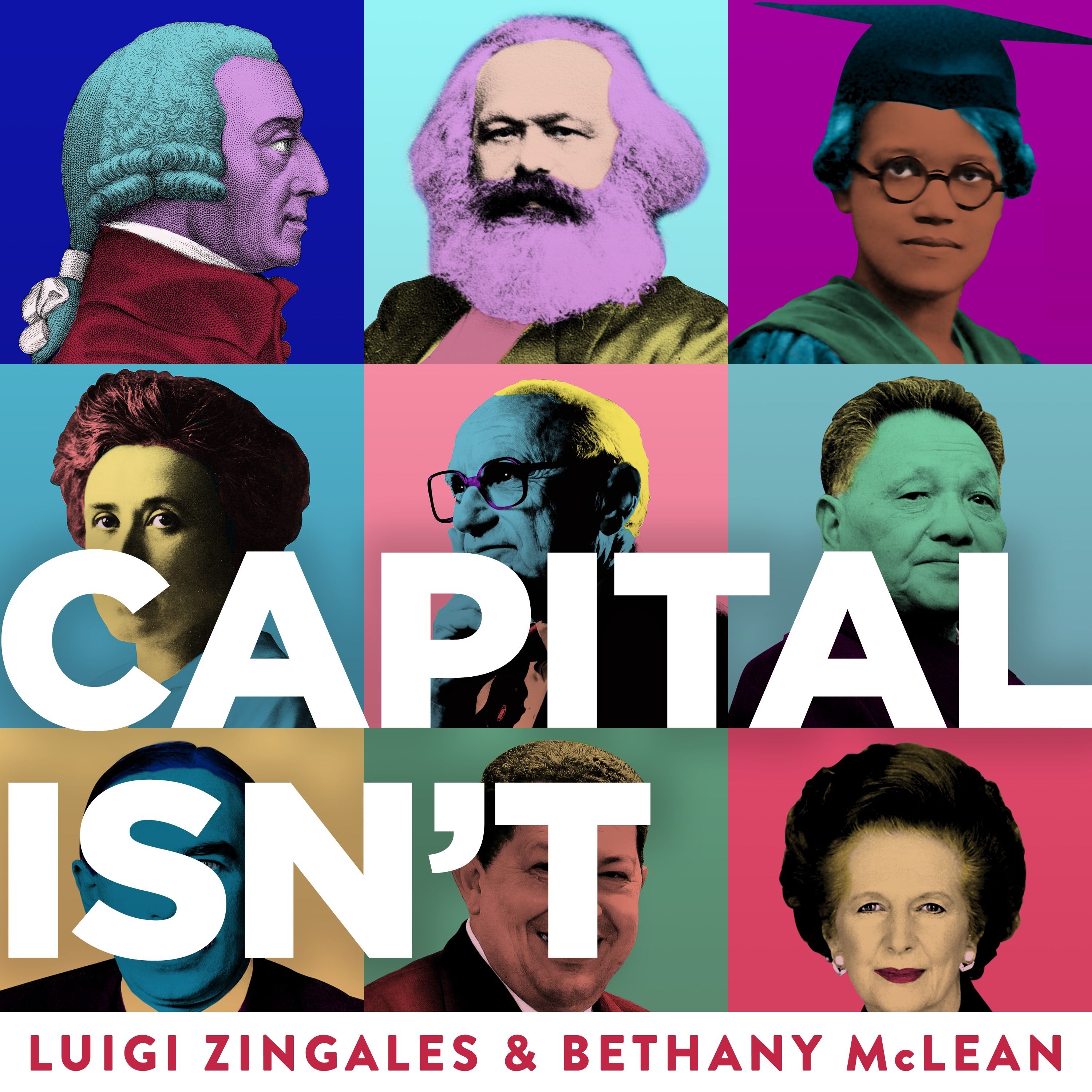
Is capitalism the engine of destruction or the engine of prosperity? On this podcast we talk about the ways capitalism is—or more often isn’t—working in our world today. Hosted by Vanity Fair contributing editor, Bethany McLean and world renowned economics professor Luigi Zingales, we explain how capitalism can go wrong, and what we can do to fix it. Cover photo attributions: https://www.chicagobooth.edu/research/stigler/about/capitalisnt. If you would like to send us feedback, suggestions fo...