Episode Summary
Executive Summary: The episode examines how economists became unusually influential in U.S. policymaking from roughly 1969 to 2008, reshaping markets, antitrust, monetary policy, and labor policy through a market-first, efficiency-first lens. Guests debate whether that influence improved capitalism or helped produce slower growth, greater inequality, and weakened democratic accountability, while arguing for broader, more pluralistic economics.
Main Topics: The rise of economist influence in public policy: Benjamin Applebaum explains how economists moved from marginal advisers to central policy actors, aided by better data, models, and institutional demand for quantitative expertise. Market efficiency as a governing ideology: The discussion centers on the economists’ claim that market mechanisms and efficiency should guide policy, often replacing political judgment with technical expertise. Conscription, militaries, and the limits of efficiency: A debate over Friedman’s argument for an all-volunteer military versus the idea that conscription can constrain war-making and keep conflict politically accountable. Antitrust’s shift to consumer welfare: The episode traces how antitrust moved from protecting producers and democracy to focusing narrowly on consumer prices, especially through Chicago School influence. Corporate power, legal strategy, and ideology: Guests discuss how corporations and sympathetic lawyers helped spread Chicago School ideas, including funding judge education and reframing legal standards. What economics should become: The speakers propose broadening economics to include history, institutions, psychology, politics, and non-monetary values, while reducing groupthink.
Key Arguments: Economists gained influence because their tools became more useful, especially as data and computing expanded, but usefulness does not guarantee better outcomes. The Economist Hour’s promise—that markets and economists would improve growth, equality, and democracy—was not fulfilled; growth slowed and inequality worsened. Conscription can act as a democratic brake on war by making military conflict more politically costly, even if it is less economically efficient. The consumer welfare standard in antitrust displaced older democratic and producer-focused goals, and it was legitimized partly through a misleading historical narrative. A major driver of policy change was not economists alone but also corporations, lawyers, judges, and journalists who adopted and amplified those ideas. Economics should reconnect with political economy, institutional knowledge, and other disciplines to better capture values that cannot be reduced to prices or metrics. There is a lag between academic shifts and policy change, so older economic ideas can continue shaping government long after the academy has moved on.
Data Points: Period of economist dominance: roughly 1969 to 2008 - Applebaum’s framing of the “Economist Hour” as the era when economist-led policymaking dominated Early macro models runtime: days per run - Description of 1960s macroeconomic models and how limited computing made analysis slow Drafting scale after WWII: tens and even hundreds of thousands of men annually - United States peacetime draft described as a major labor input into the military Minimum wage survey year: 1987 - New York Times editorial board cited economists’ opposition to the minimum wage Policy lag window: over the last decade - Discussion of recent intellectual ferment in economics not yet fully reflected in policy Historical timeframe of antitrust shift: late 19th century to late 1970s - Evolution from Sherman Act goals to Chicago School consumer welfare standard
Pivotal Quotes: "In a democracy, the ultimate responsibility for a country's economic policy should belong to the political leader." — Luisa Zingales: Opening analogy comparing military civilian control to democratic control over economic policy "The Economist Hour is a period from roughly 1969 to 2008 in which this approach to economic policy predominates." — Benjamin Applebaum: Defining his book’s central historical period "It provided us with firm ground. We didn't have firm ground beneath our feet." — Stephen Breyer (quoted by Benjamin Applebaum): Explaining why legal actors adopted the Chicago School antitrust framework
Implications: The episode argues for a less technocratic, more pluralistic economics that weighs democracy, institutions, and distribution alongside efficiency. For listeners, it suggests policy should be judged by social outcomes, not just market metrics.
About Capitalisnt
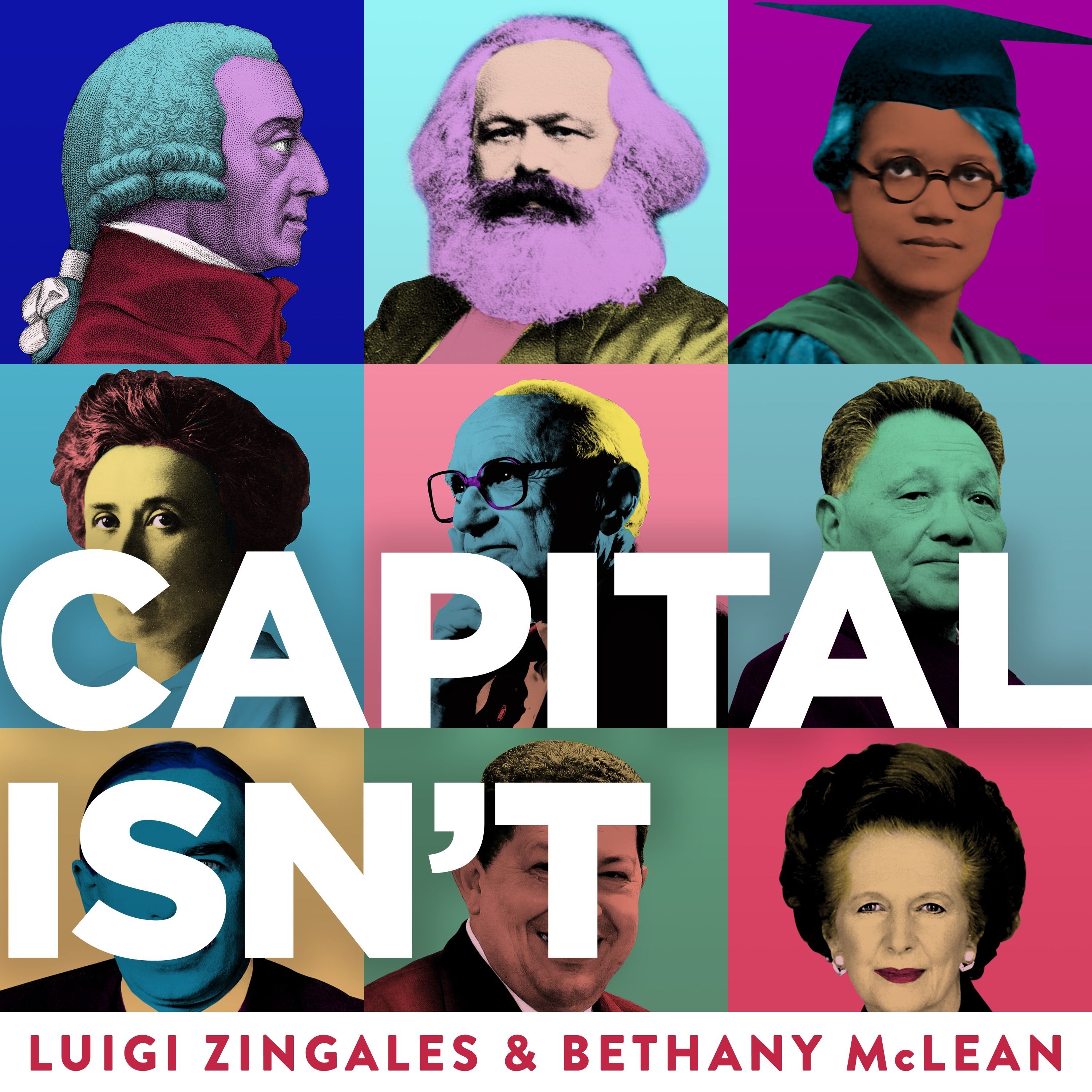
Is capitalism the engine of destruction or the engine of prosperity? On this podcast we talk about the ways capitalism is—or more often isn’t—working in our world today. Hosted by Vanity Fair contributing editor, Bethany McLean and world renowned economics professor Luigi Zingales, we explain how capitalism can go wrong, and what we can do to fix it. Cover photo attributions: https://www.chicagobooth.edu/research/stigler/about/capitalisnt. If you would like to send us feedback, suggestions fo...