Episode Summary
Executive Summary: The episode debates how economic reasoning—especially microeconomics, efficiency, and cost-benefit analysis—became dominant in policymaking and whether that dominance has gone too far. Bethany McLean, Luigi Zingales, and Elizabeth Popp Berman weigh the benefits of economic tools against their blind spots, especially around politics, distribution, and values. The core tension is whether economics should be contained, not rejected, and what should replace it where it fails.
Main Topics: Rise of economic reasoning in government: The discussion traces how microeconomic frameworks moved from academia into Washington and broader policymaking, becoming a default language for public decisions. Microeconomics vs. values and politics: Luisa and Elizabeth debate whether economic analysis can or should be separated from political goals, moral judgments, and non-monetary values. Limits of cost-benefit analysis: The speakers explore how monetization can obscure distribution, lobbying, and political manipulation, even when the approach improves decision-making. Health care and regulation as case studies: Health policy and regulatory cost-benefit analysis are used to show both the usefulness and the distortion of economic thinking in real governance. Student debt and strategic policy goals: Berman argues that some policies are justified less by narrow efficiency and more by their political and social opening effects. Political asymmetry between left and right: The conversation claims Republicans have been more flexible in using or discarding economics strategically, while Democrats became more bound to technocratic economic language. Risk of backlash against economics: Zingales worries that overreach and hubris by economists may provoke a broader rejection of economic discipline altogether.
Key Arguments: Economics is valuable as a tool for calculating monetary tradeoffs, but it should not be treated as a universal decision framework that replaces values. Microeconomic reasoning spread through policy because it offered a common language of incentives, constraints, and efficiency, especially among center-left technocrats seeking to improve government. Cost-benefit analysis can be distorted by lobbying and by assumptions that ignore distributional effects and political power. Health care became a major site where economic thinking recast public policy around markets, competition, and incentives. Some policies, like student debt cancellation, may be justified not by narrow optimality but by their role in shifting political possibilities and expanding future reform space. The left increasingly accepted technocratic and neoliberal frames after the Cold War, while the right selectively embraced or rejected economics depending on whether it served its goals. Overuse of economics risks triggering a backlash that could weaken even the legitimate role of economic discipline in policymaking.
Data Points: Book history period: 1960s-1980s - Describes the era when microeconomic reasoning became increasingly influential in policymaking and government. MBA example: 3 hours in class - Used by Luigi Zingales to illustrate non-monetary costs faced by evening MBA students. Student debt cancellation: $500 billion - Referenced as a large-scale policy choice discussed through the lens of opportunity cost. Student debt forgiveness amount: $10,000 - Mentioned as a structured version of debt cancellation intended to target benefits more toward lower- and middle-income borrowers. Reagan era: 1980s - Used as an example of Republicans selectively deploying economic expertise where it aligned with deregulatory goals. Health policy context: 1960s - Medicare and Medicaid creation marked the period before health economics became a major subfield. Discussion timeline: 30 years - Zingales references teaching net present value over roughly three decades to illustrate the evolution of economic pedagogy. Political events cited: Stagflation, Soviet decline, rising European competition - Presented as broader conditions that enabled the spread of economic rationalization in government.
Pivotal Quotes: "The role of an economist should be the role of the guy computing the net present value, but also with the humility of saying, I'm not good at evaluating the rest." — Luisa Zingales: Explaining what economics should and should not claim to evaluate in policy decisions. "I think there is a lot of value in using the economic language to attack certain problems. There are also some risks, like all the languages, all the tools, they can be overused." — Elizabeth Popp Berman: Defining her nuanced critique of the economic style of reasoning. "I think it will actually help real people. I think it will make a difference in many people's lives." — Elizabeth Popp Berman: Defending student debt relief as a politically meaningful intervention beyond pure cost-benefit analysis.
Implications: Listeners are left with a cautionary message: economics remains useful, but it needs boundaries, humility, and attention to power, distribution, and politics. The debate suggests future policy fights will hinge on whether technical efficiency or value-based goals set the terms.
About Capitalisnt
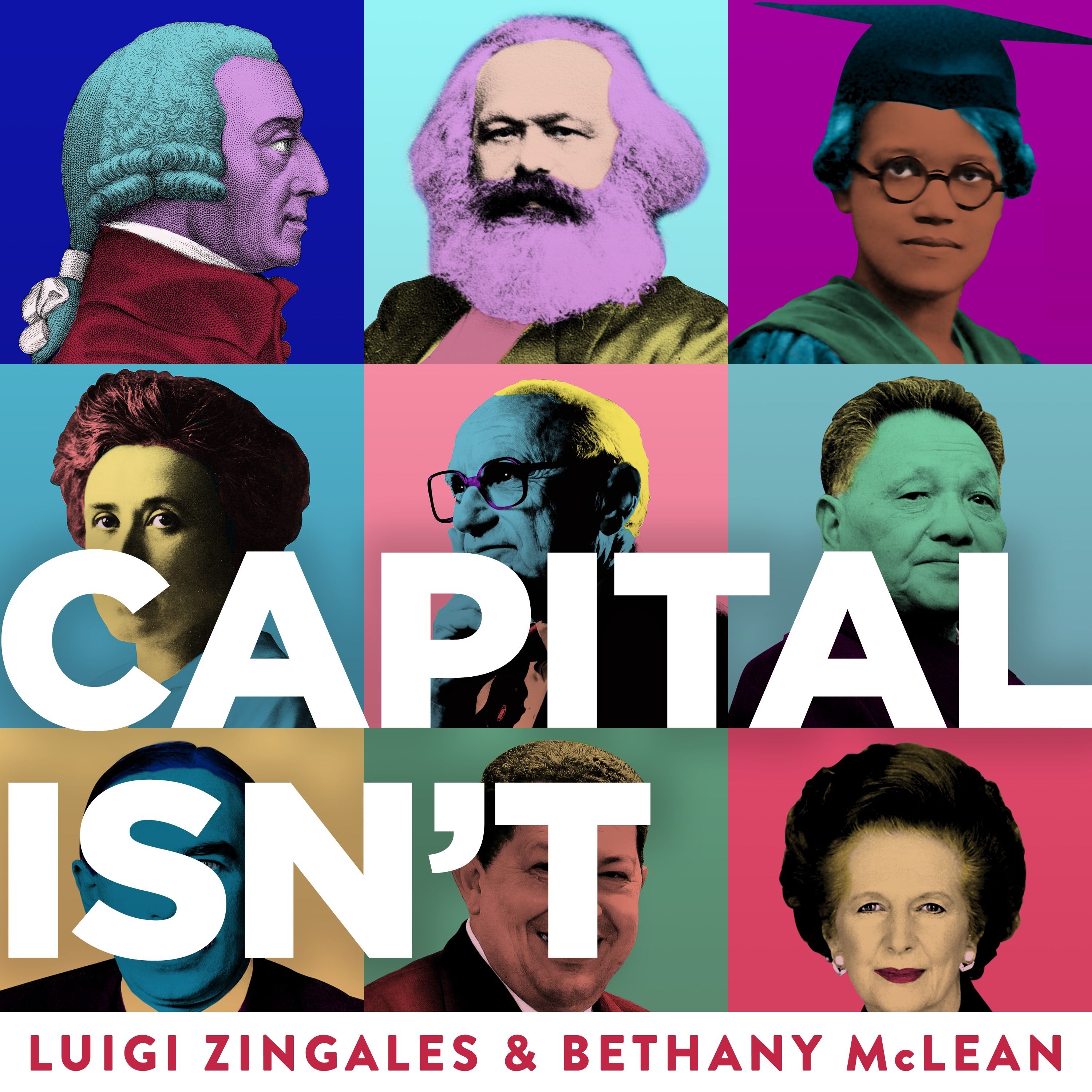
Is capitalism the engine of destruction or the engine of prosperity? On this podcast we talk about the ways capitalism is—or more often isn’t—working in our world today. Hosted by Vanity Fair contributing editor, Bethany McLean and world renowned economics professor Luigi Zingales, we explain how capitalism can go wrong, and what we can do to fix it. Cover photo attributions: https://www.chicagobooth.edu/research/stigler/about/capitalisnt. If you would like to send us feedback, suggestions fo...