Episode Summary
Executive Summary: The episode argues that U.S. public policy has been reshaped by an "economic style of reasoning"—a neoliberal, efficiency-first lens that prioritizes cost-benefit analysis, market mechanisms, and technocratic constraints over equality, universalism, and moral goals. Guest Elizabeth Popp Berman explains how this mindset spread through Democratic administrations, policy schools, law schools, and institutions like the CBO, and why progressives are now trying to rebuild policy around broader values and democratic aims.
Main Topics: The rise of economic style reasoning: Elizabeth Popp Berman defines the "economic style of reasoning" as a microeconomics/Econ 101 approach centered on efficiency, trade-offs, and cost-effectiveness that became dominant in policy circles. How neoliberal thinking entered government: The conversation traces the spread of this approach from the 1960s onward, especially through liberal and Democratic institutions that adopted it as a supposedly neutral way to make government more effective. Efficiency versus equality and universalism: The guests argue that efficiency is itself a value that often conflicts with universal programs like Medicare and Social Security, and with policies aimed at equality, participation, or broad social solidarity. Center-left responsibility for neoliberal policy: A major theme is that the center-left, not only conservatives, helped institutionalize market-oriented reasoning in policy schools, law schools, think tanks, and federal agencies. Student debt, higher education, and means testing: Student loan forgiveness and higher-ed financing are used as examples of how efficiency logic favors means testing, user-pays models, and competition, often weakening durable political support. Rejection of technocracy in the current Democratic moment: The discussion highlights a newer political opening in which parts of the Democratic coalition are questioning old cost-efficiency frameworks and debating alternatives like the Green New Deal. Building a new policy framework: Berman argues there is no single replacement ideology; instead, progressives need domain-specific arguments rooted in moral goals, intellectual communities, and new policy language.
Key Arguments: Thinking like an economist originally seemed modern and sensible, but it has become constraining because it narrows policy to efficiency and cost-effectiveness. The economic style of reasoning is not politically neutral; it embeds values, especially the prioritization of efficiency over equality, universalism, and democratic participation. Policy problems were historically framed in moral terms—for example, pollution as wrong—whereas economic framing turns them into pricing or externality problems. Universal policies often have stronger political durability and broader moral appeal than means-tested, narrowly targeted programs. Center-left institutions helped spread neoliberal policy logic more than is often acknowledged, making it part of Democratic governance and elite training pipelines. Law schools and public policy schools have taught simplified Econ 101 assumptions as factual, shaping how future policymakers and lawyers think about wages, markets, and regulation. The CBO and cost-scoring culture reinforce an institutional bias toward constraint, making ambitious policy easier to dismiss as inefficient or too costly. A new progressive path forward requires re-centering moral goals and collective action rather than defaulting to efficiency as the primary metric. There is no single universal alternative framework; progressives need to build arguments case by case around what they actually want to accomplish. Current Democratic politics show a real internal debate between neoliberal technocrats and a newer, more expansive policy vision. Higher education became more expensive partly because funding shifted from institutions to individuals, justified by human-capital and competition arguments. A policy can be effective without being efficient, and the market is not inherently efficient in the way efficiency-first thinking assumes.
Data Points: Historical spread of economic style reasoning: 1960s–1980s - Berman says the approach entered Washington in the 1960s and spread through the 70s and 80s. Policy schools as an institutional shift: late 1960s - Public policy schools were explicitly created around cost-effectiveness thinking in the late 1960s. Higher education funding model shift: up into the 1960s - Before the shift, most funding flowed to institutions rather than individuals. Degree of current change: first administration since Carter - Berman says this may be the first Democratic administration since Carter without strong dominance of center-left technocratic policy orientation. Time horizon of political frustration: 30 years - Nick notes that "thinking like an economist" might have sounded positive 30 years ago but not today.
Pivotal Quotes: "thinking like an economist, that probably would have been taken as a positive instruction 30 years ago, but today, not so much." — Nick Hanauer: Opening framing of the episode’s core critique of efficiency-first policy thinking. "Efficiency is itself a value." — Elizabeth Popp Berman: Berman explains why the supposed neutrality of cost-effectiveness is misleading. "there's much more to life than economics." — Nick Hanauer: The closing policy takeaway that government should pursue moral and democratic goals, not just efficiency.
Implications: Listeners are being urged to question efficiency as the default policy standard and to push for universal, morally grounded, and democratic solutions. The broader message: changing policy requires changing the intellectual institutions that train policymakers.
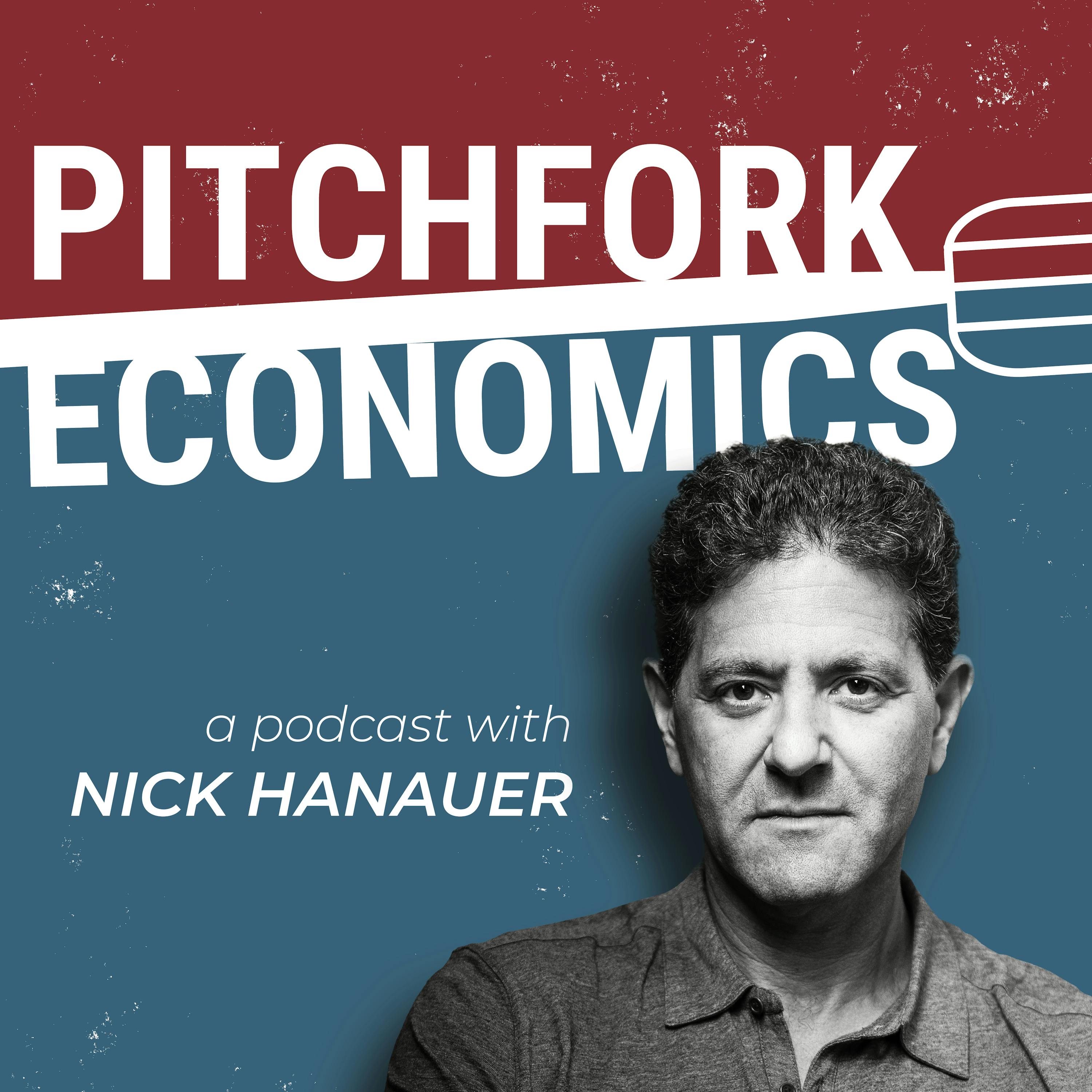
About Pitchfork Economics
We are living through a paradigm shift from trickle-down neoliberalism to middle-out economics — a new understanding of who gets what and why. Join zillionaire class-traitor Nick Hanauer and some of the world’s leading economic and political thinkers as they explore the latest thinking on how the economy actually works.