Episode Summary
Executive Summary: The episode pits Steve Kaplan’s defense of U.S. capitalism against Bethany McLean and Luigi Zingales’ concerns about inequality, health care, education, and social mobility. Kaplan argues the U.S. outperforms Europe on innovation, GDP, and employment, while critics counter that many gains are hidden by transfers, precarious jobs, and major failures in health and opportunity. The discussion ends by stressing that capitalism needs a stronger state, not less accountability.
Main Topics: How to judge an economic system: Kaplan lays out criteria for success: GDP per capita, a safety net that preserves incentives, innovation/dynamism, labor-market health, and rule of law. The hosts probe whether distribution should count more heavily in evaluating capitalism. Inequality and what counts as progress: The conversation centers on whether after-tax income and consumption gains offset weak pre-tax wage growth for the bottom half. Kaplan emphasizes broad improvements after taxes and transfers, while Zingales worries that market outcomes are too unequal to sustain democracy. Health care as the biggest U.S. failure: All three converge on U.S. health care as a major weakness: high costs, poor outcomes, insurance tied to employment, and perverse incentives that can lead to over-treatment and under-prevention. Europe vs. the United States: Kaplan argues Europe suffers from stagnation, inflexible labor markets, and lower innovation; Zingales points to better distribution, life expectancy, and happiness in some European countries, especially Sweden, and argues the U.S. could do better. Mobility, education, and the American dream: The hosts question whether the U.S. still offers real upward mobility. Kaplan blames poor public education and teacher-union power; Bethany and Luigi argue that unequal schooling and weak opportunity undermine capitalism’s legitimacy. Trade-offs from globalization and technological change: The episode revisits the China shock and the costs of rapid adjustment, including job loss, addiction, and social dislocation. Kaplan favors faster adaptation plus a stronger safety net; Zingales favors slowing change to reduce human damage. Safety net versus universal opportunity: The panel debates whether UBI or a minimal safety net is enough. Bethany and Zingales argue that merely preventing starvation is inadequate and that people need meaningful work, health security, and educational opportunity for the system to be politically durable.
Key Arguments: Kaplan argues the U.S. should be judged by overall output, employment, innovation, and institutional function, not just inequality metrics. He contends that after-tax income and especially consumption are more relevant welfare measures than pre-tax income because taxes and transfers materially improve outcomes for lower quintiles. He cites research suggesting absolute poverty in the U.S. has fallen sharply since 1980, and global extreme poverty has also declined. Kaplan says Europe’s greater redistribution comes with weaker growth, lower employment, and stagnation, making the U.S. model preferable despite its flaws. Zingales argues that if pre-tax market income is flat for much of the population while gains accrue to the top, capitalism risks losing democratic legitimacy. Bethany emphasizes that health insurance and education are not merely side issues; they shape whether people feel free to take risks, change jobs, and believe their children have opportunity. The hosts argue that state capacity and public investment are central to capitalism’s success, so markets alone should not get credit for innovation or wealth creation. The conversation suggests that some U.S. social problems—opioids, preventable deaths, school inequality—are not just “market outcomes” but failures of regulation, enforcement, and public policy. Both sides agree that the U.S. health system is broken, though they differ on whether the core problem is capitalism or government design. There is broad agreement that a system relying on transfers alone, without genuine opportunity and good jobs, may be politically unsustainable. The China shock is presented as evidence that rapid trade adjustment can devastate communities, and that policy should cushion workers more effectively. The episode concludes that capitalism needs stronger public institutions, civic responsibility, and a more visible social contract to remain viable.
Data Points: U.S. unemployment: Historically low - Kaplan cites this as evidence the labor market is functioning well. Bottom 50% real after-tax income growth (1980-2022): Up by about two-thirds - Kaplan cites Auten and Splinter to argue broad gains after taxes and transfers. Bottom 50% pre-tax income growth (last 25 years): 0% to 10% - Luigi uses this to argue market income for the bottom half has barely grown. Top 0.01% income growth (last 25 years): 100% to 200% - Luigi cites this to show extreme top-end gains. U.S. poverty rate: Fell from 13% to under 3% - Kaplan says absolute poverty declined substantially from 1980 to 2018. Public belief about poverty: 68% think poverty increased - Kaplan cites Bruce Meyer to show perception diverges from data. U.S. life expectancy change since 1980: Up by about 5 years - Kaplan uses this to argue the U.S. has improved, though less than Western Europe. Western Europe life expectancy change since 1980: Up by about 7-8 years - Used in the health comparison with the U.S. U.S. healthy life expectancy: 63 years - Luigi cites this as evidence of a major health-system failure. Preventable deaths per 100,000 in the U.S.: 358 - Luigi contrasts this with far better outcomes in Japan, Israel, and Korea. Median vs. 10th percentile consumption inequality: Has gotten less over time - Kaplan says the 50-10 measure improved on a consumption basis. U.S. vs. Europe post-GFC performance: U.S. outperformed major European economies - Kaplan argues the U.S. has continued to grow faster than Germany, France, and the Netherlands. Sweden population: About 10 million - Kaplan uses this to note Sweden’s smaller scale relative to the U.S. Premature death statistic cited by Luigi: 4 out of 100 children born to age five do not make it to 40 - Luigi attributes part of this to opioids and environmental harms. Healthcare premium increase: 40% increase - Bethany says her independent-contractor health insurance premium rose sharply while coverage worsened.
Pivotal Quotes: "The alternative is stagnation." — Steve Kaplan: Kaplan’s core defense of the U.S. model against European-style social democracy. "If it doesn't deliver for the majority of the people, then you have two choices. Either you give up with capitalists or you give up with democracy." — Luigi Zingales: Luigi frames democratic legitimacy as dependent on broad economic gains. "I think the U.S. health system is broken." — Steve Kaplan: Kaplan concedes the system’s biggest weakness during the health-care discussion.
Implications: The episode argues capitalism will remain politically sustainable only if it delivers visible opportunity, affordable health care, and broad-based gains. Otherwise, resentment grows and support for markets and democracy erodes. Public policy, not markets alone, must fix the failures.
About Capitalisnt
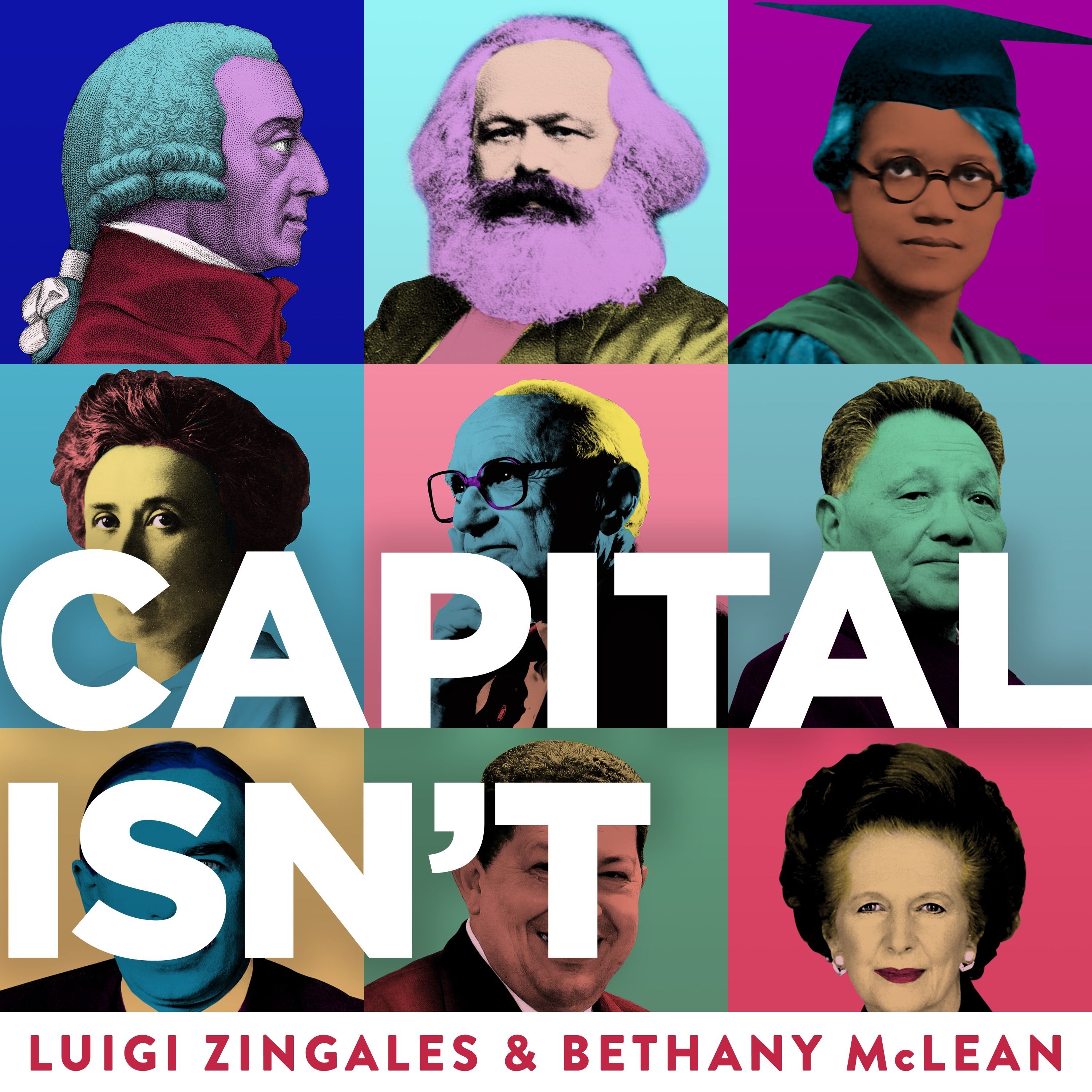
Is capitalism the engine of destruction or the engine of prosperity? On this podcast we talk about the ways capitalism is—or more often isn’t—working in our world today. Hosted by Vanity Fair contributing editor, Bethany McLean and world renowned economics professor Luigi Zingales, we explain how capitalism can go wrong, and what we can do to fix it. Cover photo attributions: https://www.chicagobooth.edu/research/stigler/about/capitalisnt. If you would like to send us feedback, suggestions fo...