Episode Summary
Executive Summary: The episode centers on Vivek Ramaswamy’s critique of “woke” corporate activism and a broader debate over what corporations owe society. He argues companies should maximize profit within the law and warns against government using private firms to do what it cannot do directly. The hosts probe limits, externalities, and the tension between capitalism, virtue, and democratic accountability, then pivot to a current issue: whether employers should pressure workers back to the office.
Main Topics: Corporate purpose vs. stakeholder capitalism: Ramaswamy argues the corporation’s bargain is explicit: society grants limited liability, and in return firms should focus on profit, not social mission. The hosts challenge how that squares with real-world externalities and public responsibility. Government coercion through private companies: A major claim is that state action can be outsourced to firms, especially in tech moderation and bank settlements. Ramaswamy says when government cannot directly do something constitutionally, it should not deputize corporations to do it. Limits of externalities and regulation: The discussion tests whether companies should self-police harms like social media effects, pollution, and product health impacts. Ramaswamy concedes hard boundary cases like DuPont and Volkswagen reveal the messiness of the argument. Virtue, civic life, and capitalism: Ramaswamy insists virtue is a precondition for society, not a product of capitalism, and argues markets should stay separate from civic, religious, and family spheres. He criticizes commercialized virtue signaling as a substitute for real moral action. Hypocrisy and crony capitalism: The conversation highlights how corporations may publicly embrace social causes while acting differently in places like China, or benefit from political alliances. This is framed as a form of crony capitalism rather than authentic responsibility. Return-to-office and workplace control: In the segment on remote work, the hosts debate whether firms can compel office attendance, noting culture, productivity, surveillance, and gender implications. They differ on whether work-from-home is liberating or subtly discriminatory.
Key Arguments: Ramaswamy’s core claim is that if government cannot do something constitutionally, it should not use private corporations to do it indirectly. He argues modern big tech censorship fits the legal standard for state action because government officials threaten, induce, and coordinate with platforms. He says corporations have an explicit bargain: limited liability in exchange for a legal duty to maximize profit, not pursue stakeholder goals. He concedes that obvious harms like toxic pollution and emissions cheating expose weak points in his theory, but argues those are boundary cases rather than the norm. He contends externalities are often normative and politically contested, so democratic institutions—not CEOs—should decide them. He says capitalism should be kept separate from democracy, religion, and family life to preserve pluralism and prevent institutional overreach. On return-to-office, the hosts argue there is a real tradeoff between flexibility, culture, manager control, and possible career penalties for remote workers. Luisa Zingales argues that work-from-home may disadvantage women by increasing childcare burdens and creating a double standard around “good motherhood.”
Data Points: Limited liability: A legally invented privilege granted to corporate shareholders - Used as the basis for the argument that society gave corporations a special benefit in exchange for a profit-focused mandate Brentwood state-action test: 3 conditions - Private company can be treated as state actor if responsive to government threats, induced by government, or coordinating in joint activity Tech moderation example: 3 conditions met - Ramaswamy says modern big tech censorship satisfies all three Brentwood conditions Bank settlement workaround: $3 off - Described as the amount banks could reduce public fines for each dollar routed to certain nonprofits Bank settlement workaround: $1 - Each dollar banks gave to a nonprofit instead of paying a DOJ fine Bank settlement workaround: 501(c)(3) - Nonprofit channel used because such contributions are tax deductible and politically useful Post-2008 crisis settlements: multi-million dollar / multi-billion dollar settlements - Referenced as examples of government using private banks to achieve policy goals indirectly Company hiring policy: 25th percentile of income or below - Ramaswamy cites RoyVant’s hiring preference as an example of decisions he sees as business-motivated rather than ideological Remote-work time frame: at least January of next year - Facebook’s stated return-to-office date in the discussion of pandemic-era workplace policy
Pivotal Quotes: "If the government can't do something under the Constitution, then the government cannot deputize a private company to go do that same thing instead." — Vivek Ramaswamy: Central thesis on state action and corporate misuse by government "Virtue is a precondition for capitalism. It's not a product of capitalism." — Vivek Ramaswamy: His view that markets depend on moral culture outside the market "we ought to be able to debate those in the open, in the sphere of public debate through free speech and open debate in a democracy" — Vivek Ramaswamy: Argument that civic institutions, not corporate platforms, should handle contested moral questions
Implications: The episode urges clearer boundaries between markets, politics, and civic life. For firms, it warns against performative activism and hidden coercion; for workers, remote work may expand flexibility but also invite surveillance and unequal career costs, especially for women.
About Capitalisnt
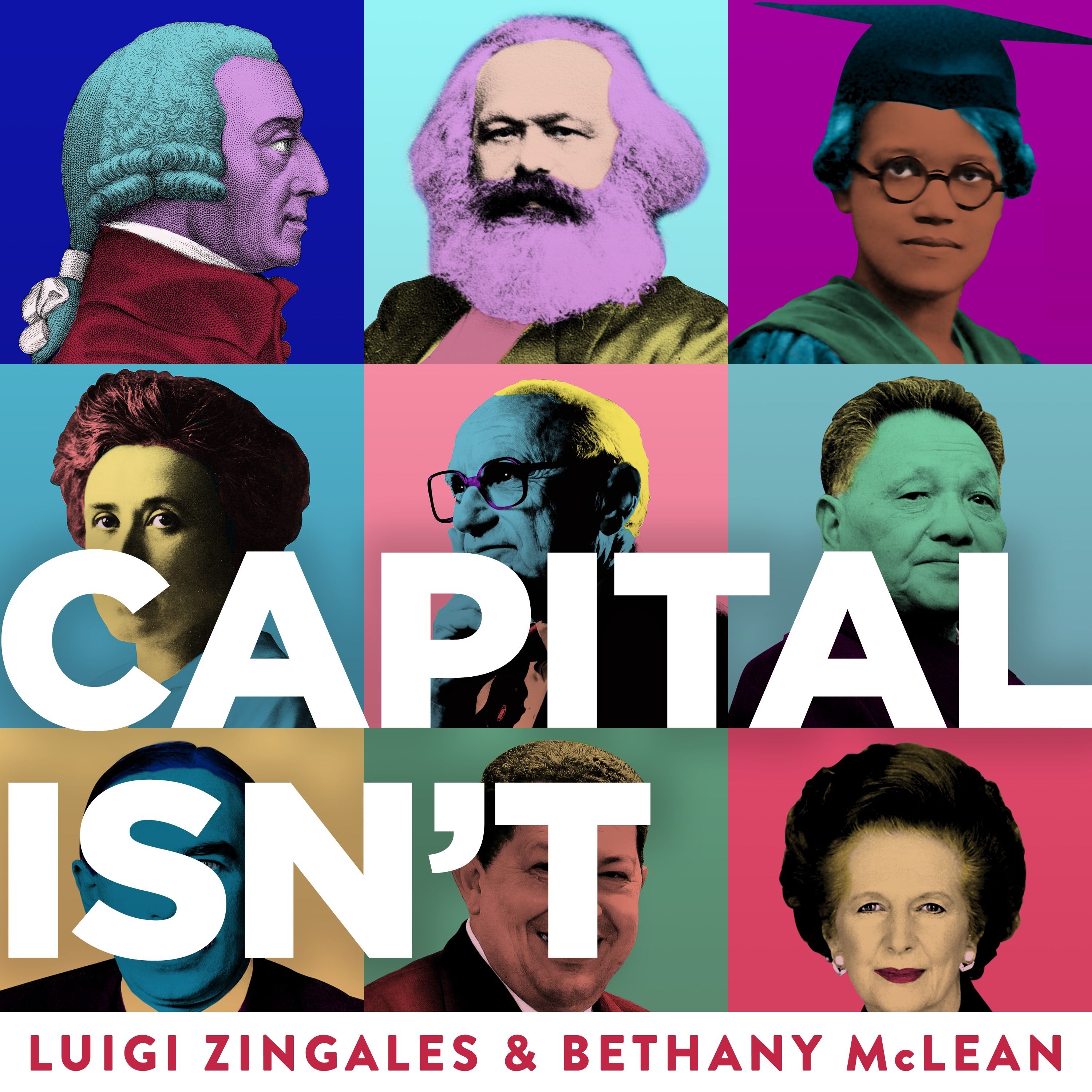
Is capitalism the engine of destruction or the engine of prosperity? On this podcast we talk about the ways capitalism is—or more often isn’t—working in our world today. Hosted by Vanity Fair contributing editor, Bethany McLean and world renowned economics professor Luigi Zingales, we explain how capitalism can go wrong, and what we can do to fix it. Cover photo attributions: https://www.chicagobooth.edu/research/stigler/about/capitalisnt. If you would like to send us feedback, suggestions fo...