Episode Summary
Executive Summary: The episode replays a wide-ranging discussion with Vivek Ramaswamy about his book 'Woke Inc.' and his critique of corporate wokeness, limited liability, and stakeholder capitalism. The conversation contrasts corporate social-justice branding with genuine virtue, argues for clear boundaries between capitalism and politics, and closes with a debate over work-from-home, gender effects, and how capitalism reshapes norms.
Main Topics: Vivek Ramaswamy's critique of woke capitalism: Ramaswamy argues that corporations use social justice language to gain power, moral authority, and competitive advantage, often while acting hypocritically in practice. Limited liability and the purpose of the corporation: A central debate is whether limited liability creates a social bargain that obligates corporations to do more than maximize profits, and whether corporations should instead stay confined to market goals. Government, private companies, and delegated state power: Ramaswamy claims modern big tech censorship and some financial settlements show government using private firms to do what it cannot legally do directly, raising constitutional concerns. Externalities, regulation, and moral judgment: The hosts probe whether corporations can or should self-police harmful behavior, using examples like social media, pollution, opioids, and drug pricing to test the limits of profit maximization. Virtue, civic life, and the role of institutions: The discussion broadens into a claim that virtue is a precondition for society, not just capitalism, and that market logic should not colonize family, religious, or democratic life. Work-from-home, culture, and surveillance: The episode ends with a debate on remote work’s effects on productivity, control, office culture, and whether it benefits or harms women and workers more broadly.
Key Arguments: Ramaswamy argues that if government cannot do something constitutionally, it should not be able to outsource that action to private companies. He claims modern tech moderation shows all three state-action signals: government inducement, coordination, and pressure on private firms. He reframes limited liability as a grant of power that should keep corporations confined to profit-making and out of civic and political life. The hosts argue that some corporate harm is real and not always corrected by reputation or law, citing pollution, opioids, and drug pricing. Ramaswamy responds that many 'negative externalities' are hard to measure in advance, so governments—not corporations—should set guardrails. Both sides agree corporations often use progressive branding selectively, especially when they act differently in China or other markets. The conversation suggests stakeholder capitalism can become performative, letting executives signal virtue while avoiding real sacrifice. On remote work, one side sees it as useful experimentation; the other worries it may create surveillance, weaken culture, and disadvantage women. A central tension emerges between capitalism as an efficient market system and broader social institutions that preserve meaning, decency, and democratic equality.
Data Points: Corporate success cited: multi-billion dollar success - Ramaswamy describes his biotech company Royvants as a multi-billion dollar success with multiple FDA-approved drugs. FDA-approved products: several - Used to show Royvants achieved concrete pharmaceutical outcomes. Law school stint: 3 years - Ramaswamy says he attended Yale Law School for three years before returning to investing. Stand-up comedy side project: 6-month stint - He says he did stand-up comedy on the side and learned to carry a notebook for annoyances. Bargain under debate: limited liability - Central concept discussed as the foundational legal privilege granted to corporations and shareholders. Drug price increase example: 300% or 1,000% - A reference to Martin Shkreli’s infamous price increases in the drug-pricing discussion. Tax rate reference: close to 90% - Used in a discussion of historical CEO compensation and tax incentives. Go-back-to-office policy timing: at least January of next year - Referenced in relation to Facebook delaying office return. Work arrangement options: remote, hybrid, all in person or on-premise - LinkedIn feature mentioned as a sign of changing work norms.
Pivotal Quotes: "If the government can't do something under the Constitution, then the government cannot deputize a private company to go do that same thing instead." — Vivek Ramaswamy: Explaining the book’s core constitutional argument against government-private coordination. "We have created this whole parallel system for corporations where the people now often have... the corporation isn't prosecuted criminally because that would destroy the corporation, and the people aren't prosecuted criminally because they're destroyed." — Bethany McLean: Describing the concern that corporate accountability has become diffuse and ineffective. "Virtue is a precondition for capitalism, not for capitalism to work in its own right." — Vivek Ramaswamy: Summarizing his view that markets depend on moral norms that lie outside capitalism itself.
Implications: Listeners are left with a sharper critique of corporate virtue-signaling and a warning that markets can distort politics, labor, and social norms. The episode suggests real reform requires clearer legal boundaries and stronger civic virtue, not just better branding.
About Capitalisnt
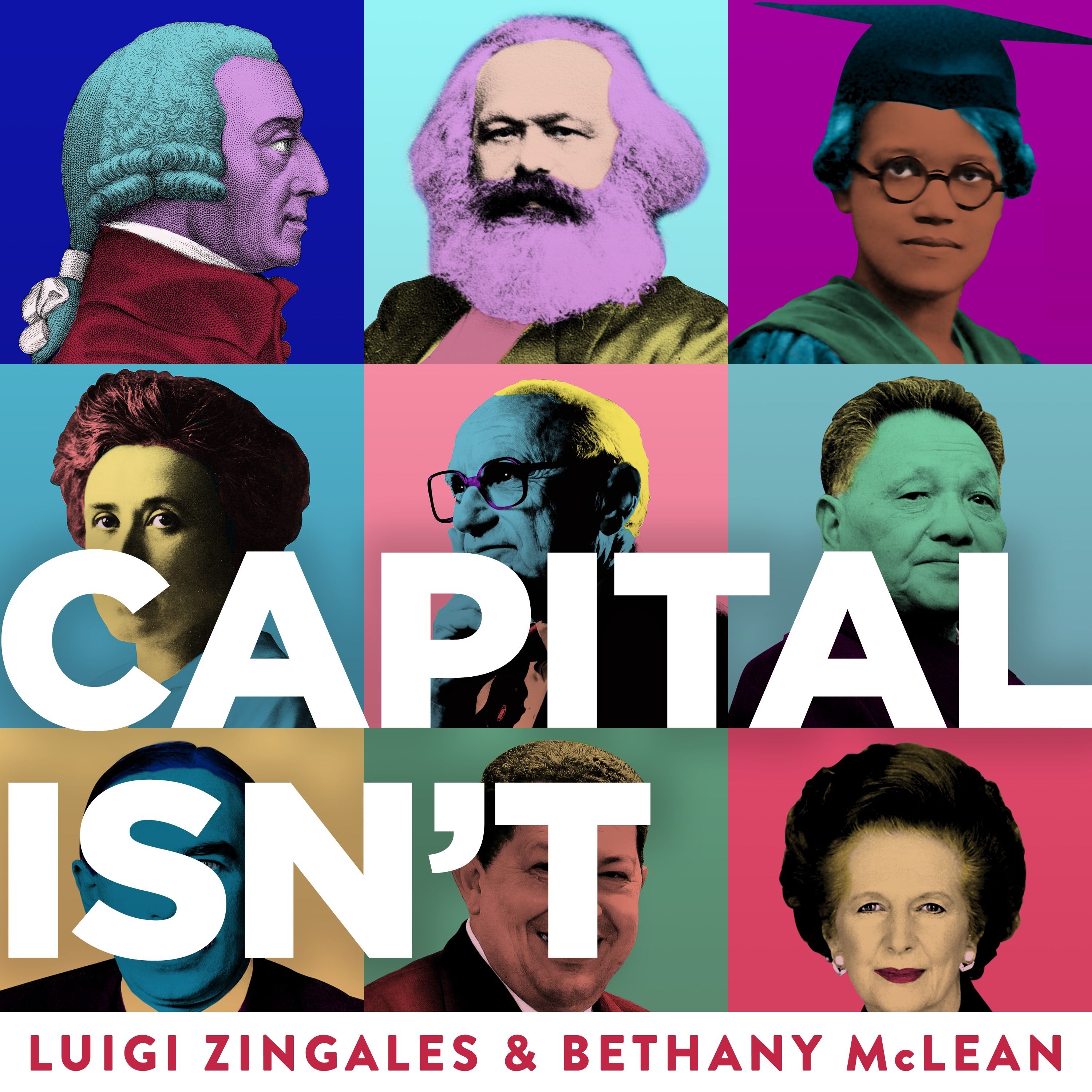
Is capitalism the engine of destruction or the engine of prosperity? On this podcast we talk about the ways capitalism is—or more often isn’t—working in our world today. Hosted by Vanity Fair contributing editor, Bethany McLean and world renowned economics professor Luigi Zingales, we explain how capitalism can go wrong, and what we can do to fix it. Cover photo attributions: https://www.chicagobooth.edu/research/stigler/about/capitalisnt. If you would like to send us feedback, suggestions fo...