Episode Summary
Executive Summary: The episode explores infinity through philosophy, math, and paradoxes, contrasting intuitive discomfort with formal mathematical tools. It moves from Thomas Nagel’s immortality thought experiment to Hilbert’s Hotel, Zeno’s paradoxes, and calculus, arguing that infinity can be handled rigorously in mathematics even if it remains metaphysically unsettling. The show also links the theme of gradual, cumulative change to cancer research breakthroughs.
Main Topics: Infinity as a philosophical and mathematical concept (Priority: 5/5): The hosts debate whether infinity is a number or an abstract boundless quantity, emphasizing how strange and counterintuitive it is while still being useful in mathematics. Hilbert’s Hotel and infinite set behavior (Priority: 5/5): The infinite hotel thought experiment demonstrates how an infinite hotel can still accommodate more guests, including an infinite bus and even infinitely many buses, illustrating that infinity does not behave like finite quantities. Historical attitudes toward infinity (Priority: 4/5): The episode traces early discomfort with infinity through the Greeks, including Pythagorean beliefs, the irrationality of square root of two, and Zeno’s paradoxes, showing how infinity was long treated as a philosophical problem. Calculus as the resolution to Zeno’s paradoxes (Priority: 5/5): Newton and Leibniz’s calculus is presented as the formal mathematical framework that makes sense of infinite subdivision and motion by using limits and infinitesimals. Newton, Leibniz, and the politics of credit (Priority: 4/5): A substantial section recounts the bitter dispute over who invented calculus, highlighting Newton’s aggressive efforts to claim credit and damage Leibniz’s reputation. Infinity, limits, and unresolved paradoxes (Priority: 4/5): The hosts note that some infinite processes still produce unresolved questions, such as Thompson’s lamp and the flag-switching paradox, because the final state is not fully specified by the rules. Cancer research as gradual, cumulative scientific progress (Priority: 3/5): Sponsor segments use cancer biology to illustrate how small changes in cellular instructions accumulate over time and how targeted therapies emerged from long-term research, reinforcing the episode’s theme of incremental discovery.
Key Arguments: Infinity is not just a vague idea; in mathematics it can be treated as a meaningful quantity or structure, even if it resists ordinary arithmetic. Hilbert’s Hotel shows that adding one more guest to an infinite, fully booked hotel is possible because infinite sets can be rearranged without changing cardinality. Zeno’s paradoxes are resolved in practice by calculus, which formalizes the idea that infinitely many smaller and smaller steps can sum to a finite result. The key missing ingredient in Zeno’s paradox is the notion of a limit: the steps shrink fast enough that the total time or distance remains finite. Newton and Leibniz independently developed calculus, but Newton’s later campaign to discredit Leibniz distorted historical credit and slowed British adoption of Leibniz’s superior notation. Some paradoxes involving infinity are not fully resolved by calculus because they ask for a final state that the rules never specify, rather than a computable limit. The episode frames scientific progress, including cancer treatment development, as a process of careful incremental advances rather than sudden breakthroughs.
Data Points: Thomas Nagel thought experiment: Living another week vs dying in 5 minutes - Used to probe whether immortality would actually be desirable Human genome typing scale: 60 words per minute for 8 hours a day for about 50 years - Illustrates the size of the DNA rulebook in each cell Cancer types: More than 200 - Cancer is described as a family of diseases shaped by different cellular changes Hilbert’s Hotel capacity: An infinite number of rooms - The hotel thought experiment used to illustrate infinite sets Infinite bus scenario: An infinite bus with an infinite number of seats - Shows that an infinite hotel can still accommodate another infinite set Historical symbol use: 1655 - John Wallis’s earliest known use of the lemniscate to mean infinity Pythagorean era: 5th century BCE - Context for early Greek philosophical discomfort with infinity Zeno’s paradox subdivision: Half, quarter, eighth, sixteenth, etc. - Illustrates infinite subdivision of distance in the Achilles paradox Cancer treatment statistic: Over eight in 10 people in the UK receiving cancer drugs - These drugs are using one developed by or with Cancer Research UK scientists Cancer treatment development: In the late 1990s - Cancer Research UK scientists explored antibody-based cancer treatment ideas EGFR-targeting drugs: 13 different drugs - Used to treat six different types of cancers EGFR-targeted cancers: Six types - Includes certain lung, bowel, and head and neck cancers UK treatment volume: Around 4,300 people per year - People beginning treatment with a drug designed to switch off a specific cancer-driving signal Daily treatment figure: 11 people every day - People beginning these treatments in England
Pivotal Quotes: "I think that infinity is an amount. I think that there are different kinds of numbers." — Michael Stevens: Opening debate over whether infinity should be treated as a number "The thing that we're hinting at here is calculus; you know, we don't... really learn it until you're 17 or 18." — Hannah Fry: Transition from Zeno’s paradoxes to the mathematical resolution via calculus "Newton's a big deal, right? So Leibniz knew... Newton had done a bit of this stuff already." — Michael Stevens: Introduction to the calculus priority dispute
Implications: Listeners are left with a clearer sense that infinity is mathematically manageable but philosophically unsettling. The episode also shows how abstract ideas can reshape real-world science, from calculus to targeted cancer therapies.
About The Rest is Science
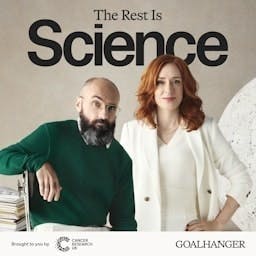
Join mathematician Professor Hannah Fry and science creator Michael Stevens (Vsauce) as they dig into the weird scientific questions that often go unexplored. Welcome to The Rest Is Science, a show that sits in the fascinating space between what we think we know, and what we actually know. Why do we assume we understand things like time, randomness, or even gravity? Once you start questioning these familiar ideas, reality becomes astonishingly strange and completely fragile. Whether you're a lifelong science fan or just naturally curious, The Rest Is Science will change your perception of reality, and prove that the biggest questions are always the most fun.