Episode Summary
Executive Summary: The episode examines the long-running debate over whether corporations should prioritize shareholders or broader stakeholders. Drawing on historical cases, legal doctrine, and recent examples like the Business Roundtable statement, the hosts argue that “stakeholder” rhetoric is often vague, may not change behavior, and can even serve as a strategic move to avoid regulation while managers retain real power.
Main Topics: Historical roots of shareholder vs. stakeholder debate: The hosts trace the debate back well before the 1970s, citing the 1919 Ford/Dodge case and the 1932 Burl/Dodd debate as foundational disputes over corporate purpose. Business Roundtable statement and its limits: They analyze the 2019 Business Roundtable announcement that corporations should serve all stakeholders, arguing it was rhetorically significant but lacked concrete operational changes. Legal doctrine and corporate fiduciary duty: The discussion explains how U.S. corporate law, especially in Delaware, largely still binds standard corporations to act in shareholders’ interests unless they adopt a benefit-corporation structure. Misreading Milton Friedman: The speakers argue Friedman is often oversimplified; he did not oppose treating employees/customers well, but opposed using shareholders’ money for broad social goals without consent. Managerial power vs. shareholder power: A key theme is that managers, not shareholders, may be the true center of power, and vague stakeholder mandates could reduce accountability and expand managerial discretion. Shareholder welfare, voting, and corporate democracy: The hosts debate whether boards should maximize stock price or shareholder utility, and whether shareholders should have stronger mechanisms to vote on socially significant issues like guns or the environment. Regulation, politics, and corporate self-interest: They argue many stakeholder claims would be better addressed through laws and regulation, and suggest corporate stakeholder language may function as a preemptive strategy against stricter regulation.
Key Arguments: The stakeholder/shareholder debate is much older than recent headlines suggest; it has roots in early 20th-century law and academic debate. The Business Roundtable statement sounds transformative but may not change incentives because it offers no concrete governance reforms. Under prevailing U.S. corporate law, standard for-profit corporations remain primarily accountable to shareholders unless they choose a benefit-corporation form. Milton Friedman is often misquoted: he did not say firms should ignore employees or customers, only that managers should not spend shareholder money on social causes without shareholder consent. Shareholder primacy is defended as a practical decision rule because stock price is measurable, while stakeholder objectives are harder to aggregate and police. A stakeholder model may empower managers rather than constituencies, creating weaker accountability and more room for self-interested behavior. If shareholders care about social issues, the better solution is stronger shareholder voting rights and more transparent disclosure, not vague stakeholder rhetoric. Many problems attributed to corporations should instead be addressed by government regulation, labor policy, and corporate tax law. The Roundtable’s statement may be a strategic move to reduce political pressure and avoid tougher regulation while appearing socially responsible. Some corporate actions, like Dick’s Sporting Goods stopping assault-weapon sales, raise the question of whether managers should maximize shareholder value or shareholder welfare/utility, which may include ethical preferences.
Data Points: Business Roundtable membership: nearly 200 CEOs - The organization issuing the statement consists of almost 200 top corporate executives. Year of Ford/Dodge case: 1919 - Historical lawsuit used to illustrate early shareholder-primacy thinking. Year of Burl/Dodd debate: 1932 - Important legal-scholar debate over corporate purpose during the Great Depression era. Business Roundtable statement year: 1981 - The Roundtable previously recognized corporations operate within complex competing relationships. Business Roundtable reversal year: 1997 - The group later emphasized that the principal objective of a business enterprise is to generate returns for owners. Milton Friedman article year: 1970 - Referenced as a major text arguing against managers acting on a social conscience. Stigler follow-up year: 1971 - Cited to show corporations can shape regulation for their own interests. S&P 500 futures reaction: barely changed; increased a little - Used as evidence that the Business Roundtable announcement had little market significance.
Pivotal Quotes: "the principal objective of a business enterprise is to generate economic returns to its owners" — Business Roundtable: Cited as the Roundtable’s 1997 shareholder-focused statement. "the only social responsibility of business is to maximize profits" — Milton Friedman: Referenced in the discussion of shareholder primacy and managerial duty. "with greater power comes greater responsibility" — Luisa Zingales: Used to frame the argument that corporate privilege can justify broader obligations to society.
Implications: Listeners should view stakeholder language skeptically: it may be more branding than reform. Real change likely requires clearer shareholder rights, stronger disclosure, and actual regulation rather than voluntary CEO statements.
About Capitalisnt
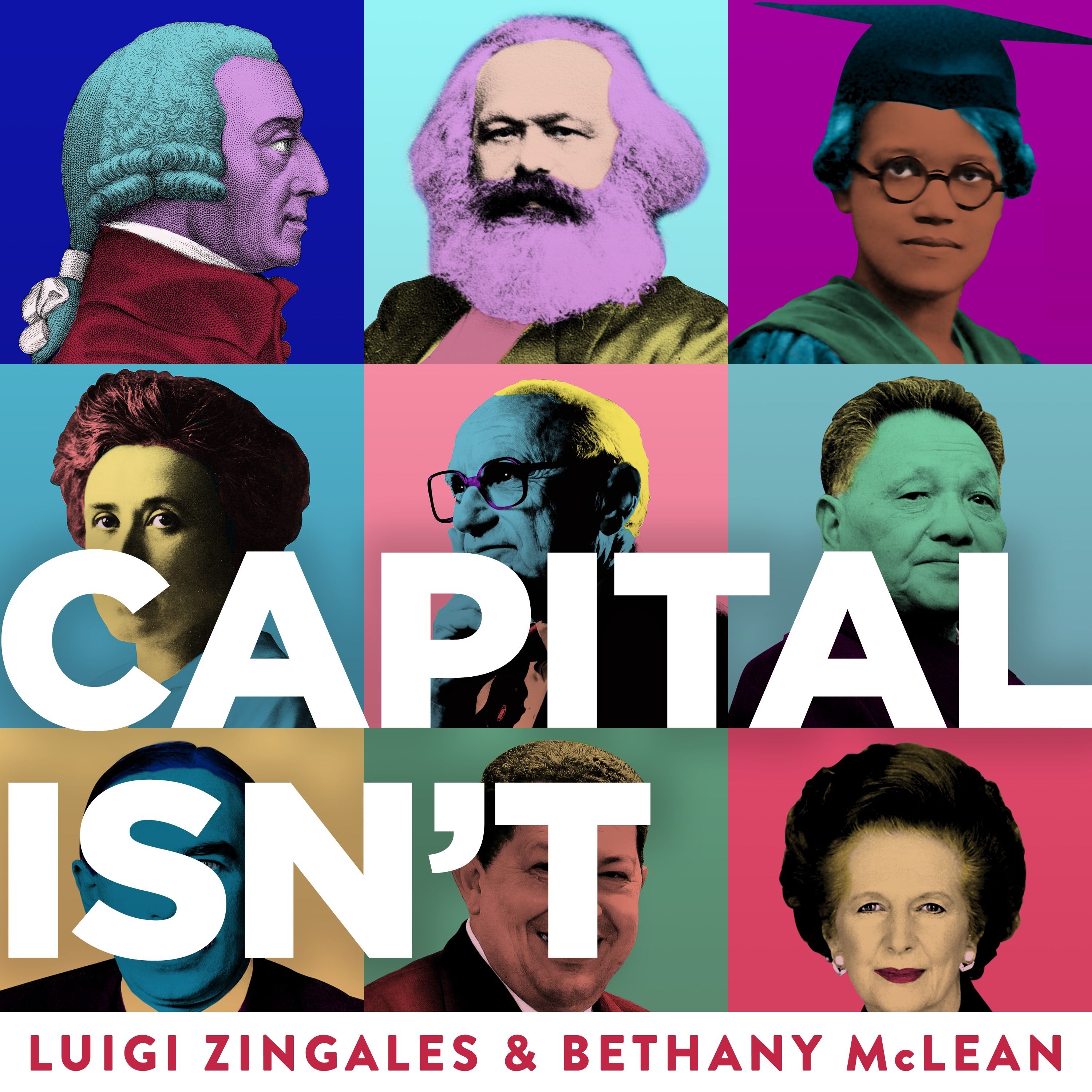
Is capitalism the engine of destruction or the engine of prosperity? On this podcast we talk about the ways capitalism is—or more often isn’t—working in our world today. Hosted by Vanity Fair contributing editor, Bethany McLean and world renowned economics professor Luigi Zingales, we explain how capitalism can go wrong, and what we can do to fix it. Cover photo attributions: https://www.chicagobooth.edu/research/stigler/about/capitalisnt. If you would like to send us feedback, suggestions fo...