Episode Summary
Executive Summary: The episode examines Milton Friedman’s 1970 shareholder-primacy thesis on its 50th anniversary, contrasting it with stakeholder capitalism and debating whether corporations should maximize profits, consider broader social goals, or be constrained by shareholders. The hosts and guest argue Friedman’s idea was both historically powerful and incomplete—especially because it ignores corporate influence over regulation and politics—while questioning whether modern shareholder activism can meaningfully reshape corporate behavior.
Main Topics: Milton Friedman’s 1970 essay and its legacy: The discussion centers on Friedman’s claim that a corporation’s sole social responsibility is to increase profits within the rules of the game, and how that idea became foundational in modern corporate governance. Stakeholder capitalism vs. shareholder primacy: The speakers contrast Friedman’s model with older and newer forms of stakeholder capitalism, noting that the concept has shifted from labor/employee protections toward broader social causes like climate and identity issues. Where Friedman is right—and wrong: Luigi argues Friedman is correct that shareholders bear residual risk and should decide on charitable or social uses of corporate funds, but wrong to ignore pollution, corruption, and the company’s ability to shape the rules through lobbying. Corporate political influence and regulatory capture: A major critique is that Friedman’s framework fails to address how corporations influence laws and regulators, potentially turning profit-maximization into an incentive to subvert the political system. Shareholder democracy and investor power: The conversation explores whether shareholders—especially via index funds and large asset managers—can act as stewards of investor preferences on issues like pollution, lobbying disclosure, and labor practices. Historical and political context of the 1970s and today: Nick Lehman argues Friedman’s influence grew because of stagflation, global competition, and the erosion of New Deal liberalism, while the hosts compare this moment to current populist backlash and policy realignment. Limits of modern ESG and symbolic activism: The speakers question whether contemporary stakeholder capitalism often amounts to low-cost signaling, and whether it fails to address core issues like inequality, worker power, and income distribution.
Key Arguments: Friedman’s essay mattered because it offered a simple, powerful rule: let corporations maximize profits while government sets the rules. The anti-Friedman view was stakeholder capitalism, historically rooted in protecting employees through unions and defined-benefit pensions. Friedman is correct that corporations can use shareholders’ money for charitable or social purposes without shareholder consent, which raises representation concerns. A purely corporate-level fix is often inefficient for harms like pollution or corruption, because preventing damage is better than paying to clean it up afterward. The deeper problem with Friedman is that he ignored regulatory capture and corporate lobbying, even though firms can shape the rules to their advantage. Modern shareholder activism may work because indexed investors increasingly share the costs and benefits of corporate behavior across the portfolio. The hosts disagree on practical feasibility: Luigi believes shareholders can and should exert power; Bethany and Nick are skeptical based on decades of investor passivity. The current stakeholder capitalism movement is unlikely, by itself, to solve inequality or populism; real change likely requires public policy and political reform. There is an inconsistency between demanding that investors be passive on social issues while allowing managers and regulators to shape outcomes without accountability. The episode frames shareholder democracy as a legitimate way to let investors choose values, while warning against letting executives define those values unilaterally.
Data Points: Friedman essay anniversary: 50th anniversary - The episode is framed around the 50-year mark since Milton Friedman’s 1970 New York Times essay. Friedman’s core rule: 1 and only one social responsibility - The quoted principle is that business should increase profits within the rules of the game. Business Roundtable statement: 2019 - The 2019 BRT proclamation is discussed as a return to older stakeholder ideas rather than something entirely new. Regulatory capture paper: 1971 - Joel Stigler’s 1971 work is cited as introducing the concept of regulatory capture soon after Friedman’s essay. Corporate market concentration: 5 highest market cap companies - Silicon Valley is described as home to the five highest-market-cap companies and as politically Democratic-leaning. Richest congressional districts: 10 of 10 - All of the 10 richest congressional districts are said to be represented by Democrats since the 2018 election. Richest congressional districts held by Democrats: 42 of 50 - The episode cites that 42 of the 50 richest congressional districts are represented by Democrats. University conference papers: 2 examples - Two studies are mentioned: one on New York Public Pension Fund activism reducing actual pollution, and one on private prisons and institutional investors. Private prison finding: more suicide in private prisons - A paper is cited claiming private prisons have higher suicide rates than public prisons, but institutional-investor-backed private prisons perform better than typical private prisons.
Pivotal Quotes: "there is one and only one social responsibility of business to increase its profit so long as it stays within the rules of the game." — Milton Friedman (quoted): Summarizing Friedman’s 1970 shareholder-primacy doctrine. "corporations should maximize profits, provided they follow the rules of the game" — Luigi Zingales: Describing Friedman’s framework before critiquing its blindness to lobbying and regulatory capture. "the current version doesn't really propose... to recreate that. It's more the idea of corporations being good for their communities" — Nick Lehman: Contrasting 1950s stakeholder capitalism with contemporary, softer ESG-style corporate social responsibility.
Implications: The episode suggests the next battle is not just shareholder vs. stakeholder rhetoric, but who controls corporate power, lobbying, and fiduciary duty. Real reform may come from investors demanding transparency and accountability, but political action may matter more than voluntary CEO initiatives.
About Capitalisnt
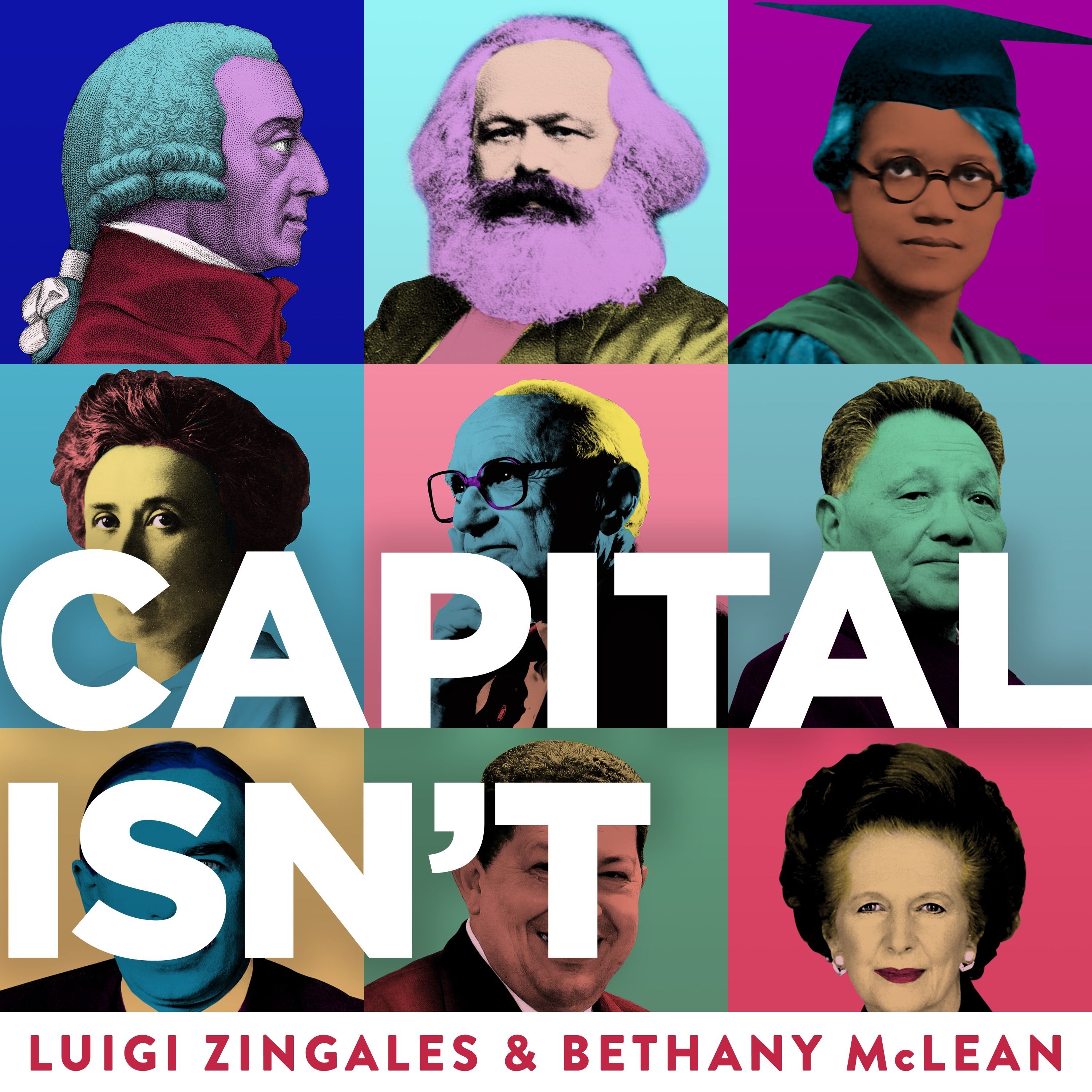
Is capitalism the engine of destruction or the engine of prosperity? On this podcast we talk about the ways capitalism is—or more often isn’t—working in our world today. Hosted by Vanity Fair contributing editor, Bethany McLean and world renowned economics professor Luigi Zingales, we explain how capitalism can go wrong, and what we can do to fix it. Cover photo attributions: https://www.chicagobooth.edu/research/stigler/about/capitalisnt. If you would like to send us feedback, suggestions fo...