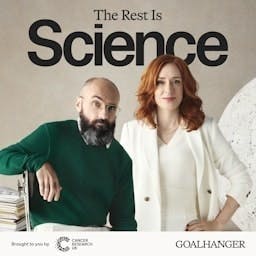
Episode Summary
Executive Summary: The episode is a playful deep dive into mechanical pencils as tools for thought, memory, and precision. The hosts compare pencil lead hardness, widths, cap mechanisms, erasers, and drafting vs everyday models, while also answering listener science questions about carbonation in space, historical eras of science, and the beauty of gravitational waves.
Main Topics: Personal conversion from pens to pencils (Priority: 5/5): One host describes abandoning pens after waterproof ink failed in an energy drink spill, and embracing pencils for permanence, erasability, and the physical process of writing and revising. Mechanical pencil feature comparison (Priority: 5/5): A detailed tour of several pencils—the Graph Gear 500, Rotring 600, Wright in the Rain models, Pentel Carry, Pentel Orenz, and Kuru Toga Dive—focusing on lead size, hardness, body material, caps, and pocket safety. Lead hardness, width, and writing feel (Priority: 5/5): The discussion explains B vs H leads, the number scale, and how thicker or softer lead changes darkness, scratchiness, control, and legibility. Why physical writing matters for memory (Priority: 4/5): The hosts argue that writing by hand helps ideas stick better because it engages the body and creates a stronger sense of ownership than typing, voice notes, or memory alone. Listener science Q&A: space carbonation (Priority: 3/5): They explain what happens when carbonated liquids are opened in microgravity: gas comes out of solution without rising upward, creating foamy messes and uncomfortable bloating. Listener science Q&A: historical science and future breakthroughs (Priority: 3/5): They discuss when they would like to live in science history, citing the early microscope era and a future paradigm shift beyond current physics as especially exciting. Listener science Q&A: the most beautiful cosmic phenomenon (Priority: 4/5): The hosts choose gravitational waves as a particularly beautiful phenomenon, emphasizing how LIGO detected them almost immediately after being switched on.
Key Arguments: Mechanical pencils are preferred because they preserve ideas better than pen and avoid loss from smudging or water damage. Different lead hardnesses and widths materially change the writing experience: hard, thin leads feel precise and scratchy, while soft, thick leads feel darker and more fluid. A good pencil design balances portability, durability, comfort, and controllability; the ideal version may require combining features from several models. Handwriting is cognitively valuable because it engages the body and reinforces memory in a way digital recording does not. The Kuru Toga’s rotating lead is ingenious, but some mechanisms can feel too active or distracting for users who prefer a stable, surgical writing feel. Scientific progress has moved toward large-scale collaboration and complex systems, making it harder for one person to achieve a lone breakthrough today. Gravitational waves are especially beautiful because they are measurable disturbances in spacetime itself, and they were detected almost immediately once LIGO became operational.
Data Points: DNA coding fraction: 2% - Cancer Research UK ad: the genes that build our cells make up only 2% of DNA. Cancer survival improvement in the UK: doubled over the past 50 years - Cancer Research UK ad highlighting decades of supported research. Lead width: 0.3 millimeter - Graph Gear 500 mechanical pencil used with H lead. Standard office mechanical pencil lead width: 0.7 millimeter - Mentioned as a common thicker size compared with 0.3 mm. Lead hardness example: 4H - A hard lead described as very scratchy and precise. Soft lead example: 4B - Used in the Rotring 600 for a darker, softer writing feel. Thick drafting lead: 1.2 millimeter - Wright in the Rain mechanical pencil, described as a rugged outdoor pencil. Ultra-thin lead: 0.2 millimeter - Pentel Orenz model noted as one of the thinnest available. Price: $9.90 - Approximate cost of the Pentel Orenz metal-grip pencil. Price: $17 - Approximate cost of the rugged Wright in the Rain 1.2 mm pencil. Price: $120 - Approximate cost of the Kuru Toga Dive capped mechanical pencil. LIGO timing: 4 days early - The first gravitational wave was detected four days before the official observation start date. LIGO date: September 14 - First gravitational-wave detection occurred while the instrument was in engineering mode.
Pivotal Quotes: "I think that the perfect mechanical pencil for me is going to be Frankenstein out of all these." — Michael: Summing up his ideal pencil as a hybrid of multiple models and features. "The lead is actually rotated a little bit." — Michael: Explaining the Kuru Toga mechanism that keeps the lead evenly sharpened while writing. "I think the most beautiful phenomenon, I'm gonna go gravitational waves" — Hannah: Choosing gravitational waves as the most beautiful cosmic phenomenon.
Implications: The episode celebrates analog tools as intellectually meaningful, not nostalgic gadgets. For listeners, it suggests that better tools can shape thinking, memory, and creativity; for science fans, it models curiosity as playful, precise, and collaborative.
About The Rest is Science
Join mathematician Professor Hannah Fry and science creator Michael Stevens (Vsauce) as they dig into the weird scientific questions that often go unexplored. Welcome to The Rest Is Science, a show that sits in the fascinating space between what we think we know, and what we actually know. Why do we assume we understand things like time, randomness, or even gravity? Once you start questioning these familiar ideas, reality becomes astonishingly strange and completely fragile. Whether you're a lifelong science fan or just naturally curious, The Rest Is Science will change your perception of reality, and prove that the biggest questions are always the most fun.