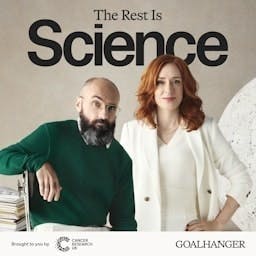
Episode Summary
Executive Summary: The episode blends a hands-on science demo with listener Q&A and sponsored cancer-research explainers. Michael tests a 25-year-old Fisher Space Pen from Space Camp, showing how pressurized ink works in zero gravity and debunking the “Russians used pencils” myth. The show then answers questions on astronaut orientation, clap resonance, and the Kardashev scale, while highlighting practical cancer research advances and the limits of speculative megascale civilization rankings.
Main Topics: Space Camp nostalgia and the 25-year-old Space Pen experiment (Priority: 5/5): Michael recounts attending Space Camp in Kansas, explains why he kept an unopened Fisher Space Pen as a childhood memento, and finally tests whether it still writes after decades. How space pens work versus regular pens and pencils (Priority: 5/5): The hosts explain that pressurized ink, not gravity, makes the pen function in space, underwater, and upside down; they also debunk the common Soviet pencil myth and note pencils create dangerous debris in spacecraft. Cancer Research UK sponsorship: turning waste disposal into therapy (Priority: 4/5): The ad segments describe cancer biology, “undruggable” proteins, and how researchers are hijacking the ubiquitin proteasome system with degrader drugs to target proteins implicated in childhood cancers. Astronaut orientation and sensory perception in microgravity (Priority: 4/5): A listener asks whether astronauts feel bodily rotation or lose orientation; the answer explains inner-ear rotation sensing, altered up/down cues, and how astronauts treat their feet as the fixed reference point. Can everyone clapping at once damage buildings? (Priority: 3/5): The hosts analyze resonance and sound propagation, concluding that even massive synchronized clapping would be loud but not structurally destructive; the bigger issue would be crowd loading, not acoustics. The Kardashev scale and its usefulness as a civilization metric (Priority: 4/5): The discussion critiques the Kardashev scale as a fun but oversimplified way to rank civilizations by energy use, while acknowledging its appeal in astronomy, SETI speculation, and sci-fi imagination.
Key Arguments: A Fisher Space Pen can still work after decades because it uses pressurized gas to push ink, not gravity. Regular pencils are poor tools for spacecraft because graphite and eraser debris can float into lungs or electronics and graphite can conduct electricity. Astronauts in orbit still experience gravity, but because they are in continuous free fall they do not feel weight in the usual way. The cell’s ubiquitin-proteasome system can be exploited to degrade cancer-causing proteins that are currently hard to drug. The Kardashev scale is a playful but hand-wavy framework; it captures imagination but is too simplistic if treated as a serious measure of progress. Synchronized clapping would not meaningfully damage buildings because sound waves attenuate quickly and the structural threat would be from physically packing people into a space rather than from the clap itself.
Data Points: Years the pen was kept unused: 25 years - Michael kept the Space Camp Space Pen as a memento before finally testing it on the show. Space Camp attendance: 3 summers in a row - Michael says he attended Space Camp for three consecutive summers as a kid. Space Camp age range: About 14–16 years old - He describes being high-school age when he attended and earned his gold wings. Cancer survival improvement in UK: Double over the last 50 years - Cancer Research UK sponsor message cites major improvements in survival rates. Undruggable proteins: Around 85% - Sponsor segment states that roughly 85% of proteins are considered undruggable. Children and young people survived into adulthood: About 35,600 - Sponsor segment cites UK children and young people whose survival benefited from Cancer Research UK work over 50 years. Cervical cancer rate reduction in young women in England: Nearly 90% lower than expected - Shown as evidence of HPV vaccination’s preventative impact. Estimated Earth civilization Kardashev level: About 0.7 to 0.73 - Hosts cite estimates that humanity is not yet a Type I civilization. Projected time to Type I at 3% annual energy growth: Roughly 100 years - They mention that continued energy growth could move civilization toward Type I within about a century. Altitude survival for ISS-only astronauts after Earth catastrophe: About 15 months to 1.5 years - They estimate the station would eventually need reboosts and would lose altitude first. NASA-approved space pen models: 2 main models - They mention the AG7 and CH4 as the two main official NASA-approved models. World-record loud clap: 117 decibels - They reference Stephen Wallace’s 2021 clap record. Previous loud clap record: 113 decibels - The prior record had stood for 15 years before being broken.
Pivotal Quotes: "“Can taking out the trash save lives?”" — Narrator: The sponsor segment frames the cancer-research explanation around the cell’s waste-disposal machinery. "“The whole thing’s nonsense.”" — Hannah Fry: Her blunt critique of the Kardashev scale as an overly simplistic measure of civilization progress. "“The distance between your claps just gets really long.”" — Michael Stevens: A joking reframing of applause as continuous over time during the clapping discussion.
Implications: Listeners get a mix of practical physics and myth-busting, plus a clearer picture of how basic cellular machinery is being repurposed for cancer therapy. The episode also argues for skepticism toward neat grand-scale rankings like Kardashev while keeping science fun and accessible.
About The Rest is Science
Join mathematician Professor Hannah Fry and science creator Michael Stevens (Vsauce) as they dig into the weird scientific questions that often go unexplored. Welcome to The Rest Is Science, a show that sits in the fascinating space between what we think we know, and what we actually know. Why do we assume we understand things like time, randomness, or even gravity? Once you start questioning these familiar ideas, reality becomes astonishingly strange and completely fragile. Whether you're a lifelong science fan or just naturally curious, The Rest Is Science will change your perception of reality, and prove that the biggest questions are always the most fun.