Episode Summary
Executive Summary: This episode is a stitched-together debate on meritocracy: whether it promotes fairness, mobility, and growth or instead produces elitism, hubris, and social fracture. The speakers contrast objective testing with distorted gatekeeping, question the moral meaning of success, and argue over whether weakening meritocracy harms democracy, innovation, and national competitiveness—especially versus China.
Main Topics: Meritocracy as a Self-Correcting Ideal: The discussion opens with the claim that meritocratic systems tend to expand inclusion over time, as excluded groups demand equal standards and real access to opportunity. Critiques of Meritocracy and Meritocratic Hubris: A central theme is that meritocracy can generate arrogance among elites, social distance, and resentment among those who feel looked down upon. Harvard, Gatekeeping, and the Meaning of Merit: The speakers debate whether elite admissions are truly meritocratic or distorted by hooks, subjectivity, and non-academic criteria. Democracy vs. Technocracy: The conversation distinguishes technical competence from political legitimacy, warning against treating policy choices as purely expert decisions. Meritocracy, Growth, and Global Competition: One side argues that functioning meritocracy supports economic growth and national strength, especially in comparison with China’s more efficient talent allocation. Plutocracy, Financialization, and Rent Seeking: The discussion broadens into how money and prestige merge with merit, creating a corrupt system where returns often reflect monopoly power or financial engineering rather than genuine value creation. Education, Character, and Civic Duty: The speakers argue that education should form character and responsibility, not only measurable achievement, and that elites should reconnect with the rest of society.
Key Arguments: Meritocracy has historically expanded opportunity by forcing institutions to admit excluded groups and justify their standards. A major modern critique is that gatekeepers redefine merit in biased ways, making the system feel fair while preserving advantage. Elite institutions like Harvard are portrayed as distorted by legacy preferences and other non-academic 'hooks,' so the issue is not too much meritocracy but too little. A strong meritocracy can improve growth by identifying and allocating talent effectively, as illustrated by Singapore. Weakening objective academic selection in the U.S. while China strengthens it could shift economic and geopolitical power. Democracy should not be replaced by expert rule; many political decisions are value judgments, not technical problems. Meritocratic societies risk hubris when elites equate high earnings and credentials with superior worth. Financialization and monopoly power can decouple reward from social value, encouraging rent seeking instead of productive competition. Education should cultivate ethics, duty, and character alongside technical excellence to prevent social and cognitive bubbles.
Data Points: Harvard academic-ability share: about 20% - Claim that only a minority of Harvard students are admitted primarily on academic ability, with most entering through various hooks. Harvard hook-based share: about 80% - Claim that the majority of Harvard admissions are influenced by legacy, athletics, family connections, or other non-academic factors. Income distribution comparison at Harvard: more from the top 2% than the bottom 50% - Used to illustrate how elite universities are skewed toward wealthier families. Timeframe of postwar meritocracy: after the Second World War - Described as the 'golden age' of meritocracy. Singapore’s historical position: a fraction of Britain’s wealth to higher living standard than Britain - Presented as evidence that meritocratic talent allocation can drive national growth. Iraq War example: 2003-era policy debate - Used to contrast expert consensus and public opinion, and to argue about elite conformity.
Pivotal Quotes: "We have socialism for the very rich, rugged individualism for the poor." — Lucia Zingales: Opening line framing the podcast’s critique of inequality and capitalism. "We ought to do better by the people that get left behind." — Bethany McLean: Introductory statement about capitalism’s social responsibilities. "The problem with Harvard is that it's not a meritocracy." — Adrian Wooldridge: Argument that elite admissions are distorted by subjective and privileged 'hooks' rather than objective merit.
Implications: The episode suggests that societies need merit-based institutions, but only if they stay open, humane, and democratically accountable. If merit becomes arrogance or gatekeeping, it fuels backlash, weakens trust, and may reduce long-term growth and resilience.
About Capitalisnt
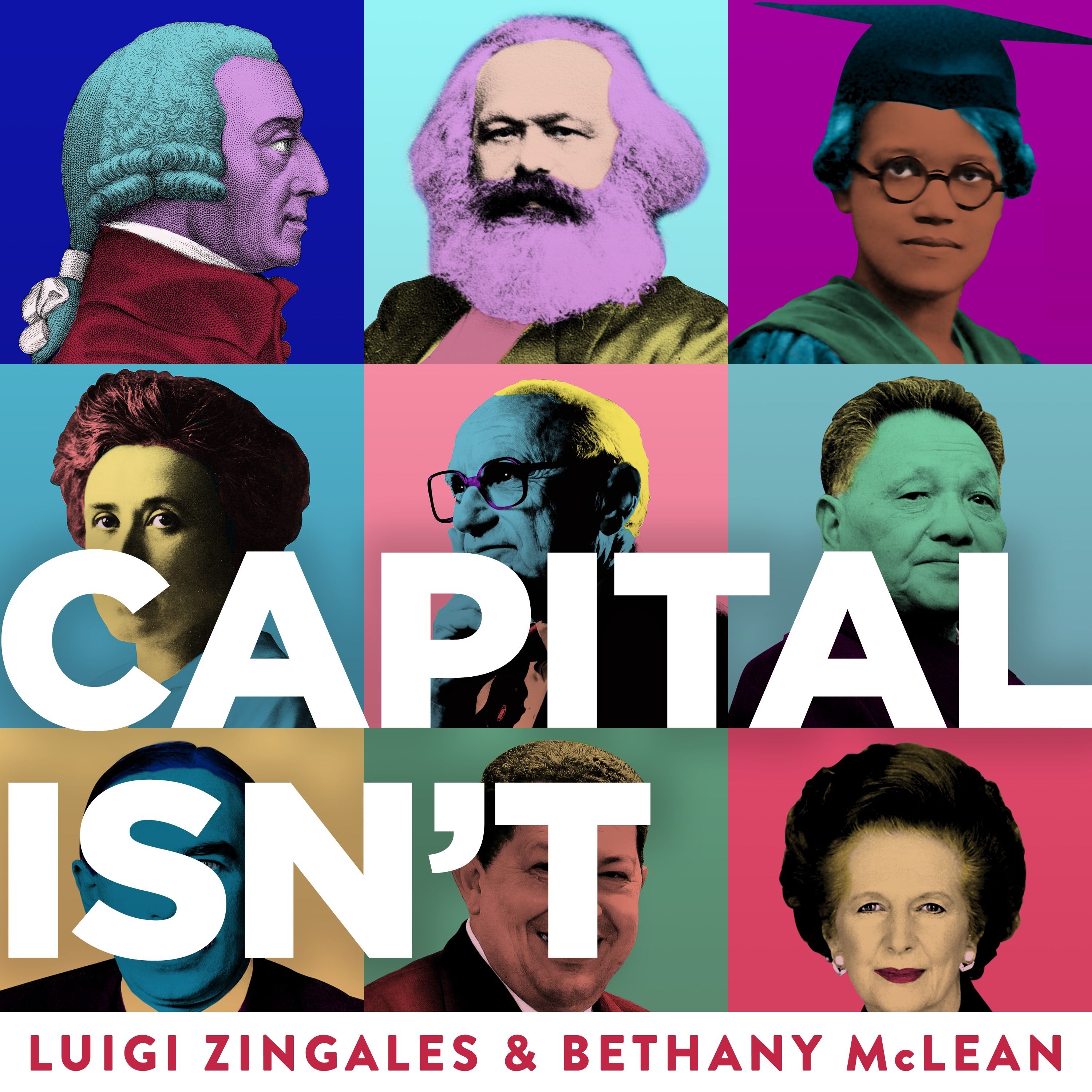
Is capitalism the engine of destruction or the engine of prosperity? On this podcast we talk about the ways capitalism is—or more often isn’t—working in our world today. Hosted by Vanity Fair contributing editor, Bethany McLean and world renowned economics professor Luigi Zingales, we explain how capitalism can go wrong, and what we can do to fix it. Cover photo attributions: https://www.chicagobooth.edu/research/stigler/about/capitalisnt. If you would like to send us feedback, suggestions fo...