Episode Summary
Executive Summary: The episode debates whether meritocracy is a force for mobility or a distorted ideology captured by elites. Adrian Wooldridge argues meritocracy, properly defined, expands opportunity, rewards effort, and can boost growth, but has been warped by plutocracy, elite gatekeeping, and rigid institutions. The hosts and guest also explore democracy, inequality, groupthink, and the need to restore moral purpose and humility to elite institutions.
Main Topics: Meritocracy as a historical mobility engine: Wooldridge traces meritocracy’s origins to postwar and Victorian reforms that opened access to talent across class and gender lines, arguing the ideal can expand opportunity when it is genuinely open. Elite capture and distorted definitions of merit: The discussion centers on how elites redefine merit to protect their own status, especially through admissions systems and subjective criteria that can obscure real bias rather than eliminate it. Democracy vs. technocratic rule: The speakers distinguish legitimate expertise from the false claim that complex social and political choices should be left entirely to experts, stressing that democracy and meritocracy must complement each other. Plutocracy, inequality, and educational gatekeeping: The conversation argues that modern meritocracy has fused with money, producing elite reproduction through expensive schooling, legacy preferences, and other “hooks” rather than pure ability. Meritocracy, growth, and global competition: Wooldridge defends meritocracy as an engine of growth, citing Singapore and warning that weakening U.S. meritocratic institutions while China strengthens its own could shift power globally. Groupthink, humility, and elite failure: The episode highlights that highly credentialed elites can fail catastrophically through conformity and overconfidence, citing the Bay of Pigs, Iraq, and the financial crisis as examples of merit without wisdom. Moral purpose in education and public life: Both sides agree meritocracy should not be purely technical; it should include duty, ethics, public service, and stronger connections between elites and the broader society.
Key Arguments: Meritocracy began as a reform against nepotism and exclusion, and historically improved mobility by searching for talent beyond inherited status. Critics often attack a distorted version of meritocracy; the real problem is that elites capture and redefine merit to suit their interests. A tight, objective definition of merit is necessary, but admissions systems like Harvard’s rely on subjective or manipulable criteria and many nonacademic “hooks.” Meritocracy should not be confused with the idea that people deserve all outcomes; the market rewards scarce and useful talent, not moral worth. The fusion of merit and money has produced a “plutocracy-meritocracy” where elite institutions reproduce privilege instead of broad opportunity. A strong meritocratic system can increase economic growth by allocating human capital more efficiently, as illustrated by Singapore. Democracy remains essential because many political decisions are value judgments, not technical questions that experts should monopolize. Elite overconfidence and groupthink lead to major policy failures; merit needs humility, dissent, and moral accountability to function well. The original meritocratic revolution included civic duty and moral reform, but modern elite culture has become insulated and self-referential. The cure for elite ossification is not less meritocracy but more real meritocracy: broader testing, wider recruitment, and greater downward as well as upward mobility.
Data Points: Postwar period: After the Second World War - Described as the “golden age of meritocracy” and social mobility Harvard academic admission share: About 20% - Guest says only around 20% of Harvard students enter on academic ability alone Harvard admissions non-academic share: About 80% - Guest says the rest enter through various “hooks” such as legacy, athletics, or faculty ties Income distribution comparison: Top 2% vs bottom 50% - Guest notes Harvard has more students from the top 2% of income than from the bottom half Cambridge Tripos year: 1892 - Philippa Fawcett sat the mathematics Tripos and ranked above the senior wrangler Oxford/Cambridge gender exclusion period: Middle of the 19th century - Used to describe early open competition reforms that initially excluded women Singapore transformation period: Early 1960s - Lee Kuan Yew’s meritocratic state-building strategy began then Civilizational comparison: Britain to Singapore - Singapore is described as surpassing Britain in living standards and life expectancy China comparison: Most serious rival the West has ever confronted - Used to argue weakening U.S. meritocracy could have geopolitical consequences
Pivotal Quotes: "we need to recapture the notion of merit from the elite" — Transcript host/opening: Sets up the central claim that merit has been captured and distorted by elites "the problem with Harvard is that it's not a meritocracy" — Adrian Wooldridge: Argues elite institutions are distorted by hooks and subjective admissions rather than true merit "getting rid of meritocracy would be an act of civilizational suicide by the West" — Adrian Wooldridge: Warns that weakening meritocratic systems could damage Western economic and geopolitical power
Implications: Listeners are left with a split verdict: meritocracy is valuable when it broadens opportunity and rewards effort, but dangerous when captured by wealth, prestige, and conformity. The future depends on restoring objective selection, civic duty, and democratic humility.
About Capitalisnt
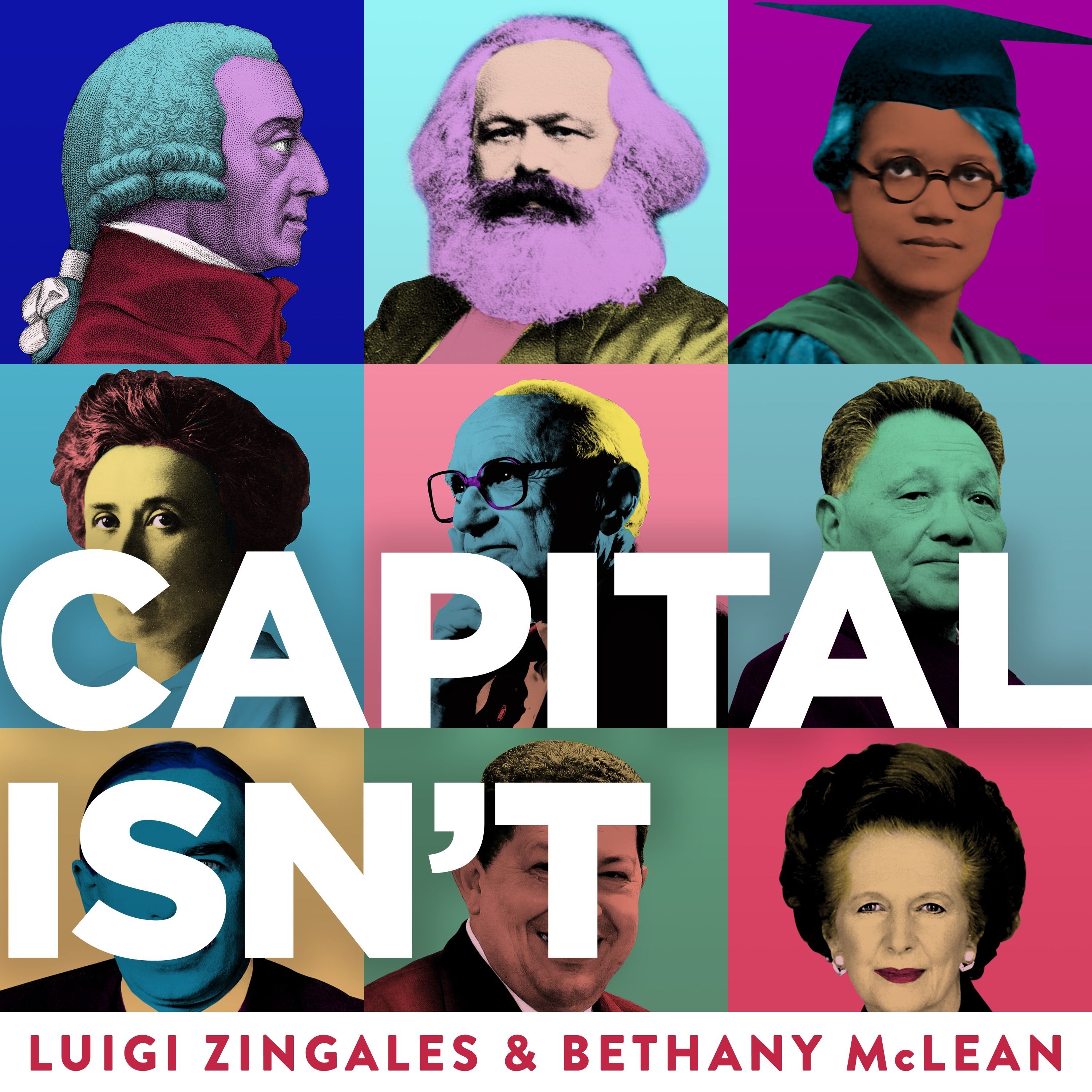
Is capitalism the engine of destruction or the engine of prosperity? On this podcast we talk about the ways capitalism is—or more often isn’t—working in our world today. Hosted by Vanity Fair contributing editor, Bethany McLean and world renowned economics professor Luigi Zingales, we explain how capitalism can go wrong, and what we can do to fix it. Cover photo attributions: https://www.chicagobooth.edu/research/stigler/about/capitalisnt. If you would like to send us feedback, suggestions fo...