Episode Summary
Executive Summary: The episode argues that capitalism depends on a strong democracy and mutual checks and balances. Using Silk Road, monopolies, campaign money, lobbying, and post–Cold War changes, the hosts contend that unchecked wealth concentrates power, erodes impartial rule enforcement, and weakens both democratic legitimacy and market fairness.
Main Topics: Capitalism Requires Democracy and Checks and Balances: The hosts frame capitalism and democracy as complementary forces: capitalism concentrates wealth and democracy redistributes and constrains power, preventing either plutocracy or populism from dominating. Silk Road as a Test Case for Anarcho-Capitalism: Ross Ulbricht’s Silk Road is discussed as an example of what happens when market exchange is separated from state enforcement, showing that rules and impartial enforcement remain necessary. Impartial Rule Enforcement and the State: The conversation emphasizes that even laissez-faire capitalism needs law enforcement, but democratic systems struggle to ensure those enforcing rules are impartial and not captured by vested interests. Money, Influence, and Democratic Erosion in the U.S.: The speakers argue that big money, lobbying, philanthropy, and elite influence have increasingly distorted U.S. politics, elections, and regulation, threatening democratic balance. Historical Shifts After the Cold War: They connect the decline of ideological alternatives after the fall of the Soviet Union and Berlin Wall to a loss of moral guardrails, weaker restraints on business behavior, and more elite capture. Monopolies, Authoritarianism, and Fascism: The episode warns that concentrated ownership and monopoly power can support authoritarian consolidation, citing examples from Hungary, Mexico, Chile, and Nazi Germany.
Key Arguments: Capitalism cannot function properly without a well-functioning democracy to provide impartial enforcement and prevent concentration of power. Silk Road demonstrated that a market without state-backed rules quickly became vulnerable to blackmail, coercion, and collapse. Democracy works best when many people serve as referees, making it harder to corrupt the system through bribery or capture. Extreme inequality makes democratic redistribution harder and encourages the rich to build systems that protect and expand their wealth. The U.S. has shifted from a period of skepticism toward business and high regulation to a period where money, academia, media, and politics are heavily influenced by wealth. The decline of ideological alternatives after the Cold War reduced external and internal checks on business and political elites. Monopolies and concentrated ownership can help authoritarian regimes consolidate power and protect elite wealth. Direct democracy and referenda can sometimes bypass elite capture better than standard legislative processes. National cohesion and some degree of nationalism may be necessary to keep capitalism within democratic bounds. Old-fashioned moral and social guardrails mattered as much as formal laws in constraining bad business behavior.
Data Points: Silk Road launch year: 2011 - The underground drug marketplace was launched as a website for anonymous drug browsing and sales. Felon voting rights restored in Florida: 2018 - Florida voters passed an initiative restoring voting rights to most felons after they served their sentences. Florida felons affected: Not specified - The transcript notes the policy applied to felons who had served their sentences, but no exact count is given. U.S. redistribution shift timeframe: Last 20 years - One speaker says the pendulum has shifted toward plutocracy in the United States over roughly the last two decades. Anti-business policy era: 1970s - The conversation references the 1970s as a time of price controls, wage controls, capital restrictions, and very high tax rates. Countries/regions cited in anti-democratic examples: Mexico, Hungary, Chile, Germany, China - Examples are used to illustrate monopoly power, authoritarian capitalism, and elite capture. West German / East German context: Fall of Berlin Wall / end of Cold War - Used to explain the decline of ideological competition and the erosion of balance between pro-business and anti-business forces.
Pivotal Quotes: "If we don't build capitalism on top of a strong democracy, it'll always be and isn't." — Podcast host/introduction: Opening framing of the episode’s central thesis. "I am fairly unique, I think, among economists because I do believe that capitalists can only survive properly in a well-functioning democracy." — Luigi Zingales: Core statement linking market survival to democratic institutions. "You need a balancing act, a tension between a democratic system that tends to redistribute... and a capitalist system that tends to reward disproportionately the people at the top." — Luigi Zingales: Explanation of why capitalism and democracy must restrain each other.
Implications: Listeners are left with a warning: when money and power capture institutions, both markets and democracy degrade. The episode argues for stronger checks, anti-monopoly vigilance, and institutional independence to preserve fair capitalism and legitimate self-government.
About Capitalisnt
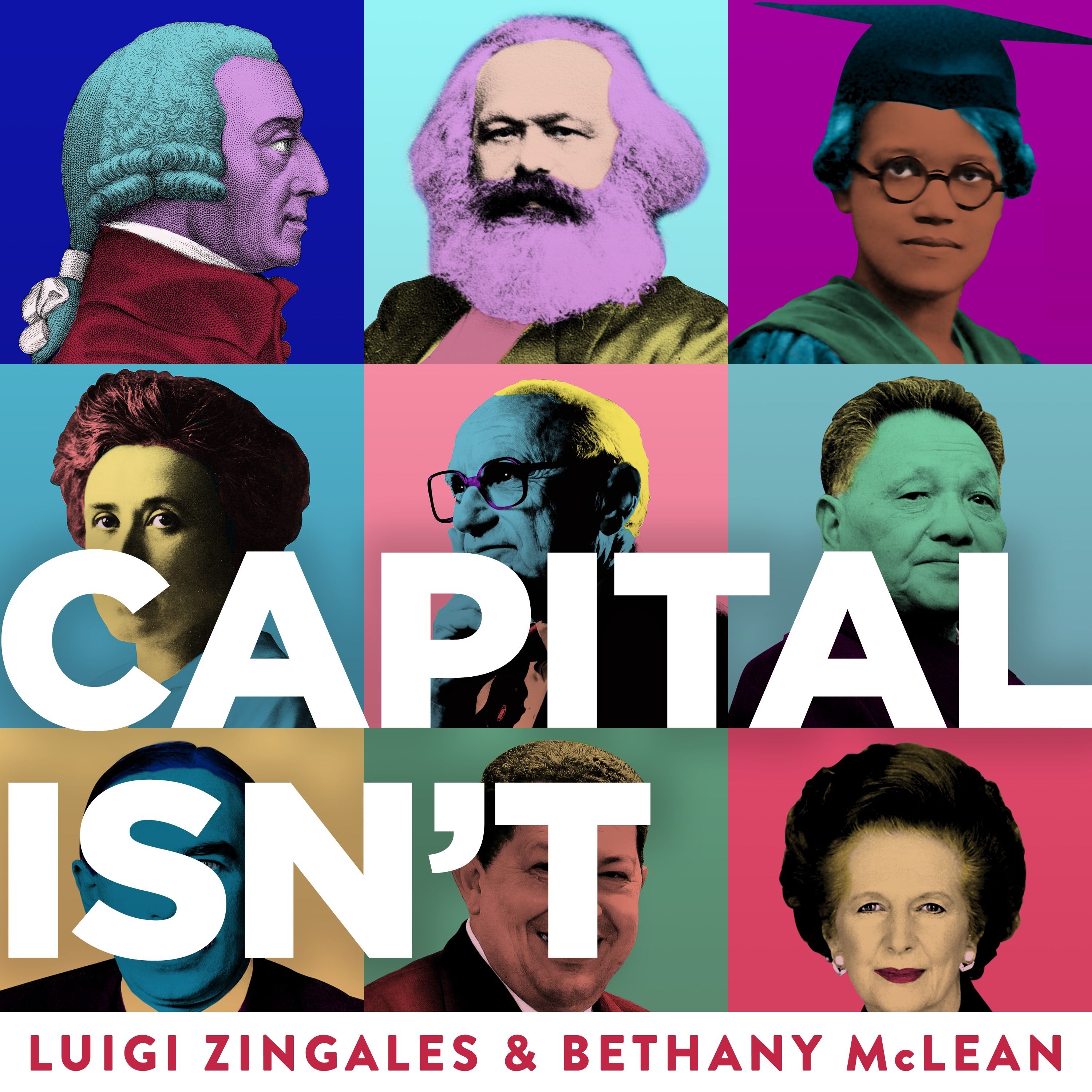
Is capitalism the engine of destruction or the engine of prosperity? On this podcast we talk about the ways capitalism is—or more often isn’t—working in our world today. Hosted by Vanity Fair contributing editor, Bethany McLean and world renowned economics professor Luigi Zingales, we explain how capitalism can go wrong, and what we can do to fix it. Cover photo attributions: https://www.chicagobooth.edu/research/stigler/about/capitalisnt. If you would like to send us feedback, suggestions fo...